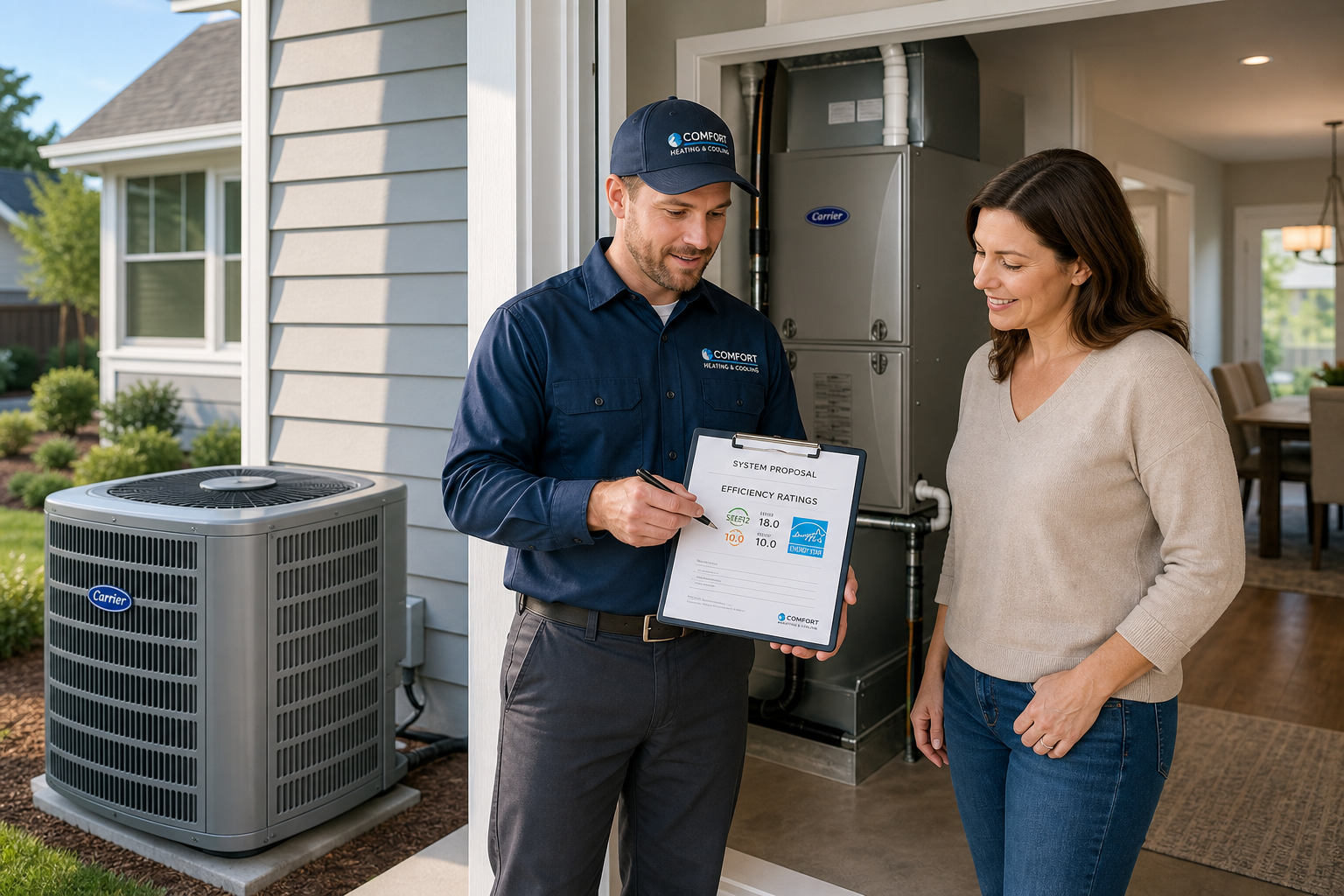
How HVAC Contractors Can Explain SEER2, EER2, and HSPF2 Without Confusing Homeowners
A practical framework for turning efficiency jargon into a clearer conversation about comfort, operating cost, and system fit.
Homeowners regularly see efficiency ratings on proposals, manufacturer brochures, and online product pages, but most do not know what those numbers mean in real life. They may recognize that a higher number is usually better, yet they still struggle to answer the practical questions that matter most: Will this lower my utility bills, will it improve comfort, and is the upgrade worth the extra investment?
That confusion creates a challenge for contractors. If you explain too little, the homeowner may reduce the decision to price alone. If you explain too much technical detail, the conversation turns into alphabet soup. The goal is not to turn the customer into an engineer. The goal is to help them make a confident decision using language that connects ratings to daily use.
This article gives contractors a simple way to explain SEER2, EER2, and HSPF2 in plain language. It also covers common homeowner misconceptions, ways to compare systems fairly, and how to keep the discussion honest when local climate, installation quality, duct condition, thermostat strategy, and usage habits all influence actual performance. Local requirements vary, so your final recommendations should always reflect the home, equipment match, and conditions in your market.
The easiest way to explain efficiency is this: ratings help estimate how effectively equipment uses electricity or fuel under specific test conditions, but the homeowner’s real experience depends on the home, duct system, climate, control settings, and installation quality.
What do SEER2, EER2, and HSPF2 actually measure?
Start with the big picture. These ratings are different ways to measure efficiency, but they are not interchangeable. Each one looks at performance from a different angle, and each one is useful in a specific context.
SEER2 is generally the seasonal cooling efficiency rating. It is useful when a homeowner wants to understand how efficiently an air conditioner or heat pump may perform over a range of cooling conditions across a typical season. In plain language, SEER2 is often the easiest rating to use when discussing overall cooling efficiency.
EER2 focuses more on efficiency at a specific operating condition rather than over an entire season. That makes it useful when discussing performance during heavier load conditions. If the customer lives in a very hot climate or asks how the system may hold up during intense summer weather, EER2 can become an important part of the conversation.
HSPF2 applies to heat pump heating efficiency across a season. If you are quoting a heat pump and the homeowner is mainly focused on winter performance and heating cost, this rating helps frame that part of the decision.
You do not need to teach the exact test procedure to explain the takeaway. A practical summary works better: SEER2 helps describe seasonal cooling efficiency, EER2 helps describe cooling efficiency under a more specific heavy-use condition, and HSPF2 helps describe seasonal heating efficiency for a heat pump.
That simple structure gives homeowners a mental map. It also helps you avoid a common problem, which is letting the customer compare one rating from one system to a different rating from another system as if they mean the same thing.
Why do homeowners get confused by efficiency ratings?
Most homeowners do not make HVAC purchases often, and many first encounter these terms when they are already under pressure. Their old system may have failed, the house may be uncomfortable, and they may be reviewing multiple estimates at the same time. That is not an ideal environment for learning technical language.
Another reason for confusion is that efficiency numbers sound precise, while real-world performance feels variable. A brochure may present a clean number, but the homeowner knows their house has hot rooms, a thermostat habit, insulation limitations, and utility bills that rise and fall. If you present the rating as a promise instead of a guideline, trust can break down later.
Marketing also contributes to the issue. Some customers come in believing that the highest rating is always the best option. Others have read that one rating matters more than another without understanding why. Some may compare online equipment listings that were not matched to their home, duct system, or indoor components.
Contractors can reduce that confusion by acknowledging something important right away: efficiency ratings are helpful, but they are only one part of a good recommendation. Telling the homeowner that comfort, equipment sizing, airflow, controls, and installation quality matter too makes the discussion more credible, not less.
It also helps to explain why there are multiple ratings in the first place. Different ratings answer different questions. Once the homeowner understands that, the conversation becomes less about memorizing acronyms and more about choosing the right system for the way the home is actually used.
How can contractors explain each rating in plain language?
The most effective approach is to tie each rating to a homeowner question. Instead of defining the acronym first, answer the concern behind it.
For SEER2, a practical script is: “If you want a general idea of how efficiently the system can cool over the course of a season, this is the number most people look at.” That keeps the explanation simple and accurate enough for a sales conversation.
For EER2, you might say: “This number can be useful if you want to know more about how the system performs in tougher cooling conditions, especially during hotter weather.” That frames EER2 as relevant without burying the homeowner in testing details.
For HSPF2, try: “If you are buying a heat pump and want to understand heating efficiency over the season, this is the number to watch.” Again, the point is not to impress the homeowner with terminology. It is to connect the metric to the reason they care.
Analogies can help, but use them carefully. One useful analogy is fuel economy. You can explain that a vehicle may have one fuel economy experience in city driving and another on the highway, while actual results still depend on terrain, speed, maintenance, and driving style. HVAC efficiency works in a similar way. Ratings are standardized measurements, but the home environment affects what the owner experiences.
Another useful tactic is to define what the rating does not mean. A higher rating does not automatically mean lower bills in every situation. It does not automatically fix uneven temperatures. It does not overcome badly designed ductwork. It does not guarantee a specific monthly savings amount. Those distinctions protect your credibility and help the customer focus on the full system.
- Lead with the homeowner’s question, not the acronym.
- Use one plain-language sentence for each rating.
- Connect efficiency to comfort and operating cost, not just equipment labels.
- Explain that installation quality and airflow affect real performance.
- Avoid promising exact bill reductions unless you have a careful, documented basis.
How should you compare two systems fairly?
Homeowners often want a side-by-side comparison between a lower-cost system and a higher-efficiency option. The problem is that they may focus on one headline number without noticing differences in staging, blower type, communicating features, sound levels, humidity control, or cold-weather heat pump performance.
A fair comparison starts by keeping system type consistent. If one option is a single-stage air conditioner and the other is a variable-speed heat pump, the conversation should not be reduced to a single efficiency metric. Those products may solve different problems and deliver different comfort experiences.
Next, compare systems as matched combinations, not isolated components. Outdoor equipment, indoor coil, furnace or air handler, controls, and airflow setup all influence how the system is represented and how it may perform in the field. This is where homeowners benefit from your guidance, because many online comparisons ignore the complete system match.
Then tie the comparison to the customer’s priorities. If the homeowner mainly wants lower upfront cost, explain what they get with the simpler option and what they are giving up. If they want quieter operation, steadier temperatures, or better humidity control, show how those features may matter as much as the efficiency rating itself.
You can also break the comparison into three practical categories: purchase cost, comfort features, and operating efficiency. That structure keeps the conversation organized and prevents the homeowner from assuming that “higher efficiency” and “better in every way” mean the same thing.
When discussing operating cost, keep your wording disciplined. It is fine to say a higher-efficiency system may reduce operating cost compared with a lower-efficiency option under similar use conditions. It is not wise to imply that every homeowner will see the same result. Climate, utility rates, runtime, thermostat settings, insulation, solar gain, and duct leakage all matter.
When does a higher efficiency rating make sense?
A higher efficiency system often makes more sense when the equipment runs a lot. Homes in longer cooling seasons may benefit more from higher cooling efficiency than homes with lighter summer use. The same logic applies to heat pump heating performance in places where the heat pump will carry a meaningful share of the winter load.
It can also make sense when the homeowner plans to stay in the home for years and values lower operating cost over time. Some buyers are less focused on the lowest initial investment and more interested in balancing monthly energy use, comfort improvements, and equipment features.
Another good fit is the homeowner who is sensitive to comfort differences, not just bills. Many higher-efficiency systems are paired with better modulation, fan control, or humidity management features. The homeowner may initially ask about ratings, but their real frustration might be temperature swings, sticky indoor air, or noise. If so, the right conversation is not just “higher number equals lower cost.” It is “this equipment may also deliver a better day-to-day comfort experience.”
On the other hand, a higher-rated system is not automatically the best recommendation for every house. If the home has major envelope issues, duct problems, airflow restrictions, or control issues, solving those first may produce better overall results than simply moving to a higher equipment rating. In some cases, the most responsible advice is to discuss those issues before presenting efficiency as the main answer.
This is also where local requirements vary. Minimum efficiency levels, product availability, and installation considerations can differ by region and application. Keep the recommendation grounded in the actual project instead of treating efficiency as a one-size-fits-all sales message.
What mistakes should contractors avoid in these conversations?
The biggest mistake is oversimplifying to the point of being misleading. Telling a homeowner that a higher rating will definitely cut their bill by a certain percentage invites disappointment unless you have a careful, supportable analysis. Even then, actual usage can differ.
A second mistake is relying on jargon to create authority. Homeowners do not need a lecture on laboratory methods. They need to understand what matters to them. If your explanation sounds technical but does not help them decide, it is not doing its job.
A third mistake is ignoring the rest of the house. If there are comfort complaints, discuss airflow, filtration, duct design, duct leakage, return limitations, insulation, and thermostat behavior where relevant. Otherwise the customer may believe the equipment rating alone solves every comfort problem.
Another common error is comparing unlike systems on only one number. A variable-capacity heat pump and a basic single-stage air conditioner should not be reduced to “this one has the bigger rating.” Explain the broader difference in operation, comfort behavior, and intended use.
Finally, do not talk about efficiency as if it exists independently from installation quality. Charge, airflow, commissioning, controls, and duct conditions all influence whether the homeowner gets the experience they expected. Reminding the customer that the installation matters helps differentiate professional contractors from sellers who focus only on model numbers.
If a homeowner asks, “Which number should I care about most?” the best answer is usually, “The one that matches how you use the system, your climate, and whether you are comparing cooling or heating performance. Then we also need to look at comfort features and the condition of the home.”
What questions should you answer before recommending an upgrade?
Good efficiency conversations start with discovery. Before recommending a higher-SEER2 air conditioner or a heat pump with stronger HSPF2 performance, make sure you understand what the homeowner is trying to solve.
Ask how long they expect to stay in the home. Ask whether their main concern is budget, comfort, noise, humidity, heating cost, or cooling cost. Ask whether some rooms are harder to maintain than others. Ask about thermostat habits and any known duct issues. These details help you connect the recommendation to the household rather than to a brochure.
It is also smart to ask what they have been told already. If they have gathered online quotes or seen ads pushing a specific efficiency number, bring context to that information instead of dismissing it. A homeowner who feels heard is more likely to trust your explanation.
When you present options, explain why each one exists. For example, one option may be the practical replacement that restores reliable comfort. Another may be the better fit for longer occupancy and lower seasonal operating cost. A third may be the comfort-focused option with enhanced control features. Framing choices this way makes the ratings easier to understand because they are attached to real outcomes.
Close the conversation by summarizing in plain language. Tell the homeowner which rating matters most for their use case, what tradeoffs exist between options, and what factors outside the equipment label could affect results. That summary is often what they remember when they review proposals later.
- Identify the customer’s top goal before discussing ratings.
- Match the recommendation to cooling-heavy, heating-heavy, or balanced use.
- Discuss comfort complaints separately from efficiency labels.
- Present system comparisons as complete packages, not isolated equipment pieces.
- State clearly that real performance depends on installation and home conditions.
Frequently Asked Questions
Should contractors lead with SEER2 in every sales conversation?
No. SEER2 is often useful, but it should not automatically be the first or only talking point. If the homeowner is considering a heat pump for winter performance, HSPF2 may be equally important. If they are in a very hot climate and asking about tougher cooling conditions, EER2 may deserve more attention.
Is a higher SEER2 system always the best value?
Not always. The best value depends on how much the system will run, how long the homeowner expects to stay in the home, the condition of the duct system, and what comfort features matter to them. A higher efficiency option can be a strong fit, but it is not automatically the best choice for every project.
How can contractors explain the difference between SEER2 and EER2 quickly?
A simple explanation is that SEER2 gives a broader seasonal view of cooling efficiency, while EER2 is more focused on efficiency at a specific operating condition. That is usually enough to help a homeowner understand why both numbers may appear on product literature.
Can contractors promise utility bill savings based on efficiency ratings?
It is better to be careful. You can explain that higher efficiency may lower operating cost under similar conditions, but actual savings depend on local utility rates, weather, home performance, settings, and runtime. Avoid blanket promises and keep the discussion realistic.
What matters more than the rating itself?
In many homes, proper sizing, airflow, duct condition, controls, and installation quality have a major impact on comfort and real-world performance. Ratings matter, but they should be discussed as part of the full system and the home it serves.
Final thoughts
If homeowners seem confused by SEER2, EER2, and HSPF2, that does not mean they are uninterested. It usually means nobody has translated the numbers into practical meaning yet. Contractors who can explain efficiency ratings clearly create better conversations, stronger trust, and more informed buying decisions.
The best approach is simple. Explain what each rating helps describe, tie it to the homeowner’s real concern, compare systems as complete solutions, and stay honest about what ratings can and cannot predict. When you do that, efficiency becomes a useful decision tool instead of a sales buzzword.
That kind of communication also protects your reputation. Homeowners remember when a contractor made a complex topic feel understandable without overselling it. In a market where many quotes can sound similar, clarity is a real advantage.
Join the HVAC Installer Network
Create an installer listing to help homeowners discover your business, learn about your services, view your company information, and connect with you about installation opportunities in your service area.
This article is for general informational purposes and is not a substitute for project-specific design, load calculations, product documentation, or code review. Efficiency terminology, equipment availability, and installation considerations can vary by system type and region. Local requirements vary, so contractors should verify current manufacturer data, matched system details, and applicable local rules before making final recommendations.