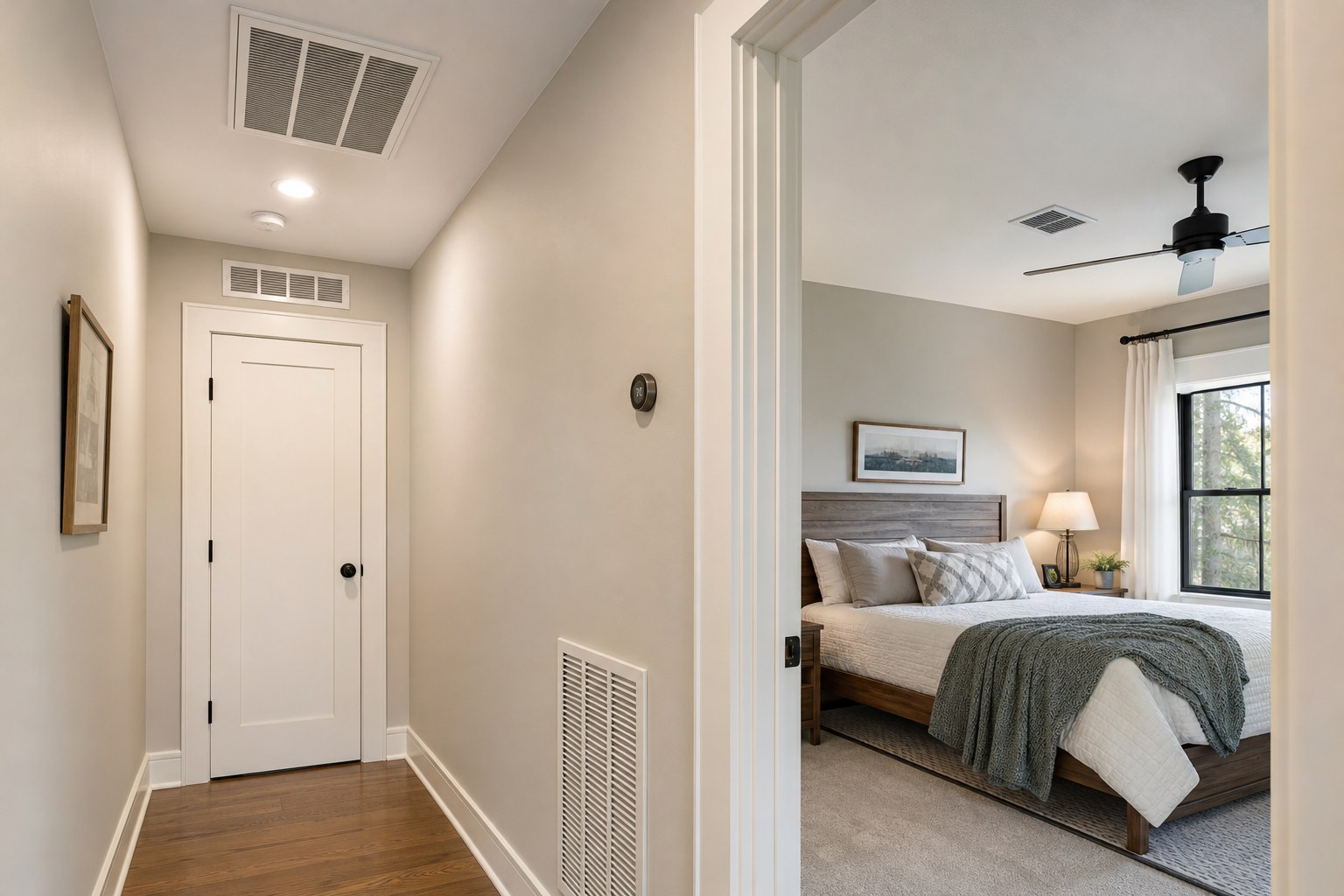
Should You Add Return Air Vents to Improve Comfort? A Homeowner’s Guide to Pressure Balance, Closed Doors, and When It’s Worth the Cost
If certain rooms feel stuffy, too hot, too cold, or noticeably different when the door is closed, return air may be part of the problem. Here is how to tell when adding return air vents can help and when another fix makes more sense.
Many homeowners assume comfort problems start at the equipment, but the issue is often the way air moves through the house. Your heating and cooling system does not just need to push conditioned air into rooms. It also needs a path for that air to get back to the system.
That is the basic job of return air. When return pathways are limited, rooms can become pressurized or starved for airflow, especially when bedroom doors stay closed for long periods. The result can be uneven temperatures, weak airflow at supply vents, extra noise under doors, and a room that never seems to feel right.
If you are wondering whether you should add return air vents, the honest answer is that sometimes it helps a lot, and sometimes it is the wrong repair. The best choice depends on your duct layout, room pressures, filter location, available wall or ceiling space, and whether the real problem is something else entirely.
A return air vent is not there to pull in fresh outdoor air. Its main job is to bring indoor air back to the HVAC system so that conditioned air can keep circulating through the home.
What does a return air vent actually do?
Your HVAC system works as a loop. Supply ducts deliver heated or cooled air into rooms. Return ducts pull air back to the air handler or furnace so it can be filtered, heated or cooled again, and recirculated.
When supply air enters a room easily but cannot leave that room easily, pressure builds. That pressure slows down supply airflow and can force conditioned air to leak out through gaps around doors, outlets, framing, or other openings. At the same time, the central return has a harder time pulling enough air back to the equipment from the rest of the house.
In a well-balanced system, supply and return airflow are planned together. That does not mean every room always gets its own full return duct, but it does mean each room needs a reasonable path for air to travel back when the system is running.
Without that pathway, comfort can suffer even if the equipment itself is in good condition.
What are the signs that return air might be part of the problem?
Return air issues often show up as comfort complaints rather than obvious mechanical failures. You may notice one or more rooms that feel fine with the door open but drift warmer or cooler when the door is closed.
Another common clue is a bedroom door that pushes open on its own, resists latching, or makes a whistling sound at the bottom when the system is running. That can indicate pressure imbalance caused by supply air entering faster than air can get back out.
You may also notice weak airflow at supply registers in rooms at the far end of the duct system, stuffy air overnight in closed bedrooms, or a return grille that seems loud because the system is straining for airflow.
These symptoms do not automatically mean you need to add return air vents, but they are good reasons to have airflow and room pressure evaluated instead of guessing.
- Rooms feel better when doors stay open
- Bedrooms become stuffy overnight
- One or two rooms stay consistently warmer or cooler than the rest of the home
- Doors move, rattle, or whistle when the system runs
- Supply airflow seems weak in problem rooms
- The system sounds noisy near the return side
- Filter gets dirty quickly because the system is pulling hard through limited return pathways
Why do closed doors matter so much?
Closed interior doors can turn an otherwise workable airflow design into a comfort problem. If a bedroom has a supply vent but no return path, the room may act like a balloon while the system runs. Air keeps getting delivered, but not enough can escape.
That pressure difference affects comfort in two ways. First, it reduces the amount of new conditioned air that can continue entering the room. Second, it changes how air moves through the rest of the house, which can make the whole system less balanced.
Some homes rely on a central return in a hallway combined with enough gap under bedroom doors to let air pass back out. In some houses, that works reasonably well. In others, carpet, thresholds, tighter doors, or larger supply airflow make that gap too small.
That is why two homes with similar floor plans can behave very differently. The details matter, including door undercuts, register sizing, duct routing, and how often rooms stay closed.
When does it make sense to add return air vents?
Adding return air vents can make sense when a contractor confirms that pressure imbalance is a major reason for poor comfort and that the home has a practical way to install proper return pathways.
This is often worth considering in homes where several bedrooms receive healthy supply airflow but still become uncomfortable with doors closed, or where the house has a single central return that is undersized for the way the home is actually used.
It can also be a good option during a larger HVAC project, such as duct renovation, major remodeling, or system replacement, because walls and ceilings may already be accessible and labor can be coordinated.
Adding returns may also help when indoor air circulation is poor and the system struggles with noise, filter loading, or consistent room-to-room temperatures even after basic balancing has already been tried.
The key is making sure the new return path is designed correctly. A poorly placed or undersized return can create new noise problems, draft complaints, or only partly solve the issue.
When is adding return air vents not the best solution?
Not every comfort complaint points to missing returns. If your system is oversized, short cycling, poorly maintained, or dealing with leaky supply ducts, adding return air vents may do little or nothing to fix the actual problem.
Likewise, if one room has too little supply air in the first place, the issue may be on the supply side rather than the return side. A disconnected duct, crushed flex duct, blocked register, bad damper setting, or poor balancing can all mimic return-air problems.
Insulation, air leakage around windows, solar gain, attic conditions, and room orientation also matter. A west-facing room with large windows may need shading improvements or supply adjustments more than a new return vent.
Sometimes the better fix is a transfer grille, jumper duct, larger door undercut, return duct enlargement at the equipment, filter grille upgrade, duct sealing, or full system balancing. Those options can be less invasive than adding dedicated returns to every room.
That is why a pressure and airflow diagnosis is more valuable than a quick sales pitch for extra grilles.
What options exist besides a full new return in each room?
Homeowners often picture adding return air vents as cutting a new grille into every bedroom and running brand-new ducts all the way back to the air handler. That is one option, but it is not the only one.
In some homes, a simpler return pathway can solve the pressure issue without creating a full dedicated return system. Which option is appropriate depends on layout, privacy concerns, sound transfer, accessibility, and local code or design requirements, which can vary by area.
- Door undercut: Increasing the gap under a door can improve airflow between a bedroom and a hall return, though there are limits to how much this alone can do.
- Transfer grille: A grille through or above a wall can let air move from a closed room to a hallway or another space with a return path.
- Jumper duct: A short duct connecting a bedroom ceiling to a hallway ceiling can relieve pressure while reducing direct sound transfer compared with a simple wall grille.
- Dedicated return: A separate return duct from a room back to the return trunk or air handler provides the most direct path but is usually more invasive and costly.
- Return trunk upgrade: If the main return side is too restrictive, improving the central return path may help the whole system more than adding branch returns.
- System balancing: Adjusting dampers, register airflow, and fan settings can improve comfort if the system is close to balanced already.
Each approach involves tradeoffs. For example, transfer grilles and jumper ducts can help pressure but may allow more sound movement between rooms and halls. Dedicated returns may perform better but take more labor and space.
If a room is uncomfortable only with the door closed, that is a strong clue that the return path deserves attention. If the room is uncomfortable all the time, the problem may be broader than return air alone.
What should homeowners know about cost, disruption, and installation difficulty?
The cost to add return air vents varies widely because homes vary widely. A single-story home with an accessible attic is usually easier to modify than a finished two-story home with limited chase space. The location of the air handler, framing obstacles, ceiling type, and return trunk access all affect labor.
Even when the work seems simple, good return design matters. Contractors need to consider duct sizing, grille sizing, noise control, filtration setup, and whether changes to one room will affect airflow in another. A shortcut installation can create a return that is too small, too loud, or poorly located.
You should also expect some finish work in certain cases. Cutting grilles into ceilings, walls, or high sidewalls may require patching, repainting, or trim adjustments. If the home has fire blocking, tight framing cavities, or limited access, the project can become more involved.
For that reason, many homeowners choose to address return upgrades during a planned remodel or at the same time as larger ductwork improvements. Combining projects can be more practical than opening finished areas twice.
Because local requirements vary, ask your contractor whether the proposed approach needs any approvals, inspections, or specific materials in your area.
What should you ask a contractor before approving return-air work?
A good contractor should be able to explain why the proposed change is needed and how they confirmed the problem. You want more than a generic statement that your home needs more return air.
Ask what symptoms point to pressure imbalance, whether room pressure or airflow was measured, and whether supply-side issues were ruled out. If the answer is based only on a quick glance, slow down before approving the job.
You should also ask where the new return path will go, how large it will be, whether it may increase sound transfer, and whether it will affect filtration or maintenance access. If a simpler option like a jumper duct or transfer grille would likely solve the problem, ask why a full dedicated return is or is not necessary.
- What testing or observations show that return air is the problem?
- Is the issue isolated to one room or affecting the whole system?
- Would a jumper duct, transfer grille, or door undercut help enough?
- How will the new return be sized?
- Will this change increase noise or reduce privacy?
- Will the work require opening finished walls or ceilings?
- Are there local requirements that could affect the design or installation?
- What other comfort issues should be addressed at the same time?
The best proposals usually connect the recommendation to your actual complaint. For example, a contractor might say that the guest room goes positive when the door is closed and that a jumper duct to the hallway should relieve pressure without the cost of a fully ducted return. That kind of explanation is more useful than a one-size-fits-all answer.
So, is adding return air vents worth it?
It can be worth it when return-air limitations are clearly causing comfort problems and the fix is designed around the way your home is laid out and used. In the right situation, improving return pathways can make bedrooms feel less stuffy, reduce door pressure issues, improve room-to-room balance, and help your HVAC system move air more smoothly.
But it is not an automatic upgrade. If the diagnosis is weak, you may spend money on new grilles and ductwork without meaningfully changing comfort. That is especially true when the root problem is poor supply airflow, duct leakage, insulation issues, or equipment sizing.
For many homeowners, the smartest path is to start with a real airflow and pressure evaluation, then compare solutions from least invasive to most invasive. Sometimes a simple pathway improvement solves the issue. Other times, a dedicated return or larger return-side duct change is the right long-term answer.
Frequently asked questions
Can every bedroom have its own return air vent?
Some homes can be designed that way, but it is not always necessary or practical. Many homes perform well with central returns plus properly designed return pathways from closed rooms.
Will adding return air vents lower my energy bills?
It may improve system airflow and comfort, but savings are not guaranteed. The main reason to consider return-air improvements is usually better comfort and pressure balance, not a promised utility reduction.
Can I just leave bedroom doors open instead?
If comfort improves noticeably when doors stay open, that is useful information. But many homeowners want privacy, quieter rooms, or closed doors at night, so a better return path may still be worth considering.
Are transfer grilles and jumper ducts as good as dedicated returns?
Sometimes yes, sometimes no. They can be effective for relieving room pressure, but the best option depends on airflow needs, sound concerns, space constraints, and the overall duct design.
Can a new return vent create noise?
Yes. If the grille or duct is undersized or poorly placed, it can whistle or transmit more sound. Proper sizing and layout matter.
Should I add returns during an HVAC replacement?
It is a good time to evaluate the issue because duct modifications are often easier to coordinate during larger system work. Still, the recommendation should be based on your home’s airflow needs, not added automatically.
Final Thoughts
If you are dealing with rooms that feel uncomfortable only when the doors are shut, do not ignore the possibility of a return-air problem. Airflow is a whole-house system, and comfort depends on having a path out of each room, not just a vent blowing air in.
The most practical approach is to get the problem diagnosed before committing to new ductwork. In some homes, adding return air vents is absolutely worth the cost. In others, a simpler fix can deliver most of the improvement with less disruption.
Either way, the goal is the same: better pressure balance, steadier airflow, and rooms that stay comfortable the way your family actually uses them.
Find an HVAC Installer Near You
Search the HVAC Installer Network to find local professionals, review installer profiles, and connect with contractors serving your area.
This article is for general informational purposes only and is not a substitute for an in-home evaluation by a qualified HVAC professional. Duct design, airflow, sound control, and return-air requirements vary by home, system type, and local requirements. Have any proposed modifications reviewed by a licensed professional familiar with your area and installation conditions.