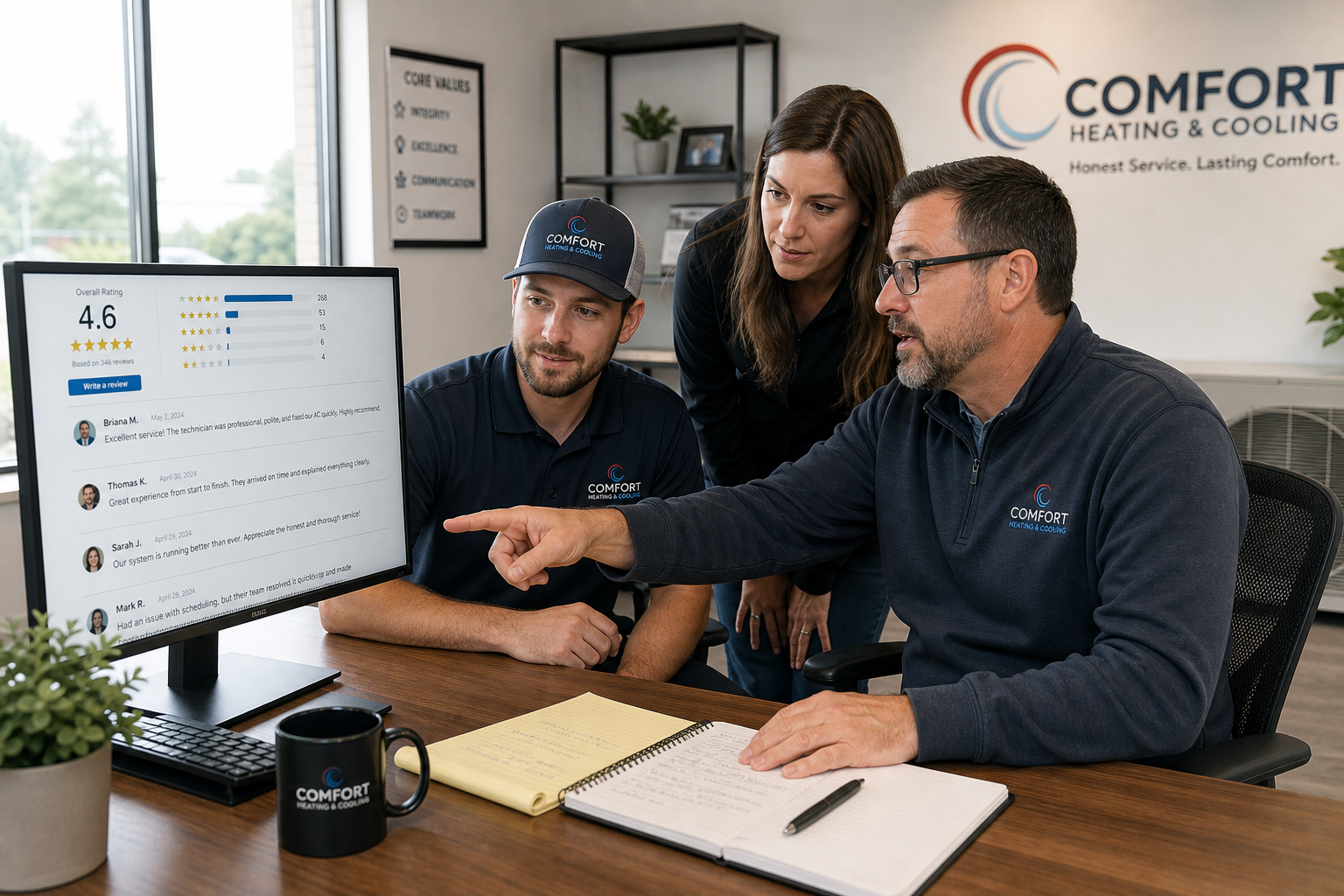
How HVAC Companies Can Turn Negative Reviews Into Trust-Building Customer Service Wins
A practical playbook for HVAC contractors who want to respond well, recover service problems, and show future customers what accountability looks like.
Every HVAC company gets negative reviews eventually.
Sometimes the complaint is fair. Sometimes it is incomplete. Sometimes it reflects a communication breakdown more than a workmanship problem. And sometimes it comes from a customer who was upset before your team ever arrived.
What matters most is not whether your company avoids every bad review forever. What matters is whether your team has a calm, repeatable way to respond that protects your reputation and improves the customer experience.
For contractors, negative reviews are public proof points. Prospective customers are not only reading the complaint. They are studying how your business behaves under pressure. A defensive answer can confirm their concerns. A thoughtful answer can build more trust than a five-star review ever could.
If you want to turn negative reviews into trust-building customer service wins, you need more than a polite template. You need a process that connects online reputation, dispatch, field service, management follow-up, and internal coaching.
This guide walks through how HVAC companies can do that in a practical way.
A negative review is not just a marketing issue. In most HVAC companies, it is also a service process issue, a communication issue, or an expectation-setting issue. Treat it like an operational signal, not just a public relations problem.
Why do negative reviews matter so much for HVAC contractors?
HVAC service is high trust work.
Customers usually cannot verify technical quality on sight. They rely on your communication, professionalism, arrival process, recommendations, pricing explanation, cleanliness, and follow-through to decide whether your company is trustworthy.
That means online reviews often shape buying decisions before a homeowner ever calls your office. A prospect who sees one critical review may not be alarmed by the complaint alone. Most people understand that no contractor pleases everyone. What they really watch for is your response.
Did your company ignore the issue?
Did someone answer with sarcasm or blame?
Did your team acknowledge the concern and offer a path to resolution?
The public reply shows prospective customers what it will feel like to work with you if something goes wrong. In that sense, a negative review is a live demonstration of your customer service culture.
It can also reveal hidden operational friction. If several reviews mention scheduling confusion, poor arrival windows, messy work areas, surprise charges, weak communication, or unresolved callbacks, the issue may not be one employee. It may be a system problem.
- Negative reviews influence future buyers who are comparing contractors.
- Responses reveal whether your company is defensive or accountable.
- Patterns in reviews can point to training or process gaps.
- Handled well, complaints can create stronger trust than silence.
How quickly should an HVAC company respond to a bad review?
Promptly, but not carelessly.
A same-day or next-business-day response is a strong target for most contractors. That shows attentiveness without creating pressure to write something reckless. Waiting too long can make the company look indifferent. Responding too fast without checking facts can make things worse.
The right balance is speed plus discipline.
Someone on your team should own review monitoring every day. In a smaller shop, that may be the owner, service manager, or office manager. In a larger operation, it may sit with customer service or marketing, but serious complaints should still be escalated to operations leadership.
The first response does not need to solve the entire case in public. Its job is to acknowledge the concern, show professionalism, and signal that your company is taking action.
If the issue involves safety, property damage, alleged misconduct, billing disputes, installation quality, or unresolved warranty-related concerns, local requirements vary and your internal review should include management quickly before anyone makes public commitments.
Speed matters because customers want to feel heard. Process matters because your company needs the facts.
What should a public response to a negative HVAC review include?
The best public responses are calm, brief, human, and specific enough to feel real without arguing details online.
A strong response usually includes five elements.
- Acknowledgment of the customer’s frustration or disappointment.
- A professional tone with no blame or defensiveness.
- A statement that the company wants to review what happened.
- A clear next step for direct contact.
- A commitment to making a reasonable effort to resolve the issue.
What it should not include is just as important.
- Do not accuse the customer of lying.
- Do not reveal private account details.
- Do not debate technical facts line by line in public.
- Do not copy and paste the same generic script for every complaint.
- Do not promise refunds, free work, or outcomes before reviewing the job.
Here is the basic tone to aim for: respectful, concerned, and solution-focused.
For example, a weak response sounds like this: “We have no record of this. Our technician says that is not what happened.”
A better response sounds like this: “We are sorry to hear you were frustrated with your recent service experience. This is not the level of communication we aim to provide. We would like to review the visit and speak with you directly so we can better understand what happened and work toward a resolution.”
The second example protects your company without sounding dismissive. It tells future readers that your team listens first and investigates second.
When should you move the conversation offline?
Almost always after the initial public response.
The public reply is for the audience as much as it is for the customer. It should show that your company cares and is responsive. The actual problem-solving usually belongs in a phone call, direct email exchange, or documented service recovery process.
Moving offline helps for several reasons.
- It reduces the chance of a public back-and-forth that becomes emotional.
- It allows your team to verify job notes, photos, invoices, recordings, and technician feedback.
- It protects customer privacy.
- It makes it easier to offer practical next steps.
That said, moving offline should not sound like avoidance. “Call us” by itself is weak. Give the customer a clear path and a sense that a real person will handle it.
For example, you might say that a manager would like to connect directly to review the appointment details and help resolve the concern. If appropriate, include a direct phone number or ask the customer to contact the office and mention the review so it reaches the right person quickly.
If the customer refuses to continue privately and keeps posting publicly, stay measured. Repeat that your company remains willing to review the matter directly. Never let a review thread pull your team into an argument.
How should HVAC companies investigate a negative review before offering a fix?
This is where many contractors either miss the root cause or overcorrect too fast.
The goal is not to protect your ego or automatically side with the customer. The goal is to understand what actually happened from start to finish.
Start with the basics.
- Find the customer record and confirm the date, address, and service type.
- Review dispatch notes, call recordings if available, and scheduling communication.
- Read technician notes, photos, and any recommendations presented on site.
- Check invoices, signed approvals, and change orders if applicable.
- Speak with the technician and any office staff involved.
- Identify whether the complaint is about workmanship, diagnosis, pricing, timing, cleanliness, conduct, or communication.
Then separate the review into categories.
Some complaints are technical. For example, the system still does not cool properly after a repair. Some are expectation issues. The customer may have expected same-day completion when parts had to be ordered. Some are communication failures. The work may have been acceptable, but the homeowner never felt informed. Some are emotional trust breaks. The customer may feel ignored, pressured, surprised, or dismissed.
That distinction matters because the right recovery step depends on the actual failure point.
If the diagnosis may be in question, you may need a manager review or second visit. If the issue is price shock, your team may need to walk through what was approved and how options were presented. If the issue is a no-show or a late arrival, an apology without excuses may matter more than a technical explanation.
Do not let the team jump straight to “the customer is impossible” or “just refund it.” Both reactions can hide preventable problems.
Many bad reviews come from expectation gaps, not catastrophic workmanship failures. That is good news for contractors, because expectation gaps can often be fixed with better confirmation, clearer options, tighter arrival communication, and stronger post-visit follow-up.
What does a trust-building service recovery process look like?
A strong service recovery process is simple enough to use every time and flexible enough to fit different situations.
In practice, it often looks like this.
- Respond publicly with professionalism.
- Assign internal ownership to a manager or decision-maker.
- Review records before contacting the customer.
- Call the customer to listen fully before defending the company.
- Confirm the issue in plain language.
- Offer a reasonable next step.
- Complete the follow-up quickly.
- Document the outcome and any lessons learned.
The phone call is where trust is either rebuilt or lost.
Train managers to listen without interrupting. Let the customer explain what they experienced. Then summarize the concern back to them. Even if you disagree with part of the account, show that you understand the frustration.
For example: “I understand that your concern is not only the repair itself, but also that you felt unclear on the price and did not receive a return call when the system still had the same issue. I can see why that would be frustrating.”
That kind of response lowers tension because it proves your company is paying attention.
From there, offer the next best step. Depending on the situation, that might mean a return visit, a manager inspection, a billing review, a clearer explanation of findings, or a reset of expectations around parts, scheduling, or scope. Local requirements vary, and your policy decisions should fit your market, documentation standards, and business model.
Not every complaint should lead to a concession. But every legitimate complaint should lead to a fair review and a respectful response.
How can contractors write responses that feel human instead of scripted?
Templates are useful for consistency, but they should be starting points, not final answers.
If every review gets the same generic response, your company can look robotic or insincere. Customers notice that quickly.
To make responses sound human, customize three things.
- Reference the type of issue, such as communication, scheduling, cleanliness, or system performance.
- Acknowledge the experience, not just the existence of the review.
- State the next step in a natural way.
Here is a usable structure.
First sentence: acknowledge the concern.
Second sentence: identify the category of problem.
Third sentence: explain that your team wants to review and resolve it.
Fourth sentence: provide a contact path.
For example: “Thank you for bringing this to our attention. We are sorry to hear you were disappointed with the communication around your service appointment. We want to review what happened and see how we can help make this right. Please contact our office and ask for our service manager so we can look into the visit details with you directly.”
That is short, clear, and credible.
How can negative reviews help improve training for technicians and office staff?
If your team only treats reviews as reputation events, you miss their real value.
Reviews can become a feedback loop for training, coaching, and process improvement. The key is to classify them consistently.
Instead of looking at comments one by one, sort them into themes over time.
- Late arrival or scheduling frustration
- Poor communication before arrival
- Unclear diagnosis or recommendations
- Price surprise or weak option presentation
- Messy work area or property respect concerns
- Incomplete repair or recurring issue
- Perceived pressure or sales discomfort
- Rude interaction or lack of professionalism
Once themes emerge, tie each one to a process owner.
Scheduling problems may belong to dispatch. Price explanation may belong to service management and technician training. Cleanliness and professionalism may need field standards and ride-along coaching. Recurring diagnosis issues may require technical review and stronger documentation.
This is where negative reviews can become genuinely valuable. Instead of punishing people every time a complaint appears, use the feedback to improve systems. Your technicians are more likely to buy into review accountability if they see it leading to practical support rather than automatic blame.
In many HVAC companies, the office side and field side each assume the other caused the bad experience. Reviews often expose the handoff problem between them. That makes review analysis a useful management tool.
Should HVAC companies ask customers to update or remove a negative review after resolution?
You can ask thoughtfully, but do not pressure people.
If your company resolved the issue fairly and the customer expresses satisfaction afterward, it is reasonable to say something like: if you feel your concern was handled well, we would appreciate it if you updated your review to reflect the final outcome.
That approach is better than asking for deletion right away. An updated review that says the company responded, followed up, and fixed the problem can be powerful social proof for future buyers.
The goal is not to erase all criticism. The goal is to show that your company stands behind its work and communication.
If the customer does not update the review, move on professionally. You still gained value if the problem was resolved internally and your public response shows accountability.
What internal habits help contractors prevent repeat negative reviews?
Prevention usually comes from boring consistency, not clever marketing.
The contractors who reduce recurring complaints tend to be strong in a few predictable areas.
- They confirm appointments clearly.
- They communicate delays before the customer has to call.
- They train technicians to explain findings and options plainly.
- They document approvals carefully.
- They set realistic expectations around repair outcomes, part availability, and installation timelines.
- They follow up after difficult or high-ticket jobs.
- They escalate complaints quickly instead of letting them linger.
It also helps to define who can make service recovery decisions. If your office staff has no authority, the customer may get bounced around. If technicians are left to solve everything in the field without support, they may overpromise. Clear escalation rules prevent that.
For example, decide in advance which kinds of complaints require manager contact, what response time your team targets, and how outcomes are documented. A simple playbook can reduce inconsistency across the company.
Remember that many online complaints begin as unresolved direct complaints. If a homeowner has to call multiple times for an answer, the review often writes itself. Fast internal follow-up can prevent public escalation.
Frequently Asked Questions
Should the owner respond to every negative review personally?
Not necessarily. What matters is that the response comes from someone authorized, informed, and professional. In smaller companies, that may be the owner. In larger companies, a service manager or office manager may be more practical. Serious complaints should still be escalated internally.
What if the review is unfair or factually wrong?
Stay calm and avoid arguing publicly. Acknowledge the concern, state that you want to review the matter, and invite direct contact. You can protect your reputation better with professionalism than with a point-by-point rebuttal.
Is it a mistake to apologize if the company is not fully at fault?
No. You can apologize for the customer’s frustration or poor experience without admitting facts you have not verified. A respectful tone often opens the door to a better conversation.
How long should a public response be?
Usually short to moderate. Long responses often become defensive and reveal too much detail. Say enough to show care, responsibility, and next steps, then move the issue offline.
What if a customer becomes abusive in public responses?
Do not match the tone. Reply once or twice at most with a professional invitation to discuss the issue directly, then stop engaging publicly. Protect your team, document the exchange, and follow platform rules as applicable.
Final Thoughts
For HVAC contractors, negative reviews are not pleasant, but they are useful.
They show where expectations broke down, where communication failed, and where service recovery either happened or did not. More importantly, they give your company a public opportunity to demonstrate maturity.
If you want to turn negative reviews into trust-building customer service wins, build a real process. Monitor reviews consistently. Respond promptly. Investigate carefully. Follow up like a professional. Use patterns to improve training and operations.
Future customers are paying attention to more than your star rating. They are looking for signs that your company is responsive, fair, organized, and accountable when problems happen. A strong recovery process helps them see exactly that.
Join the HVAC Installer Network
Create an installer listing to help homeowners discover your business, learn about your services, view your company information, and connect with you about installation opportunities in your service area.
This article is for general informational purposes only. Business practices, platform policies, insurance considerations, documentation standards, and local requirements vary. Contractors should use their own judgment and consult qualified professionals when developing customer service, review response, and complaint resolution procedures.