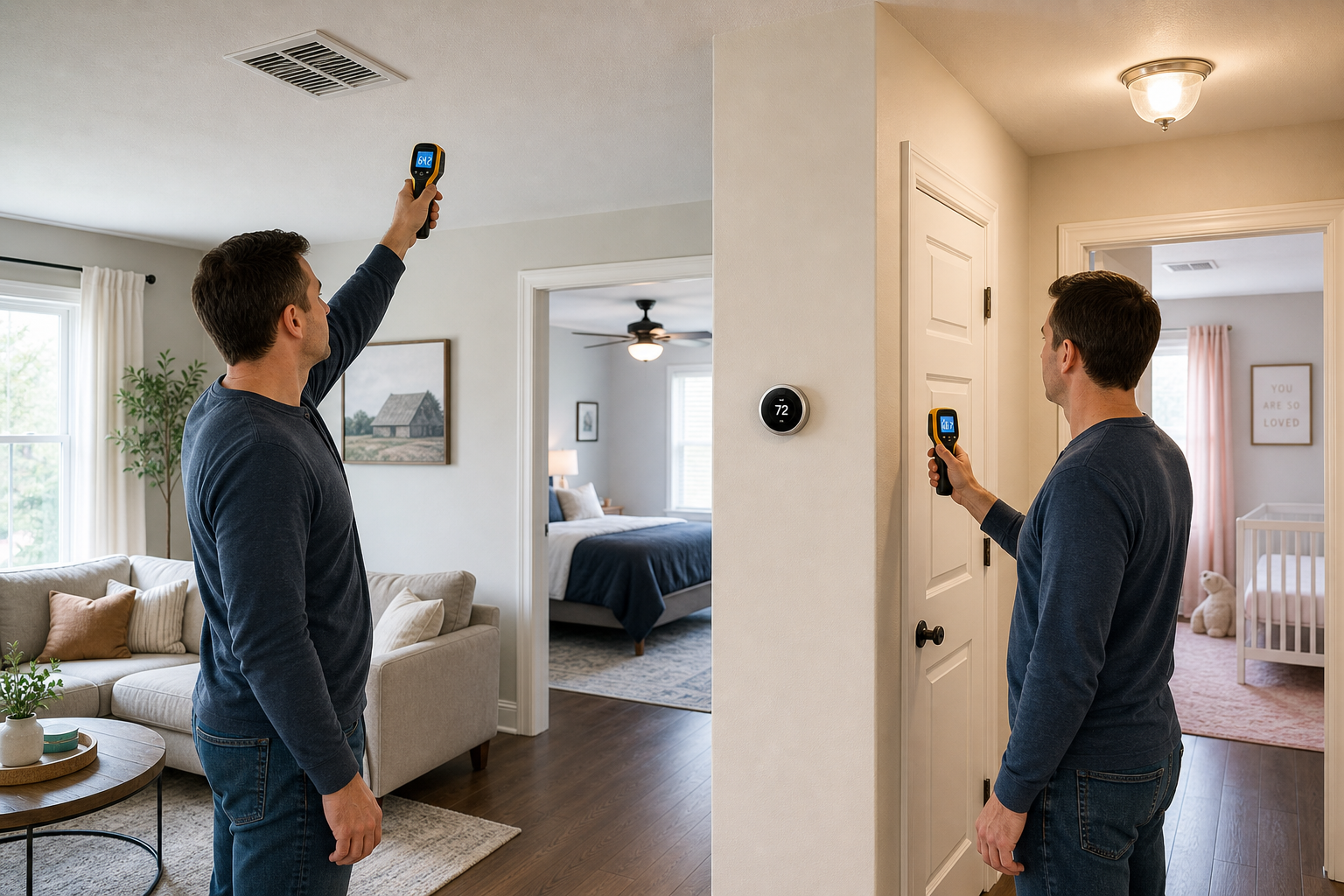
Uneven Temperatures Room to Room: What Homeowners Can Do Before Replacing HVAC Equipment
Before you assume your furnace, heat pump, or air conditioner has reached the end of the road, it helps to look at the comfort issues inside the house that often cause one room to feel just right while another feels too hot or too cold.
Uneven temperatures room to room are one of the most common complaints homeowners have about heating and cooling systems.
Maybe the upstairs bedrooms stay warm at night in summer, while the living room feels fine.
Maybe one back bedroom is always cold in winter, even when the rest of the house feels comfortable.
Or maybe the thermostat says the house has reached the set temperature, but the rooms you actually use never seem to catch up.
That kind of problem is frustrating because it can make you think the answer is a full system replacement.
Sometimes replacement is appropriate, especially with aging or improperly sized equipment, but many room-to-room comfort problems come from airflow, insulation, duct layout, sun exposure, thermostat placement, or basic maintenance issues.
In other words, the equipment itself may only be part of the story.
Before spending money on a new system, it makes sense to work through the practical steps that can improve comfort, reduce wasted energy, and help you have a more informed conversation with an HVAC professional.
If one room is uncomfortable, replacing the HVAC equipment may help less than expected if the real cause is poor airflow, duct leakage, insulation gaps, or an oversized system that does not run long enough to even out temperatures.
Why do uneven temperatures room to room happen in the first place?
Most homes do not heat and cool evenly because each room behaves differently.
Some rooms have more windows, more sun, higher ceilings, longer duct runs, fewer return air paths, or more outside wall exposure.
Others sit near the thermostat, near the indoor unit, or in interior parts of the house that naturally stay more stable.
That means your HVAC system is trying to serve rooms with different loads at the same time.
In a perfect world, the system design, ductwork, insulation, air sealing, and controls would all work together to balance that out.
In real homes, there are usually compromises.
Older homes may have duct systems that were expanded over time.
Two-story homes often struggle because heat rises and upper floors can gain more solar heat.
Additions may have been tied into an existing system without enough airflow planning.
Finished basements, bonus rooms over garages, and rooms at the far end of the house are especially common trouble spots.
It is also possible for comfort issues to develop gradually.
A dirty filter, a blocked vent, a slipping blower performance issue, disconnected duct, or attic insulation problem can make a once-acceptable room become uncomfortable over time.
That is why the first step is not guessing.
The first step is observing patterns.
What patterns should homeowners pay attention to before calling for replacement?
Look for when the problem happens, where it happens, and whether it is tied to weather, time of day, or system operation.
If the issue is mostly on hot sunny afternoons, solar gain through windows may be a major factor.
If the issue is mostly overnight in winter, insulation and cold exterior exposure may matter more.
If one room is uncomfortable year-round, airflow or duct design may be a stronger suspect.
If the whole second floor struggles in summer, stack effect, attic heat, or inadequate return airflow could be involved.
It helps to make a simple list of the rooms that feel off and whether they run hot, cold, or both depending on season.
Note whether doors are usually open or closed.
Notice whether supply vents feel weak compared to other rooms.
Pay attention to whether the thermostat satisfies quickly while the problem room still feels uncomfortable.
You do not need special instruments to start narrowing things down.
A basic thermometer can help you compare rooms, but your own comfort observations are also useful.
The goal is to give an HVAC pro better information and avoid jumping straight to equipment replacement as the only answer.
What are the first things you can check yourself?
Start with the simple items that affect airflow and system performance.
- Check the air filter and replace it if it is dirty or overdue.
- Make sure supply registers are open and not blocked by rugs, furniture, or curtains.
- Check return grilles for dust buildup or blockage.
- Confirm interior doors are not restricting air movement, especially in rooms with the comfort problem.
- Look for dampers near accessible ducts if your system has them, but avoid random adjustments if you are unsure what they control.
- Verify the thermostat settings are correct and that schedules are not creating comfort swings.
- Inspect visible duct sections in attics, basements, or crawl spaces for obvious disconnections, crushed flex duct, or missing insulation.
These checks matter because HVAC systems depend on moving the right amount of air through the home.
Even a good system can struggle when airflow is restricted.
Likewise, a room may feel starved for conditioned air simply because the register is partly covered by a dresser or the door is shut most of the day.
If your filter is heavily loaded, replacing it can improve performance enough to reduce temperature imbalance.
If a visible duct has come loose in an attic, that can create a major comfort problem in one or more rooms.
These are not glamorous fixes, but they are often the right place to begin.
How much do vents, returns, and closed doors really affect comfort?
Often more than homeowners expect.
Supply registers deliver conditioned air into a room, but that air also needs a path back to the system.
If a room has a supply vent but poor return air movement, the room can become pressure-imbalanced when the door is closed.
That can reduce airflow into the room and leave it less comfortable.
Bedrooms are a common example.
When doors stay closed for privacy or sleeping, the room may not receive or release air effectively unless the house has been designed to allow that movement through returns, transfer grilles, jump ducts, or undercut doors.
Similarly, homeowners sometimes close vents in rooms they use less, thinking it will push more air to other areas.
In some systems that can create airflow and pressure problems rather than improving comfort.
It is better to ask a contractor before making broad vent-closing changes throughout the house.
If one room has consistently weak airflow while nearby rooms feel normal, that points more strongly toward a balancing or duct issue than a failing furnace or air conditioner by itself.
Could insulation and air leaks be causing the problem instead of the HVAC equipment?
Absolutely.
Some rooms are uncomfortable not because too little conditioned air is reaching them, but because the room loses or gains heat faster than the rest of the house.
A bonus room over a garage is a classic example.
It may have more surface area exposed to hot or cold conditions, less insulation beneath the floor, and different sun exposure than the main living area.
Older homes may have wall, attic, or knee-wall insulation deficiencies that create room-specific temperature swings.
Air leaks around windows, doors, attic hatches, recessed lights, plumbing penetrations, and wall penetrations can also make a room feel drafty or hard to condition.
In summer, sun-facing rooms often get hit hardest, especially if they have large windows with limited shading.
In winter, rooms with more exterior walls can lose heat faster and feel chilly even when supply air is present.
If your comfort problem follows the building shell more than the HVAC run time, it is smart to consider insulation and air sealing as part of the solution.
That does not mean you should guess and start tearing into walls.
It means a full comfort diagnosis should look beyond the equipment cabinet.
What role does thermostat location play?
The thermostat only knows what it senses where it is mounted.
If that location warms up or cools down faster than the rooms you care about most, the system may shut off before those rooms are comfortable.
A thermostat located in a central hallway may be satisfied while a far bedroom still needs conditioning.
A thermostat near a return, a sunny wall, a kitchen, or a drafty area can also lead to misleading readings.
This is one reason homeowners sometimes say, “The thermostat says the right number, but the house does not feel right.”
They are often describing a control-location issue rather than pure equipment failure.
In some homes, better thermostat placement, sensor options, or zoning changes may help.
The right answer depends on the layout, duct system, and equipment type.
A contractor can help determine whether the thermostat is controlling the house based on the wrong part of the house.
Can ductwork be the main reason some rooms are too hot or too cold?
Yes, and this is one of the most common reasons uneven temperatures room to room persist even after basic maintenance.
Ductwork problems can include undersized runs, overly long flex duct, kinked sections, disconnected joints, leaky seams, poor balancing, inadequate returns, or a layout that never matched the home well.
Sometimes the issue traces back to a home addition or remodel.
The existing system may have been asked to serve more square footage without meaningful duct upgrades.
Sometimes the problem is hidden in an attic where flexible duct has been compressed or disturbed.
In other cases, supply air reaches the room but too much of it is lost before it gets there because of leakage.
Homeowners can inspect visible sections, but proper diagnosis often requires measuring airflow, static pressure, and temperature behavior across the system.
That matters because replacing the equipment without fixing the duct issue can leave you with a new system and the same comfort complaint.
In some cases, a contractor may recommend duct repairs, balancing adjustments, additional returns, or partial redesign work before discussing equipment replacement.
Could the existing HVAC equipment still be part of the problem?
Yes, but it is important to understand how.
Older equipment may struggle because of declining performance, blower issues, coil problems, refrigerant-related concerns, or general wear.
But even newer equipment can contribute to room imbalance if it is oversized, undersized, or poorly matched to the house and duct system.
An oversized air conditioner or heat pump can cool the thermostat area quickly and shut off before distant rooms stabilize.
A system that short-cycles may also do a poorer job with humidity control and even air mixing.
An undersized system, meanwhile, may run for long periods and still fail to keep up in rooms with the heaviest load.
Variable-speed or staged equipment can sometimes improve comfort because it can run longer and more gently, but it is not a cure-all if the real issue is duct layout or insulation.
This is why a homeowner should be cautious about assuming that newer automatically means more even comfort.
Replacement can help, but only if the underlying comfort problem has been diagnosed correctly.
What upgrades or corrections might help before replacing the whole system?
Depending on the home, several targeted improvements may make a meaningful difference.
- Air sealing around windows, doors, attic penetrations, and other leakage points.
- Adding or improving attic or room-specific insulation where appropriate.
- Duct sealing and insulating accessible duct runs.
- Adjusting dampers or rebalancing airflow.
- Improving return air pathways for closed-off rooms.
- Correcting crushed, kinked, or disconnected ducts.
- Thermostat relocation or use of compatible remote sensors where applicable.
- Window treatments or shading strategies for rooms with heavy afternoon sun.
- Ceiling fan use to improve air circulation in occupied rooms.
Not every home needs all of these.
The point is that there are intermediate steps between doing nothing and replacing the entire HVAC system.
Some of these improvements are building-envelope solutions.
Some are airflow solutions.
Some are control solutions.
The best combination depends on what is actually causing the problem in your house.
When should you call an HVAC professional, and what should you ask?
Call a professional if you have ruled out basic maintenance issues and the comfort problem persists, especially if one or more rooms are consistently uncomfortable in the same pattern.
It is also a good idea to call if airflow feels weak, your utility bills have changed noticeably, visible ducts appear damaged, or your equipment seems to short-cycle.
When you schedule the visit, describe the problem by room and season instead of simply saying the system does not work well.
Ask the contractor to evaluate airflow, visible duct conditions, balancing, thermostat location, and whether insulation or air leakage may be contributing.
If replacement is suggested, ask what evidence supports it and whether the room-to-room issue appears to be an equipment problem, a duct problem, a house problem, or some combination.
For major work, local requirements vary, and any upgrades involving ducts, controls, or equipment should be handled in accordance with applicable codes and manufacturer instructions.
A practical contractor should be willing to explain the likely cause in plain language and tell you what changes may improve comfort most directly.
When does replacing HVAC equipment actually make sense?
Replacement may make sense when the equipment is old, unreliable, expensive to repair, improperly sized, or no longer a good fit for the home.
It can also make sense when a larger comfort strategy is needed and the existing system cannot support that plan effectively.
For example, if the equipment is near the end of its service life and the contractor has identified both performance issues and duct or airflow issues, it may be reasonable to address them together.
Likewise, if a home has long-standing temperature imbalances and a thorough evaluation shows the system was badly oversized or undersized from the beginning, replacement may be part of a better solution.
Still, homeowners should be careful not to treat replacement as the only answer to every comfort complaint.
A new system attached to flawed ductwork or serving a poorly sealed room may leave you disappointed.
The smartest path is usually diagnosis first, targeted corrections second, and replacement only when the evidence points there.
What is a practical homeowner checklist before deciding on replacement?
- List the rooms with comfort problems and note whether they run hot, cold, or both depending on season.
- Replace the air filter if needed and confirm all vents and returns are clear.
- Observe whether doors being open or closed changes the room comfort.
- Check visible ducts for obvious damage, disconnection, or missing insulation.
- Note whether the thermostat reaches setpoint before problem rooms feel comfortable.
- Look for signs of sun gain, drafts, weak insulation, or room-specific exposure issues.
- Use ceiling fans and shading where appropriate to see whether comfort improves.
- Schedule an HVAC evaluation focused on airflow, ductwork, and controls rather than replacement alone.
- Ask whether building-shell improvements could solve part of the issue.
- Compare recommendations and make sure any replacement proposal explains how room-to-room comfort will be addressed.
This kind of checklist helps you make a better decision because it separates symptoms from causes.
It also helps you compare contractor recommendations on a more practical basis.
Frequently Asked Questions
Is uneven temperature between upstairs and downstairs normal?
It is common, especially in two-story homes, but common does not mean unavoidable. Differences in rising heat, attic exposure, sun gain, duct layout, and thermostat location often contribute, and many of those factors can be improved.
Will closing vents in warmer rooms force more air to colder rooms?
Not always. In some systems, closing vents can disrupt airflow and increase pressure problems. It is better to have balancing evaluated properly rather than relying on trial and error throughout the house.
Can a smart thermostat fix uneven temperatures room to room?
Sometimes it can help if the issue is partly related to thermostat sensing or scheduling, but it will not solve duct leakage, poor insulation, weak airflow, or a bad room layout by itself.
Should I replace my HVAC system if only one room is uncomfortable?
Usually not as a first step. A single uncomfortable room often points more toward a localized airflow, duct, insulation, or sun exposure issue than a whole-system failure.
Can duct repairs really make that much difference?
Yes. If ducts are leaking, disconnected, crushed, poorly insulated, or badly balanced, repairs can improve delivered airflow and comfort significantly. The exact results depend on the home and the severity of the issue.
Final thoughts
Uneven temperatures room to room can make a home feel uncomfortable even when the HVAC system seems to be running.
That does not automatically mean the equipment needs to be replaced.
In many homes, the better first step is to look at airflow, duct condition, thermostat behavior, insulation, air leaks, room exposure, and how the house is actually being used.
The most cost-effective solution is often a targeted one.
By checking the basics and asking the right questions, you can avoid replacing equipment before you understand the real cause of the problem.
And if replacement does turn out to be necessary, you will be in a much better position to make sure the new system is part of a complete comfort solution instead of just a new box connected to the same old issues.
Find an HVAC Installer Near You
Search the HVAC Installer Network to find local professionals, review installer profiles, and connect with contractors serving your area.
This article is for general informational purposes only and is not a substitute for an in-person evaluation by a qualified HVAC professional.
System design, duct modifications, electrical work, controls, permits, and installation practices can vary by home, equipment type, and location.
Local requirements vary, so homeowners should confirm recommendations with licensed professionals serving their area.