Do You Need an HVAC Surge Protector? A Homeowner’s Guide to Protecting AC and Heat Pump Electronics
Modern AC and heat pump systems depend on circuit boards and controls that can be vulnerable to power spikes. Here is how surge protection works, when it makes sense, and what to ask before adding it to your system.
If you think of your heating and cooling system as mostly motors and metal, it may be time for an update. Today’s air conditioners and heat pumps often include control boards, communicating components, sensors, inverter electronics, thermostats, and other sensitive parts that do not always respond well to unstable power.
That is why many homeowners ask about an HVAC surge protector. The basic idea is simple: help reduce the chance that a voltage spike damages expensive HVAC electronics. The practical question is whether adding one is worth it for your home and your system.
In many cases, surge protection is worth discussing, especially if your area experiences frequent storms, utility interruptions, flickering power, or if your HVAC equipment uses advanced electronic controls. It is not a guarantee against every electrical problem, but it can be an extra layer of protection for one of the most expensive systems in your home.
This guide walks through what HVAC surge protectors do, what they protect, when they make sense, and how to talk with a qualified installer. Because electrical codes and installation requirements vary by location, always confirm local requirements and product compatibility before moving forward.
Practical rule of thumb: if your air conditioner or heat pump has an electronic control board, communicating thermostat, inverter-driven compressor, or other advanced controls, surge protection is usually worth a conversation with a qualified HVAC professional or electrician.
What does an HVAC surge protector actually do?
An HVAC surge protector is designed to help protect heating and cooling equipment from damaging voltage spikes. When an abnormal spike shows up on the electrical line, the device helps divert or limit that surge before it reaches sensitive HVAC components.
Think of it as a defensive layer between unstable power and the electronics inside your equipment. It does not make your system immune to all electrical issues, and it cannot fix wiring problems, poor grounding, or failing utility service. What it can do is reduce exposure to sudden events that may otherwise damage a control board, blower motor module, thermostat interface, or compressor electronics.
Some surge protection devices are installed specifically for outdoor condensers or heat pumps. Others may be added at the electrical panel as part of a whole-home protection strategy. In many homes, the conversation is not whether surge protection matters, but which level of protection makes the most sense.
For homeowners, the main benefit is straightforward: a relatively small protective device may help lower the risk of losing expensive HVAC components to an electrical event.
Why are modern AC and heat pump systems more vulnerable?
Older HVAC systems were often simpler. Many relied on basic controls and had fewer electronic parts. Modern systems are usually more efficient, more capable, and more comfortable to live with, but they also tend to contain more delicate electronics.
Depending on the equipment, your system may include a control board, communicating controls, ECM blower motor electronics, variable-speed components, sensors, inverter boards, smart thermostat connections, and safety circuits. These features improve performance, but they can also be more sensitive to electrical disturbances than older mechanical designs.
Heat pumps in particular can have complex control strategies because they provide both heating and cooling. Higher-end systems may stage output, adjust compressor speed, and communicate across indoor and outdoor components. When one key board or module is damaged, the repair can become more involved than replacing a simple contactor or capacitor.
That does not mean modern HVAC equipment is fragile. It means the electrical side of the system deserves more attention than many homeowners realize. If you have invested in newer equipment, surge protection may be one way to help protect that investment.
- Single-stage systems can still contain sensitive control boards.
- Variable-speed and inverter systems often have even more electronics to protect.
- Communicating systems may depend on multiple connected components working correctly.
- Smart thermostats and accessory controls add convenience but can increase sensitivity to power quality issues.
Where do power surges come from?
Many homeowners think only of lightning when they hear the word surge. Lightning can certainly create damaging electrical events, but it is not the only source. In fact, many surges are smaller and happen more often than people expect.
Utility grid switching, outages followed by power restoration, nearby electrical work, downed lines, storm activity, generator transitions, and large appliances cycling on and off can all contribute to voltage disturbances. Even if the surge is not dramatic enough to affect every device in the house, it may still be enough to stress HVAC electronics over time.
Air conditioners and heat pumps themselves involve motors and compressors starting and stopping under load. The electrical environment around the home is not always as stable as it seems. If your lights flicker during storms, if you lose power periodically, or if you live in an area with frequent service interruptions, those are practical signs that surge protection deserves consideration.
It is also important to understand that damage is not always immediate and obvious. A severe event may cause instant failure, but repeated smaller events can also contribute to premature issues. A technician may find a failed board or module without being able to prove exactly which specific surge caused it.
When does surge protection make the most sense?
There is no universal rule that every homeowner must add an HVAC surge protector, but there are several situations where it becomes especially practical to consider.
First, surge protection often makes sense when you have newer or higher-end equipment. If your air conditioner or heat pump includes inverter technology, variable-speed operation, or communicating controls, the system likely has components you would rather not replace after a power event.
Second, it is worth discussing if your home experiences frequent thunderstorms, utility disturbances, rolling outages, or visible light flickering. Homes in areas with overhead utility lines may also prompt more questions about surge exposure, though local conditions vary.
Third, adding protection can be attractive when you are already replacing HVAC equipment. Installation is often easiest to discuss during a system changeout, when electrical connections and equipment planning are already part of the project.
Fourth, surge protection may be a smart topic if you have already had unexplained board failures, thermostat issues after storms, or repeated electronic part replacements. It may not solve every reliability problem, but it can help address one common risk.
Finally, homeowners who simply want to protect major home systems often view HVAC surge protection the same way they view smoke alarms, drain pans, or condensate safety switches: not exciting, but sensible.
A practical way to think about it: if replacing one damaged HVAC control board or module would be frustrating and expensive, paying attention to surge protection may be worthwhile.
Whole-home vs equipment-level protection: do you need both?
This is one of the most useful homeowner questions because the answer is often not either-or. Whole-home surge protection and equipment-level HVAC surge protection serve related but slightly different roles.
A whole-home surge protector is typically installed at the electrical panel. Its job is to reduce the impact of surges entering the home’s electrical system. This can help protect a broad range of appliances and electronics, not just the HVAC system.
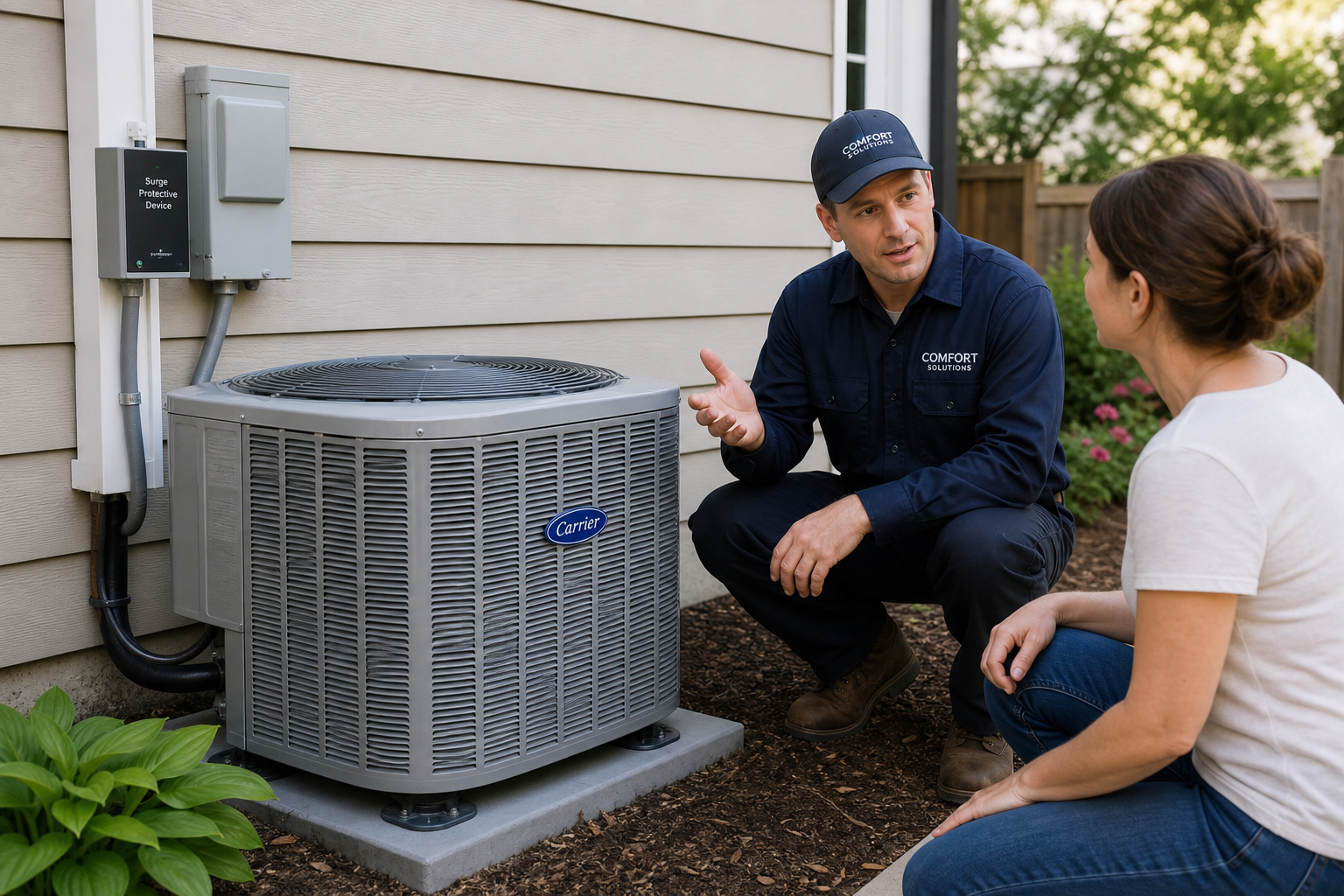
An equipment-level HVAC surge protector is installed for the heating and cooling equipment itself, commonly near the outdoor unit or as part of the system’s dedicated electrical setup. Its purpose is more targeted: help protect the AC or heat pump directly.
Many professionals view layered protection as the best approach. A whole-home device helps at the panel level, while dedicated HVAC protection helps closer to the equipment. Whether you need both depends on your home, your electrical setup, your budget, and the type of HVAC system you own.
For some homeowners, starting with whole-home surge protection makes sense because it benefits more than one appliance. For others, especially those focused on a newer heat pump or AC system, dedicated HVAC protection may be the first thing they consider. In some cases, a professional may recommend both.
- Whole-home surge protection: broader protection at the panel for multiple household systems.
- HVAC surge protector: focused protection for the air conditioner or heat pump.
- Layered approach: often the most complete option when budget and electrical setup allow.
- Best choice: depends on equipment type, local power conditions, and professional recommendations.
Because installation involves electrical work, product ratings, and compatibility considerations, the decision should be made with a qualified professional who can evaluate the system on site.
What should you ask an HVAC installer before adding one?
If you are considering an HVAC surge protector, a short conversation with a knowledgeable installer can save confusion later. The goal is not to become an electrical expert. It is to understand what is being recommended and why.
Start by asking whether your specific AC or heat pump includes sensitive electronics that would benefit from dedicated surge protection. This helps move the conversation away from generic sales language and toward your actual equipment.
Next, ask whether the recommendation is for equipment-level protection, whole-home surge protection, or both. If both are suggested, ask what role each device would play. A good contractor should be able to explain this in plain language.
You should also ask whether the selected surge protector is appropriate for your system voltage, configuration, and installation location. Product compatibility matters. Not every device is right for every setup.
Another practical question is where the device will be installed and whether any additional electrical work may be needed. Depending on the home and local requirements, some installations may be straightforward while others may involve coordination with an electrician.
Finally, ask how you will know if the device is still functioning. Some surge protectors include status indicators or diagnostic lights. Since homeowners rarely think about these devices after installation, it helps to know what to check during routine maintenance.
- Does my AC or heat pump have electronics that are especially worth protecting?
- Are you recommending a dedicated HVAC surge protector, whole-home surge protection, or both?
- Why is this device a good match for my equipment?
- Where will it be installed?
- Will installation require electrical upgrades or coordination with another trade?
- How can I tell whether the surge protector is operating properly later on?
- What local code or permit requirements apply in my area?
If a contractor cannot explain the recommendation clearly, keep asking questions. Homeowners do not need a complicated pitch. They need a practical explanation tied to the equipment in front of them.
What are the key takeaways for homeowners?
An HVAC surge protector is not a flashy upgrade, but it addresses a real concern. Air conditioners and heat pumps increasingly rely on electronics that can be costly and inconvenient to replace after a power event.
If your home deals with storms, outages, flickering power, or utility instability, the case for surge protection gets stronger. If your HVAC equipment is newer, more advanced, or recently installed, protecting it may be especially worth considering.
That said, surge protection should be viewed as part of a broader reliability strategy. Proper installation, good grounding, correct system sizing, routine maintenance, and prompt attention to electrical issues all matter too. A surge protector helps with one important risk, but it is not a substitute for overall system quality.
The best next step is simple: ask a qualified HVAC professional whether your air conditioner or heat pump would benefit from dedicated surge protection and whether whole-home surge protection should also be part of the conversation. Local requirements vary, so on-site evaluation matters.
Frequently Asked Questions
Can a power surge really damage an air conditioner or heat pump?
Yes. Modern HVAC systems often include circuit boards, sensors, and electronic modules that can be damaged by voltage spikes. The risk varies by system and by local power conditions.
Is an HVAC surge protector the same as a power strip surge protector?
No. HVAC surge protection is designed for the electrical characteristics of heating and cooling equipment and is installed as part of the equipment or home electrical system by a qualified professional.
Do I need whole-home surge protection if I already have an HVAC surge protector?
Not always, but many homeowners consider both because they serve different purposes. Whole-home protection helps at the panel level, while a dedicated HVAC device focuses on the heating and cooling system.
Should surge protection be added during HVAC replacement?
That is often a convenient time to discuss it because the installer is already evaluating the equipment and electrical connections. It may be easier to plan during installation than after a problem occurs.
Can I install an HVAC surge protector myself?
Because it involves electrical work and equipment compatibility, installation should generally be handled by a qualified professional. Local codes and requirements vary.
Will a surge protector prevent every HVAC electrical failure?
No. It helps reduce risk from surges, but it does not eliminate every cause of electrical damage or system failure. Wiring issues, poor grounding, component wear, and other problems can still occur.
Final Thoughts
For many homeowners, an HVAC surge protector is a practical way to help protect an expensive air conditioner or heat pump from an unpredictable problem. It is especially worth discussing if you have modern equipment with advanced electronics or if your home sees repeated storms and power disturbances.
The key is to treat surge protection as a thoughtful equipment decision, not a generic add-on. Ask how it fits your specific system, whether whole-home protection also makes sense, and what local installation requirements apply. A clear conversation now can be easier than dealing with avoidable electronic damage later.
Find an HVAC Installer Near You
Search the HVAC Installer Network to find local professionals, review installer profiles, and connect with contractors serving your area.
This article is for general informational purposes only and is not a substitute for professional HVAC or electrical advice. Equipment design, power conditions, code requirements, permits, and installation methods vary by home and location. Always consult a qualified professional to evaluate your specific system and confirm local requirements.