How HVAC Contractors Can Price Electrical Upgrades on Replacement Jobs Without Losing the Sale
A practical approach to scoping, pricing, and explaining electrical work so replacement proposals stay credible, profitable, and easier for homeowners to accept.
Electrical upgrades are one of the fastest ways for a straightforward HVAC replacement to become a difficult sale.
The homeowner may have called expecting to replace a condenser, furnace, or heat pump, but once your team looks more closely, you find a problem at the disconnect, breaker, whip, service panel, grounding, circuit sizing, or line-voltage controls.
At that point, many contractors make one of two mistakes.
They either bury the electrical cost inside the equipment proposal and create sticker shock, or they mention it too casually and leave the customer thinking it is optional when it may not be.
A better approach is to identify electrical issues early, define what is required versus recommended, and present pricing in a way that protects trust.
When homeowners understand why the upgrade matters, what work is actually included, and how it affects the installation, they are far less likely to see it as a surprise add-on.
For contractors, the goal is not just to win the sale.
The goal is to sell a replacement job that can be installed safely, cleanly, and profitably without mid-job disputes, margin erosion, or callback risk.
Best practice: treat electrical upgrades as a defined project scope, not a vague line item. The clearer you are about what triggered the recommendation and what is included, the easier it is for a homeowner to say yes with confidence.
Why do electrical upgrades derail replacement sales?
Most homeowners do not think about electrical infrastructure when they think about heating and cooling replacement.
They think about comfort, utility bills, reliability, noise, and whether the old system has finally reached the end of the road.
So when an estimate suddenly grows because of panel work, a disconnect replacement, a new circuit, or wiring corrections, it can feel unrelated to the equipment in their minds.
That disconnect is where sales get lost.
If the homeowner believes the electrical work was discovered late, priced vaguely, or padded into the job, trust drops immediately.
Some buyers then start shopping quotes more aggressively, hoping another contractor will simply ignore the issue.
Others agree to the replacement but push hard to remove the electrical scope, which creates risk for your company later.
Electrical upgrades also derail sales because many HVAC companies do not have a repeatable language for discussing them.
A salesperson may say, “You need some electrical work,” but that phrase can mean almost anything.
Does it mean a new breaker, a permit-related correction, a service disconnect, a whip and conduit replacement, a larger circuit for a heat pump, or coordination with a licensed electrician because the existing panel is full?
Without specifics, the customer hears uncertainty.
And uncertainty usually slows decisions.
The solution is not to avoid the conversation.
The solution is to make the conversation more precise, more visual, and more organized than the average replacement quote.
What should contractors inspect before building the proposal?
If you want to price electrical upgrades on replacement jobs accurately, the work starts long before the proposal is presented.
Your comfort advisor, field supervisor, or lead estimator needs a consistent pre-sale inspection process.
That process should go beyond model numbers and tonnage.
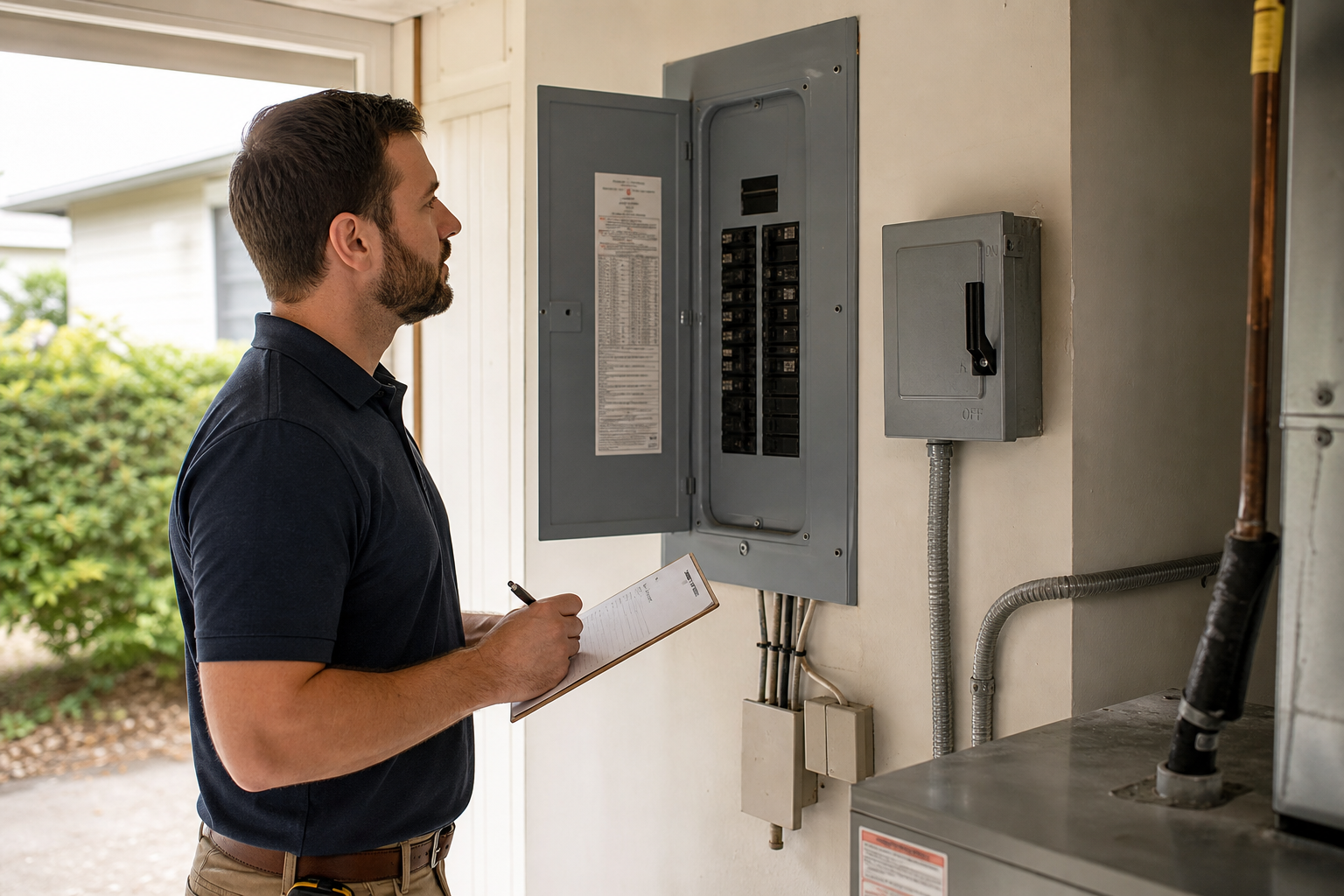
At a minimum, review the equipment electrical data, existing breaker size, wire size when visible, disconnect condition, whip condition, service access, panel labeling, open breaker spaces, and any obvious signs of previous modifications or nonstandard wiring.
Look closely at whether the new equipment changes the electrical demand compared with the existing system.
A like-for-like changeout may still need electrical corrections if the current installation is worn, undersized, poorly protected, or simply not suitable for the new match-up.
Heat pump conversions deserve even more attention.
Moving from a straight cool system with gas heat to a heat pump with electric backup can change branch circuit requirements, accessory wiring, control needs, and panel capacity considerations.
You should also inspect the location where the new system will be installed.
Is the disconnect readily accessible?
Is the conduit exposed to weather and deteriorated?
Will line-voltage routing need to change because of equipment orientation or pad relocation?
Is there visible corrosion that suggests the connection hardware should not be reused?
Inside, check accessories and related devices that may affect scope.
Air handlers, strip heat kits, condensate pumps, UV devices, dampers, or communicating controls can all affect wiring needs and labor time.
None of this means your sales staff must become electricians.
It means they need enough training to identify red flags, document them clearly, and bring in the right licensed trade partner when local requirements call for it.
Local code, permitting, and licensing rules vary, so avoid assumptions and confirm the process in each jurisdiction you serve.
- Photograph the panel, breaker, disconnect, and existing equipment connections.
- Record model and nameplate electrical requirements for old and proposed equipment.
- Note visible wire condition, whip age, conduit type, and disconnect accessibility.
- Check whether panel space appears limited or labeling is unclear.
- Flag heat pump conversions and electric heat applications for deeper review.
- Confirm whether electrical permit or licensed electrical subcontracting may be required locally.
- Document what is visible and what will need field verification on install day.
How do you separate required electrical work from recommended upgrades?
This is one of the most important parts of preserving the sale.
Homeowners can accept added cost more easily when they understand which items are necessary for the replacement to proceed and which items are advisable but optional.
Many proposals fail because everything gets lumped together under “electrical.”
Instead, break the scope into clear categories.
Required electrical work includes items necessary to connect and operate the new system safely and appropriately based on the equipment and job conditions.
That may include replacing a failed or unsuitable disconnect, correcting obviously deteriorated whip or conduit, providing the correct breaker and circuit arrangement for the selected equipment, or coordinating service modifications if the existing setup cannot support the installation.
Recommended electrical work includes items that improve reliability, serviceability, or future readiness but are not always mandatory to complete the changeout.
Examples may include tidying exposed low-voltage wiring, replacing older but still functioning accessories, improving labeling, or addressing nearby conditions that are not directly part of the HVAC connection.
The key is honesty.
If everything is presented as essential, customers may feel pressured.
If truly essential items are framed as optional, you risk field conflict later when the installation team cannot proceed without them.
A good proposal often uses language like required to complete installation, recommended for reliability, and excluded pending electrician review.
That simple structure makes the decision process easier.
It also protects your company from the common problem of a salesperson verbally minimizing electrical needs just to keep the quote moving.
If a licensed electrician must confirm part of the scope, say that plainly.
It is better to present a defined allowance or conditional line item than to pretend the cost is known when it is not.
How should pricing be structured so the homeowner does not feel blindsided?
When contractors ask how to price electrical upgrades on replacement jobs without losing the sale, they are usually asking a sales question and a production question at the same time.
The sales question is how to present the added cost.
The production question is how to avoid underpricing uncertain scope.
The cleanest answer is to use layered pricing.
First, show the base HVAC replacement scope clearly.
Then show required electrical scope as its own section with specific descriptions.
Then show recommended or conditional items separately.
This protects transparency.
It also reduces the chance that the customer compares your total against a competitor who quietly left out necessary electrical work and appears cheaper for the wrong reason.
A strong estimate does not say “electrical modifications as needed.”
That sounds open-ended and invites mistrust.
Instead, use plain descriptions such as replace existing outdoor disconnect, provide new properly sized breaker for selected equipment, replace deteriorated whip and fittings, or coordinate panel evaluation by licensed electrician due to limited capacity.
If there is uncertainty, note the trigger.
For example, you might state that final panel upgrade pricing is subject to electrician confirmation after inspection because available capacity or service condition cannot be fully verified at the time of the estimate.
That approach is far better than absorbing unknown risk into a flat number and hoping the field conditions cooperate.
Many contractors also benefit from building standard electrical pricing templates for common replacement scenarios.
That can include a menu for disconnect replacement, whip and conduit replacement, breaker changes, low-voltage protection updates, heat kit wiring coordination, or electrician dispatch for panel review.
Templates improve estimating consistency, but they should not replace judgment.
Every job still needs scope confirmation.
You can also reduce sticker shock by framing the upgrade in context.
Do not say, “This adds more cost because the electrical is old.”
Say, “The new system can only be installed properly if the power supply components serving it are in suitable condition, and we separate that work on the proposal so you can see exactly what is driving the price.”
That language sounds organized rather than defensive.
How can you explain electrical scope without sounding alarmist or pushy?
Homeowners tend to resist surprises, but they also resist fear-based selling.
If your team overdramatizes every panel concern or disconnect issue, trust will disappear quickly.
What works better is calm specificity.
Show the customer what you found.
Use photos from the estimate.
Point to the actual disconnect, breaker, wire condition, or panel space issue.
Explain how it relates to the equipment they selected.
Then explain what your company can include, what may require an electrical trade partner, and what local requirements may affect final scope.
Keep the wording practical.
You are not there to lecture the customer on code theory.
You are there to explain why the installation cannot be treated as only a box swap.
A few communication habits help a lot.
- Lead with what was observed, not with a dramatic conclusion.
- Connect the issue directly to the replacement scope.
- Use pictures whenever possible.
- Separate safety, equipment compatibility, and workmanship reasons clearly.
- Avoid absolute statements when field verification or local review is still pending.
- Never promise that an electrical issue can be ignored just to save the sale.
For example, instead of saying, “Your panel is a mess and it all has to be redone,” say, “Based on what we can see today, the panel may need review before we connect this new system, because available capacity and final circuit requirements need to match the equipment being installed.”
That phrasing is factual and measured.
Likewise, instead of saying, “You have to buy this upgrade,” say, “This item is included because it is part of completing the installation properly for the selected system.”
The difference is subtle, but homeowners feel it.
Customers are more likely to accept electrical upgrade pricing when they see that your company is trying to define the job correctly, not expand the ticket opportunistically.
How do you coordinate with electricians without giving away margin?
If your company self-performs limited electrical tasks within the scope allowed locally, you still need a process for the jobs that exceed that boundary.
And if you regularly partner with licensed electricians, the quality of that relationship affects your close rate more than many contractors realize.
The biggest pricing problems usually come from one of three issues.
The electrician is brought in too late.
The scope is described too vaguely.
Or the HVAC company treats electrical as a pass-through cost instead of a managed part of the project.
To protect margin, create a standard handoff package for electrical review.
Include jobsite photos, equipment selections, nameplate data, visible panel information, site access notes, and a short written summary of what your estimator observed.
The more complete your handoff, the more accurate and faster the electrician can be.
That helps you present a cleaner quote to the homeowner.
You should also decide internally how your company handles electrical pricing.
Some contractors use flat-rate upgrade options for common scopes.
Others use electrician quotes plus internal project management and coordination markup.
Either way, your price needs to reflect more than subcontractor cost.
You are managing scheduling, customer communication, responsibility handoff, installation coordination, and often permit sequencing.
That work has value.
The mistake is when contractors feel guilty charging for coordination and then absorb avoidable overhead themselves.
Another useful practice is to predefine decision thresholds.
For example, if visible conditions suggest a basic disconnect and whip replacement, your estimator may price that immediately from a standard menu.
If the panel appears full, mismatched, damaged, or unclear, the estimator flags electrician review before finalizing the proposal.
This keeps your process efficient while reducing guesswork.
Just as important, do not let install crews become the first people to discover major electrical scope.
That is when the sale is most likely to unravel.
The customer feels ambushed, the crew loses time, and your office has to renegotiate under pressure.
Good coordination turns electrical work from a surprise into a planned part of the project.
What should be included in the estimate and sales process to reduce objections?
Your estimate should help the homeowner understand the project at a glance.
That means the document must do more than list equipment and price.
For replacement jobs with electrical scope, include a short summary of findings, a breakdown of required and recommended work, exclusions or allowances where appropriate, and language explaining that local requirements vary.
It also helps to include a short note about who will perform the work.
If your company will coordinate with a licensed electrician where required, state that directly.
If the price assumes no hidden conditions beyond what was visible at the time of inspection, say that too.
Clarity reduces conflict.
Your sales presentation should follow the same structure every time.
Start with the system recommendation.
Then review the supporting scope such as refrigerant line set, drain, pad, controls, duct transitions, and electrical items.
When electrical comes up in sequence as part of the installation plan, it feels normal.
When it appears abruptly at the end as an extra charge, it feels suspicious.
You can also improve conversion by giving the homeowner a decision path.
For example, if electrical review is still pending, explain the next step clearly.
Tell them whether the proposal includes an allowance, whether an electrician must inspect before final approval, and whether scheduling depends on that confirmation.
That keeps momentum in the sale without pretending uncertainty does not exist.
Internally, train your sales team to avoid a few common mistakes.
- Do not refer to electrical scope as miscellaneous.
- Do not promise that the install crew will sort it out on site.
- Do not remove required electrical items just to lower the quote total.
- Do not compare your company to competitors by accusing them of cutting corners.
- Do explain what was observed, what is included, and what could change after licensed review if local requirements call for it.
One more practical point: document homeowner decisions.
If a customer declines recommended but nonessential electrical improvements, note that in writing.
If a conditional item remains pending electrician confirmation, note that too.
Documentation keeps your office, install team, and customer aligned.
That alignment is often what prevents a manageable issue from becoming a sale-losing problem.
Frequently Asked Questions
Should electrical upgrades be bundled into the equipment price?
Usually no. Separating electrical scope from the base HVAC replacement price improves transparency and helps homeowners see what work is tied directly to the system versus what is being added for electrical reasons.
What if the exact electrical scope is unclear at the estimate?
Be direct about it. Use an allowance, conditional line item, or electrician review step rather than pretending the scope is fully known. Homeowners generally accept uncertainty better when it is explained early and specifically.
How do I compete with lower quotes that leave electrical work out?
Show the customer exactly what your proposal includes and why. A lower quote may not reflect the full installation scope. Your job is to make the difference visible without turning the conversation into an attack on competitors.
Can salespeople identify electrical issues without being electricians?
Yes, if they are trained to spot common red flags, gather good documentation, and escalate correctly. They do not need to diagnose beyond their role, but they do need a repeatable process for identifying concerns that affect pricing and installation planning.
What is the biggest mistake contractors make with electrical upgrades on replacement jobs?
The biggest mistake is waiting too long to define the issue. When required electrical work first appears on install day, you risk delays, customer frustration, reduced margin, and a damaged close rate on future referrals.
Final Thoughts
Electrical upgrades do not have to kill HVAC replacement sales.
In many cases, they only become a problem when the contractor discovers them late, explains them poorly, or prices them vaguely.
If you inspect consistently, document clearly, separate required work from recommended work, and present the scope in an organized way, homeowners are much more likely to see the upgrade as part of a properly planned installation rather than a last-minute upcharge.
For your company, that means fewer uncomfortable proposal conversations, fewer install-day surprises, and better protection of gross margin.
The winning approach is simple.
Find the issue early.
Define it clearly.
Price it honestly.
And communicate it with the same professionalism you bring to equipment sizing, installation quality, and startup.
Join the HVAC Installer Network
Create an installer listing to help homeowners discover your business, learn about your services, view your company information, and connect with you about installation opportunities in your service area.
This article is for general informational purposes only. Electrical scope, permitting, licensing, inspection, and installation requirements vary by location and project conditions. Contractors should verify local requirements and coordinate with qualified licensed professionals as needed before finalizing scope or performing work.