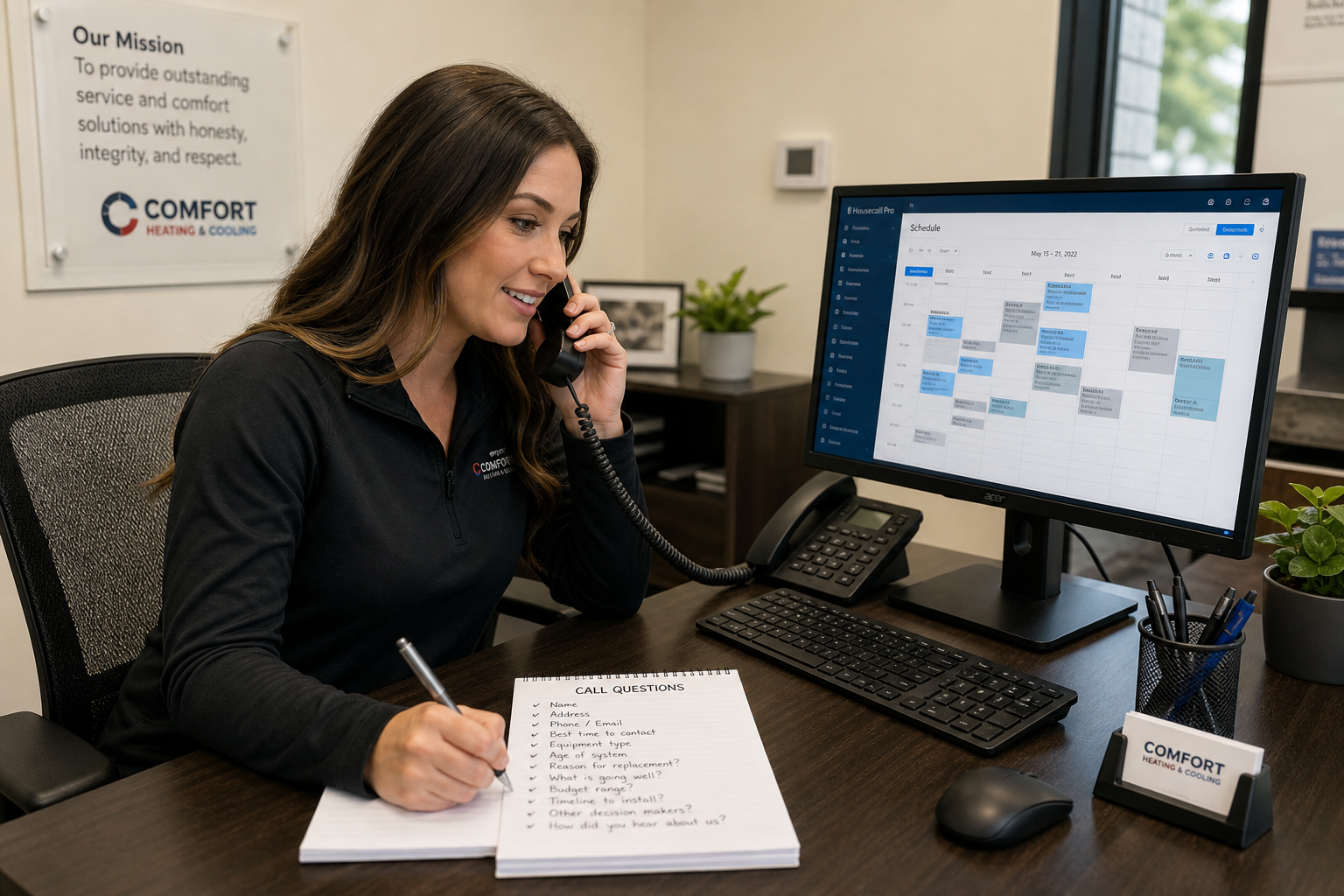
How HVAC Contractors Can Pre-Qualify Replacement Leads on the Phone to Improve Close Rates and Reduce Wasted Estimates
A practical phone process for screening replacement opportunities, setting expectations, and booking better sales appointments without sounding rigid or scripted.
For many HVAC contractors, the real sales process starts long before the comfort advisor reaches the driveway. It starts on the first phone call.
When replacement leads are booked with little or no screening, the sales calendar fills up with weak opportunities, price shoppers, duplicate decision-makers who are not available, homes outside the service area, and situations that were actually repair calls from the beginning. That costs time, fuel, morale, and closing percentage.
Strong HVAC replacement lead pre-qualification does not mean interrogating callers or trying to sell over the phone. It means gathering enough information to decide whether the prospect is a good fit, whether the appointment should be a repair visit or a sales consultation, and what expectations need to be set before anyone is dispatched.
The best pre-qualification process is simple, repeatable, and easy for office staff to follow under pressure. It helps your team book more qualified estimates, improve show rates, reduce wasted site visits, and create a smoother homeowner experience from the first contact.
Pre-qualification works best when the goal is clarity, not pressure. A short, well-run call can protect your schedule, help the homeowner feel understood, and put your sales team in front of better opportunities.
Why pre-qualification matters before the estimate is booked
Contractors often treat estimate volume like a pure numbers game. More appointments should mean more sales. In practice, that only works if the appointments are reasonably qualified.
If your team is visiting homes where the customer only wants a free second opinion on a recent repair diagnosis, is three years away from making a decision, has not spoken with the spouse or co-owner, or is calling companies far outside your service model, your salespeople are spending prime hours on low-probability calls.
A phone screening process helps separate three very different situations.
- A homeowner with a near-term replacement need who is ready for an estimate.
- A homeowner with a service problem who first needs diagnostics or a repair conversation.
- A homeowner who is still in early research mode and may need education before an in-home sales visit makes sense.
That distinction matters because each lead type requires a different next step. Sending a comfort advisor to what should have been a service call usually creates frustration for both sides. Sending a technician to a homeowner who is clearly ready to replace can slow down the sales cycle and create unnecessary back-and-forth.
Phone pre-qualification also improves the quality of the estimate itself. When your team already knows the home size range, equipment type, age, comfort complaints, and who will be present for the appointment, the advisor can prepare appropriately. That leads to better conversations and fewer surprises.
What your office should learn on every replacement inquiry
Your office does not need to perform a full technical evaluation on the phone. It does need a consistent set of questions that uncover fit, urgency, and sales readiness.
At minimum, most contractors should collect the following information on every replacement inquiry.
- Caller name, property address, best phone number, and email address.
- Whether the caller is the homeowner or an authorized decision-maker.
- Whether the property is owner-occupied, tenant-occupied, vacant, or a sale transaction.
- Type of system currently in the home, if known, such as furnace and AC, heat pump, package unit, boiler, or ductless system.
- Approximate age of the equipment, if known.
- Main reason for calling, such as repeated repairs, system breakdown, high utility concerns, comfort issues, remodel plans, or proactive replacement.
- Whether the system is currently operating at all.
- Whether the lead expects repair options, replacement options, or wants guidance on both.
- Ideal timing for the project.
- Whether all decision-makers can be present for the appointment.
- How the customer heard about your company.
Some contractors also ask for home square footage, number of systems, recent renovations, or whether ductwork issues are suspected. Those can be helpful, but they should come after the core qualification questions. If the call becomes too long too early, your staff may lose control of it.
The most important point is consistency. If one CSR asks great questions while another simply books any caller requesting a quote, your estimate pipeline becomes unpredictable. A documented intake standard gives your team a reliable baseline.
How to structure the phone call without sounding scripted
Most homeowners do not mind being asked a few smart questions if the reason is explained clearly. Problems start when the CSR sounds robotic, dismissive, or overly defensive about pricing before understanding the situation.
A practical call structure is simple.
Start by acknowledging the reason for the call and getting permission to ask a few questions.
You might say that you would be happy to help and that a couple of quick questions will make sure you schedule the right type of visit.
Next, identify the trigger. Ask what is happening with the current system. Are they without cooling or heating right now, dealing with recurring repairs, planning ahead because the equipment is older, or comparing options after another contractor made a recommendation?
Then clarify whether the homeowner is looking for a diagnostic service appointment or a replacement consultation. Some callers say they need a new system simply because their unit is not working today. Others have already decided they do not want to keep repairing old equipment. Your staff should not assume either one.
After that, move into readiness questions. Ask when they hope to make a decision, whether anyone else needs to be involved, and whether there are any access or scheduling limitations at the property.
Finally, set the next step in plain language. If it is a strong replacement lead, explain what your consultation includes and who should be present. If it sounds more like a service issue, explain why a diagnostic visit is the appropriate first step.
The tone matters as much as the content. Good CSRs sound helpful, confident, and calm. They do not debate equipment sizing, promise exact pricing, or try to force the caller into a sales track that does not fit the situation.
When a lead is not really a replacement lead
One of the biggest reasons contractors waste estimates is mislabeling the call type.
A homeowner may say, “I need a quote for a new AC,” but the underlying situation could mean several different things. They may have one room that is warm and assume the whole system needs replacement. They may have been told by another company that the system is old and want confirmation. They may be trying to avoid paying for a service call. Or they may truly be ready to replace immediately.
Your office should listen for clues that the lead needs diagnosis before sales.
- The customer cannot describe any reason for replacement beyond one sudden breakdown.
- The system age is unknown and there has been no prior repair history discussed.
- The homeowner is mainly asking what it costs before sharing any home or equipment details.
- The comfort complaint points to airflow, duct, thermostat, zoning, or insulation issues rather than clearly failed equipment.
- The customer says another company quoted a repair but they want a free estimate instead.
That does not mean the customer is a bad lead. It means the first appointment should match the actual problem.
Many contractors handle this by giving callers two legitimate paths. One path is a diagnostic service visit if the system problem still needs to be identified. The other is a replacement consultation if the homeowner has already decided they want options for new equipment. Framing it this way feels professional rather than adversarial.
It also protects your advisors from walking into homes where the prospect expected a technician and is immediately skeptical of a sales conversation.
How to set expectations that improve close rates
Many close-rate problems start as expectation problems.
If the homeowner thinks the appointment will produce a quick ballpark price in ten minutes, but your process requires a full home evaluation and a decision-maker meeting, there will be friction. If the homeowner expects you to quote over the phone without seeing the system, they may feel guarded before the visit even begins.
Strong pre-qualification includes expectation setting on four fronts.
First, explain what will happen during the appointment. Let the homeowner know whether the visit includes system inspection, load considerations, comfort discussion, equipment options, and proposal review. Keep it simple, but make it clear that a meaningful recommendation requires seeing the home.
Second, explain who should be there. If your company policy is that all owners or decision-makers should attend, say so respectfully and early. This is one of the easiest ways to reduce stalled proposals and repeated return visits.
Third, set timing expectations. Tell the homeowner approximately how long the appointment usually takes. That helps avoid rushed meetings where the customer is trying to leave in fifteen minutes and cannot focus on the conversation.
Fourth, explain limitations honestly. Do not promise exact pricing, installation timing, accessory compatibility, or code-related details over the phone when those items depend on field conditions. Local requirements vary, and some installation details cannot be confirmed until the home and existing system are evaluated.
Expectation setting should feel like preparation, not resistance. Homeowners generally respond well when they understand that your process is designed to give them accurate options instead of a guess.
What information to pass to the comfort advisor
Pre-qualification only helps if the information collected actually reaches the field in usable form.
Too often, the office gathers details that never make it into the advisor’s notes. Then the advisor starts from scratch, asks the same questions again, and loses the advantage the call should have created.
Your handoff should include the homeowner’s stated problem in their own words, not just a generic label like “estimate for replacement.” That distinction matters. “System runs but never cools the back bedrooms” leads to a different conversation than “compressor failed and customer wants to replace instead of repair.”
A good handoff note usually includes:
- Current equipment type and approximate age if known.
- Primary pain point or trigger event.
- Whether the system is working now.
- Urgency and desired installation timeline.
- Who will be present at the appointment.
- Any competing quote context the homeowner volunteered.
- Property access notes, pets, gate codes, or occupancy details.
- Any signs the customer may need repair-versus-replace education.
This handoff allows the comfort advisor to prepare mentally and operationally. It can shape route planning, appointment length, financing conversation timing, and whether additional technical support may be needed. Even a few accurate notes can materially improve appointment quality.
Common pre-qualification mistakes to avoid
Contractors do not usually fail at pre-qualification because they ask too few questions. They fail because the process is inconsistent, poorly explained, or disconnected from how appointments are actually sold.
One common mistake is treating every incoming quote request as a high-priority replacement lead. That may keep the calendar full, but it often lowers net efficiency.
Another mistake is making CSRs responsible for technical judgments they are not trained to make. Office staff should gather facts, identify likely fit, and route the call properly. They do not need to diagnose compressors, size systems, or debate refrigerant issues with callers.
A third mistake is sounding defensive about price too early. If the first substantial part of the call becomes an argument about whether you can give a quote over the phone, the interaction often goes sideways. It is usually better to explain that system recommendations depend on the home, the equipment, and the installation conditions, then move back to useful discovery questions.
A fourth mistake is failing to require attendance from key decision-makers when your sales process depends on it. This is one of the simplest preventable causes of low close rates and delayed decisions.
A fifth mistake is not reviewing outcomes. If your team is pre-qualifying leads but you are not comparing appointment source, call notes, close rate, cancellation rate, and average sale quality, you cannot refine the process. Listening to recorded calls, when legally appropriate in your area, can also help managers coach tone and consistency. Local rules on call recording and disclosure vary, so follow the requirements that apply in your market.
Finally, avoid making the process feel like a gatekeeping exercise. The point is not to weed people out aggressively. The point is to direct each lead to the most appropriate next step and make sure your team spends in-home sales time where it has the best chance to help and close.
If a lead cannot answer every question, that does not automatically make it unqualified. What matters is whether your team learned enough to choose the right appointment type and set clear expectations before dispatch.
A simple phone framework your team can use today
If your current intake process is loose or inconsistent, start with a short framework your CSRs can learn quickly.
- Thank the caller and confirm the property address and contact details.
- Ask what prompted the call today.
- Ask whether the system is still operating and whether they are seeking repair, replacement, or guidance on both.
- Ask about system type and approximate age if known.
- Ask when they hope to make a decision.
- Ask whether all decision-makers can be present.
- Explain the appropriate next step and what the appointment includes.
- Confirm date, time window, and any preparation items.
That framework is short enough to be practical and strong enough to improve lead quality immediately. Once your team is comfortable with it, you can add more nuance for special cases such as landlords, remodels, real estate transactions, and second-opinion requests.
- Write the intake questions in the order your team should ask them.
- Give CSRs approved language for explaining why they cannot quote accurately by phone.
- Create clear rules for when to book service, when to book sales, and when to escalate to a manager.
- Require notes that reflect the homeowner’s actual concern, not just the appointment type.
- Review booked estimate outcomes regularly and coach from real examples.
Frequently asked questions
How many questions should a CSR ask on a replacement lead call?
Enough to determine fit, urgency, and the correct appointment type, but not so many that the call feels burdensome. In many cases, a focused five- to eight-minute conversation is enough to gather the essentials.
Should HVAC contractors give replacement pricing over the phone?
Most contractors are better served by avoiding exact pricing over the phone unless the offering is highly standardized and the installation conditions are already well understood. Home layout, equipment match, duct considerations, electrical details, and local requirements can all affect the final recommendation, and local requirements vary.
What if the homeowner refuses to have all decision-makers present?
Your company should have a clear policy. Some contractors will still book the visit but note a lower probability of immediate progress. Others require all decision-makers for a replacement consultation. The key is to explain the reason respectfully so the homeowner understands it is about giving complete answers and avoiding repeat visits.
How can contractors tell whether a replacement lead is really a service call?
Listen for single-symptom breakdown language, uncertainty about equipment age or condition, and requests that focus on avoiding diagnostic charges rather than replacing the system. When the issue is unclear, offering a service-first path is often the cleaner solution.
Who should own the pre-qualification process?
Usually the office manager, sales manager, or service manager should define the process, but CSRs or dispatch staff often execute it day to day. Ownership matters because scripts, training, and call review need ongoing maintenance to stay effective.
Final thoughts
Better HVAC replacement lead pre-qualification is not about making it harder for homeowners to get help. It is about making sure the right person goes to the right home for the right reason.
When contractors tighten up the first phone call, they usually see improvements in several places at once. The sales calendar becomes healthier, advisors spend more time with serious prospects, homeowners get clearer next steps, and the company wastes less energy on appointments that were mismatched from the start.
If your team struggles with low close rates, weak estimate quality, or too many unproductive quote requests, do not start by blaming the field. Start by reviewing what happens when the phone rings. A better intake process can quietly fix a surprising number of downstream sales problems.
Join the HVAC Installer Network
Create an installer listing to help homeowners discover your business, learn about your services, view your company information, and connect with you about installation opportunities in your service area.
This article is for general informational purposes only and is not legal, financial, tax, code, licensing, or safety advice. Contractor workflows, call handling practices, permitting steps, and installation requirements vary by company and market. Local requirements vary, so verify applicable rules, disclosures, and operational policies in your area before implementing process changes.