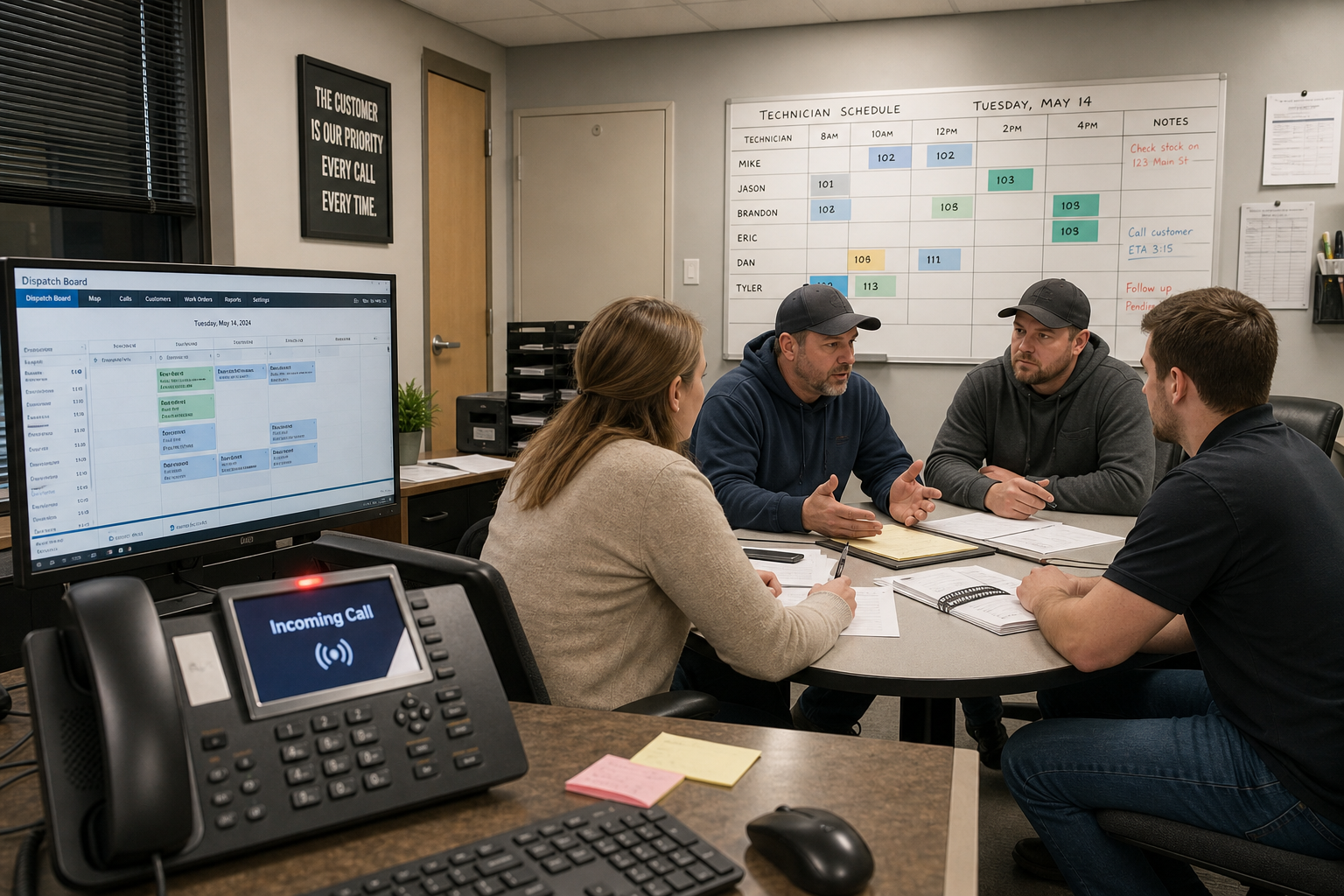
How HVAC Contractors Can Create a Missed-Call and After-Hours Response Process That Recovers More Leads
A practical playbook for turning unanswered calls into scheduled opportunities instead of lost revenue.
For many HVAC contractors, lead generation gets plenty of attention while call recovery gets almost none. The company spends money on trucks, wrap designs, SEO, reviews, yard signs, referral programs, and paid ads, but when a homeowner calls after hours or during a busy stretch and no one picks up, that lead can disappear in minutes. In a trade where timing matters, the first company that responds often earns the opportunity.
A missed-call and after-hours response process does not have to be complicated. In fact, the best systems are usually simple, documented, and easy for office staff and technicians to follow. The goal is not to create a giant call-center operation. The goal is to make sure every inbound call has a clear next step, whether it comes in at 10:00 a.m., during lunch, while your CSR is helping another customer, or late in the evening when the office is closed.
This article breaks down how HVAC contractors can build a practical process that recovers more leads, reduces response delays, and gives homeowners a better experience from the first touch. It is written for real-world operations, including small teams where one person may handle phones, dispatch, scheduling, and customer questions all at once.
If your company is spending money to make the phone ring, every unanswered call should be treated like a process issue, not just a busy moment. The goal is not perfection. The goal is a repeatable recovery system that gives every lead a fast and professional next step.
Why do missed calls matter so much for HVAC contractors?
HVAC buyers rarely call with unlimited patience. Some are dealing with no cooling, no heat, water near equipment, a real estate deadline, or a quote request they want handled quickly. If they reach voicemail and hear nothing back for an hour or two, many will simply move on to the next company. That means the missed call is not just a communications problem. It is a lead-loss problem.
Missed calls also create hidden inefficiencies. Office staff may spend the next day sorting through voicemails, trying to figure out who still needs help, or calling back leads that have already booked with someone else. Technicians may get interrupted with direct calls because customers do not trust that the office will respond. Management may think lead volume is soft when the real issue is response consistency.
Contractors who build a better recovery process often improve more than booking rates. They also improve perceived professionalism, customer confidence, scheduling control, and internal accountability. A homeowner does not need a perfect system. They just need to feel that someone heard them and that the company has a plan.
Where do HVAC leads usually fall through the cracks?
Most missed leads do not happen because a contractor does not care. They happen because the company has not mapped all the moments when calls can be dropped, delayed, or mishandled. Once those moments are visible, they become easier to fix.
Common failure points include a single CSR covering too many tasks, long hold times during peak call periods, phones forwarding to a generic voicemail with no clear next step, technicians receiving customer calls while driving, no text follow-up after a missed call, and no morning process for overnight messages. Another common issue is that nobody owns the callback queue, so everyone assumes someone else handled it.
Seasonality makes this worse. During the first hot week, first cold snap, or a weather event, call volume can spike quickly. A process that feels good on a normal Tuesday can collapse under pressure if it depends on one person remembering what to do.
- Review what happens when the main line rings and no one answers within the first few rings.
- Check where calls go during lunch breaks, training meetings, and dispatch rushes.
- Audit your voicemail greeting to see whether it sounds helpful, current, and action-oriented.
- Confirm whether after-hours callers can request service without waiting until the next business day.
- Look at how overnight messages are assigned, prioritized, and documented each morning.
- Make sure web leads and text inquiries are included in the same response mindset.
What does a good missed-call and after-hours process actually look like?
A strong process has a few basic characteristics. First, it is fast. Second, it is consistent. Third, it tells the customer what to expect next. Fourth, it assigns responsibility internally. And fifth, it is simple enough that your team will actually use it on busy days.
At a minimum, the process should define what happens when a call is missed during business hours, what happens when a call comes in after hours, how urgent situations are separated from routine quote requests, who is responsible for callbacks, and what timeframe the company is targeting for response. Your exact setup may depend on staff size, service area, and whether you offer emergency service. Local requirements vary, so make sure your process and messaging align with your actual service commitments.
Good systems also avoid making promises the team cannot keep. If your company does not offer 24/7 emergency service, do not imply that every overnight caller will receive immediate dispatch. It is better to be clear and dependable than vague and disappointing.
How should contractors handle missed calls during business hours?
Business-hours missed calls should have a structured recovery path, not a casual callback whenever someone has time. The easiest approach is to create a short workflow that begins the moment a call is missed and ends when the lead is contacted, documented, and either booked or closed out.
Start with call routing. If a live answer is not available, the next best outcome is a controlled handoff. That could mean a backup ring group, a receptionist overflow path, a remote answering solution, or a monitored voicemail box combined with automatic text acknowledgment. The point is to avoid dead air and uncertainty.
Then define your callback sequence. For example, when a business-hours call is missed, the lead should receive a prompt text that confirms the company saw the call and invites a reply. A team member should then return the call as soon as possible. If there is no answer, leave a short voicemail and log the result. If the lead still has not responded, send a second follow-up later the same day if appropriate.
What matters most is that every missed call enters a visible queue. If callbacks only live in one person’s memory, recovery rates will remain inconsistent.
- Create a single callback queue inside your phone system, CRM, dispatch platform, or shared office process.
- Assign one role per shift to own the queue, even if others can help clear it.
- Use a text acknowledgment for missed calls when possible.
- Require notes on each callback attempt, including time, outcome, and next step.
- Separate no-heat, no-cool, water, and safety-related concerns from routine estimates and general questions.
- Review open missed-call items before lunch, before closing, and first thing the next morning.
Even a small team can do this well. The key is discipline, not size.
What should an after-hours and weekend response workflow include?
After-hours calls need a different path because the office is not fully staffed and the company may not want every inbound request to reach the on-call technician directly. A useful process protects technicians from avoidable interruptions while still giving customers a clear route to help.
Begin with a well-written after-hours greeting. It should identify the company, explain whether emergency service is available, tell callers how to leave the necessary information, and set expectations for routine calls that will be returned on the next business day. If your company uses an answering service, make sure the script reflects your real service area, equipment types, and scheduling rules.
Next, define escalation criteria. Which calls should be sent to the on-call technician or manager right away? Which should be logged for morning follow-up? The exact categories depend on your business model, but the distinction should be written down. Without written criteria, every after-hours handoff becomes subjective.
Finally, create a morning recovery routine. Overnight leads should be reviewed early, prioritized, and assigned before the day gets crowded. The first office hour often determines whether those callers stay in your pipeline or book with another contractor.
A practical after-hours process might look like this: the caller hears a clear greeting, leaves a message or reaches an answering service, urgent issues are flagged based on company rules, a text confirmation is sent if your system supports it, all overnight contacts go into a morning callback list, and one person is responsible for reviewing and assigning that list at opening.
What should contractors say in voicemail, text, and callback follow-up?
Many companies lose leads not because they failed to respond, but because the response sounded generic, slow, or uncertain. The message should be brief, human, and action-focused.
Your voicemail greeting should sound current and intentional. Avoid long recordings full of menu clutter. A simple message usually works better: thank the caller, identify the company, explain the fastest way to get help, and set expectations. If emergency service availability is limited, say so clearly.
Text acknowledgments can be especially helpful for missed calls because many homeowners are more likely to reply to a text than answer an unknown callback number. Keep the wording polite and easy to respond to.
Here are examples contractors can adapt to fit their own operations:
- Missed-call text: Hi, this is [Company Name]. Sorry we missed your call. How can we help with your heating or cooling issue today?
- After-hours routine text: Thanks for contacting [Company Name]. We received your message and will follow up during business hours. If this is an urgent service need and your company offers emergency service, follow your local process and company guidelines.
- Callback voicemail: Hi, this is [Name] with [Company Name] returning your call. Please call us back at [number], or reply to our text if that is easier. We would be glad to help.
- Morning follow-up text: Good morning, this is [Company Name] following up on your message from last night. If you still need service or an estimate, reply here or call us and we can help with the next step.
The exact wording matters less than the tone. Sound available, organized, and easy to work with. Avoid jargon and avoid asking the customer to repeat the same information multiple times if your team already has it documented.
Who should own the process, and how do you train the team to follow it?
Every effective missed-call system has an owner. That does not mean one person does all the work. It means one role is accountable for making sure the process happens. In a small company, that may be the office manager, dispatcher, or lead CSR. In a larger operation, it may be a customer experience lead or service manager.
Ownership should cover documentation, queue review, staff expectations, script updates, and exception handling. If callback performance slips, that owner should be able to identify why. Was call volume too high? Did the after-hours service fail to tag urgent messages correctly? Did technicians get calls that should have stayed with the office? Ownership turns a vague issue into a manageable operational task.
Training should include more than reading a script once. Walk the team through common call types, role-play missed-call recovery, define what counts as urgent, and explain how notes should be entered. Show the team what a good callback sounds like. Also show what not to do, such as calling back without introducing the company, sounding rushed, or leaving vague voicemails with no clear next step.
Do not forget technicians. Even if they are not primary call handlers, they should understand the process so they know where to direct customers and what to do when someone contacts them directly after hours. The cleaner the handoff between field and office, the fewer leads get stuck.
How can contractors tell whether the process is actually recovering more leads?
If you do not measure the process, it will be hard to improve it. You do not need a complicated analytics stack to start. Begin with a few operational numbers your team can review consistently.
Track how many inbound calls were missed, how many received a same-day callback or text response, how many produced a conversation, and how many became scheduled appointments. It is also helpful to separate business-hours missed calls from after-hours missed calls so you can see where breakdowns are happening.
Listen for patterns in lost opportunities. Are routine estimate requests getting delayed until the next day? Are after-hours callers hanging up because the voicemail is too long or unclear? Are office staff closing the queue without confirming an actual customer response? Small operational details can create large booking gaps over time.
You can also review a sample of recordings or notes each month. The purpose is not to criticize staff for every imperfect interaction. It is to tighten the process, improve consistency, and identify training opportunities.
A missed-call process is successful when it becomes boring in the best way: the team knows exactly what happens next, customers get timely follow-up, and fewer leads disappear because no one was available at the first ring.
- Total inbound calls versus missed calls
- Missed calls contacted within your target response window
- Booked appointments from missed-call recovery
- Booked appointments from after-hours inquiries
- Open callback items at end of day
- Common reasons leads were not recovered
When these numbers are visible, the process becomes easier to manage and improve.
Final thoughts
Most HVAC contractors do not need more complexity. They need more consistency. A missed-call and after-hours response process is one of the simplest operational improvements a company can make because it protects the leads you are already generating.
The best version is the one your team will actually follow on busy days. Keep it clear. Keep it documented. Give every missed call a next step. Define who owns the queue. Set realistic expectations in voicemail and text messaging. Review results often enough to catch problems before they become normal.
When contractors recover more unanswered calls, they often find that revenue growth was not only a marketing problem. In many cases, it was a response-process problem hiding in plain sight.
Frequently asked questions
Do small HVAC companies really need a formal missed-call process?
Yes. Smaller companies often need it even more because one busy person can unintentionally become the bottleneck. A simple documented process helps protect leads when the office is juggling phones, scheduling, and customer questions at the same time.
Should every after-hours call go to the on-call technician?
Usually not. Many contractors benefit from screening and prioritizing after-hours calls so technicians only receive contacts that match the company’s true emergency or urgent-service criteria. The exact rules depend on your business model and local operating practices.
Is text messaging worth using for missed-call recovery?
In many HVAC businesses, yes. A short text can reassure the customer that the company saw the call and is following up. It also gives the customer an easy way to reply if they cannot answer a callback. Make sure your messaging approach fits your systems and applicable local requirements.
What is the biggest mistake contractors make with missed calls?
One of the biggest mistakes is assuming callbacks will happen naturally without a documented owner or queue. When no one is clearly responsible, follow-up becomes inconsistent and leads are more likely to move on.
Join the HVAC Installer Network
Create an installer listing to help homeowners discover your business, learn about your services, view your company information, and connect with you about installation opportunities in your service area.
This article is provided for general informational purposes for HVAC contractors. Business practices, staffing models, communication tools, and service commitments vary by company and market. Local requirements vary, so contractors should review their own operational needs, phone system capabilities, and customer communication practices before implementing any process changes.