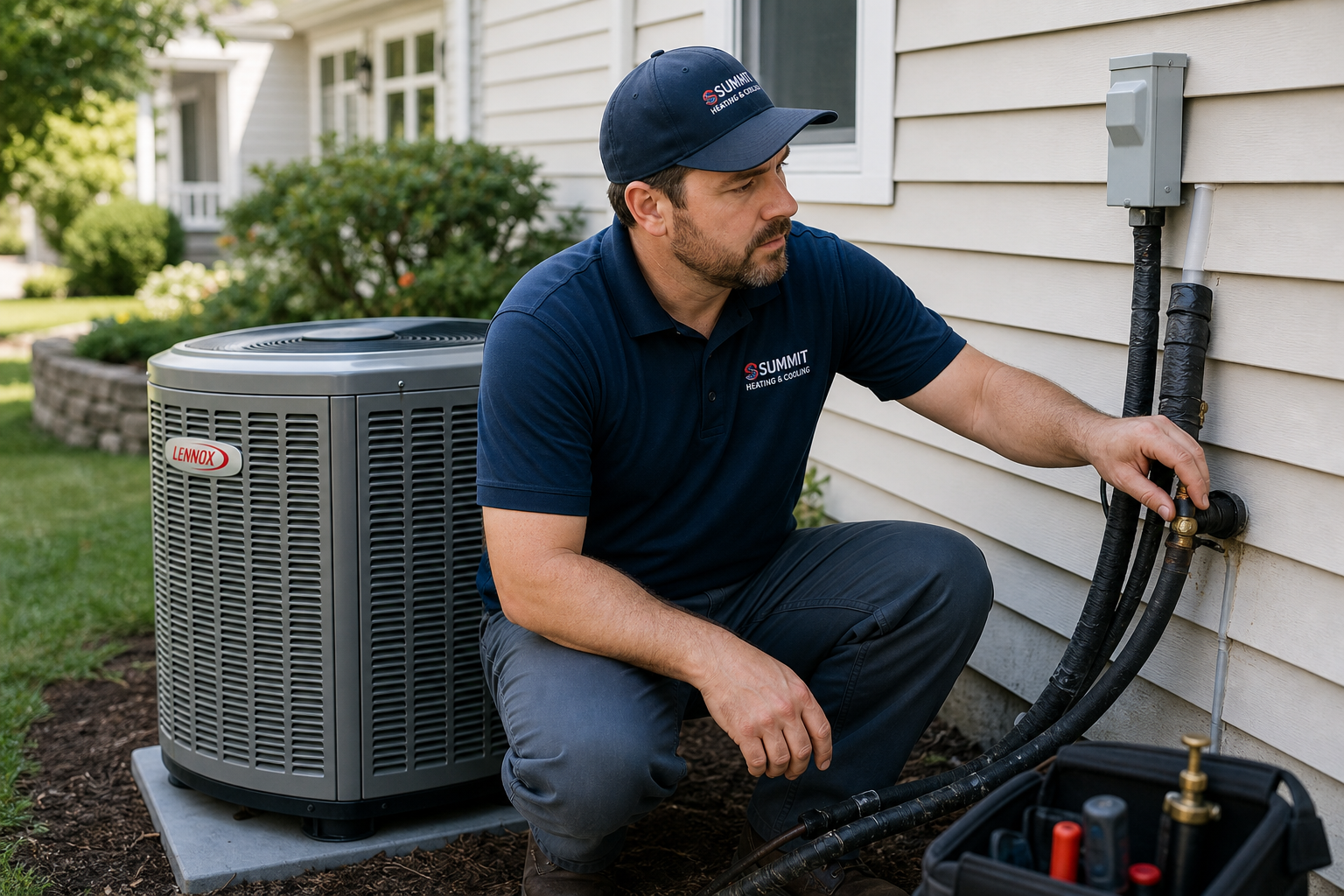
Should You Replace Refrigerant Lines During an AC or Heat Pump Changeout?
A practical guide to deciding when existing line sets can be reused, when replacement is the safer move, and how to avoid hidden problems during a new system installation.
If you are replacing an air conditioner or heat pump, most of your attention will naturally go to the indoor equipment, the outdoor unit, the thermostat, and the price. One part of the job that often gets far less attention is the refrigerant line set. These copper lines connect the indoor and outdoor equipment and carry refrigerant between them. They may be hidden in a wall, routed through an attic, or run along the outside of the home, so it is easy to assume they can simply stay in place.
Sometimes they can. Sometimes they should not.
Reusing refrigerant lines can save labor, reduce disruption, and avoid opening finished walls or ceilings. But if the existing lines are the wrong size, contaminated, damaged, kinked, poorly routed, or simply in questionable condition, leaving them in place can create performance issues, reliability problems, and installation shortcuts you may regret later.
The right answer depends on your home, your existing system, the new equipment being installed, and how accessible the line set is. This is not a place where a one-size-fits-all rule works well.
In this guide, you will learn what refrigerant lines do, when reuse may be reasonable, when replacement is usually the better choice, and what questions to ask your installer before the job begins.
Practical rule of thumb: if an installer recommends reusing existing refrigerant lines, ask why they are confident that reuse is appropriate for your specific system, not just easier for the job.
What are refrigerant lines and why do they matter?
A typical split HVAC system has two refrigerant lines connecting the indoor and outdoor sections. One is a larger insulated suction line, and the other is a smaller liquid line. Together, they allow the system to move heat where it needs to go.
Because these lines are part of a sealed refrigeration circuit, their condition matters more than many homeowners realize. If they are too small, too large, contaminated, leaking, crushed, or installed with poor practices, the new system may not operate the way it was designed to operate.
That can affect cooling or heating performance, efficiency, compressor life, noise, and serviceability. It can also complicate startup and make future diagnosis harder.
Think of the refrigerant lines as more than old copper tubing left over from the previous system. They are an active part of the new installation. A high-quality changeout is not just about setting a new outdoor unit on a pad and connecting whatever happens to be there.
That is why careful installers evaluate line size, length, condition, routing, insulation, fittings, and compatibility with the new equipment before deciding whether reuse makes sense.
When can existing refrigerant lines sometimes be reused?
There are situations where reusing existing refrigerant lines is reasonable. In fact, it may be the most practical option when the line set is difficult to access and it meets the requirements of the new system.
Reuse is more likely to be acceptable when the existing lines are the correct size for the new equipment, the lines are in good physical condition, there is no known leak history, and the installer can properly prepare and test the line set before startup.
It also helps when the previous system did not suffer a major compressor burnout or other contamination issue that could leave harmful residue inside the tubing.
In a straightforward replacement, an installer may inspect the exposed portions of the line set, verify sizing against the equipment specifications, confirm line length and elevation limits, and determine whether the lines can be cleaned and reused under the manufacturer’s installation requirements.
If the line set is concealed inside finished construction, replacing it may require opening walls or ceilings. In those cases, reuse may be the least disruptive approach, but only if the installer is confident it will not compromise the new system.
For homeowners, the key point is that reuse should be a technical decision supported by condition and compatibility, not just a convenience decision made to reduce labor.
- Existing line size matches the new system requirements.
- The copper lines are not visibly kinked, crushed, corroded, or damaged.
- There is no strong history of refrigerant leaks on the old system.
- The old system did not experience a severe burnout or contamination event.
- The installer plans to pressure test, evacuate, and commission the system properly.
- The line insulation can be replaced or upgraded if needed.
When should refrigerant lines usually be replaced?
Replacement is often the safer choice when there is any doubt about condition, sizing, cleanliness, or compatibility. While replacing a line set can add labor and sometimes require more invasive work, it may reduce the chance of early problems after the new equipment is installed.
One common reason for replacement is incorrect line sizing. Modern equipment may call for a different diameter than the previous system used. Even if the old system seemed to work, that does not automatically mean the existing line set is ideal for the new one. Manufacturers provide allowable sizes and lengths for a reason.
Another strong reason is physical damage. Kinks, flattened sections, excessive bends, rubbing points, poor support, outdoor deterioration, oil staining, and patch-style repairs can all be signs that the line set is not a great candidate for reuse.
Leak history is another concern. If the old system repeatedly needed refrigerant or had a suspected line set leak, installing a new system on those same lines can be risky. Even if the leak has not been fully confirmed, a questionable line set may not be worth betting a major equipment investment on.
Contamination is also a big factor. If the previous system suffered a compressor failure or burnout, the inside of the refrigerant circuit may contain acids, carbon, debris, or oil contamination. In some cases, installers may discuss specialized cleanup steps, but many homeowners will prefer replacement when practical rather than trying to salvage suspect tubing.
Poor routing can matter too. If the old line set has awkward bends, unsupported spans, excessive exposure, or installation details that make future service difficult, replacing it during the changeout may be the best time to correct those issues.
And finally, if the insulation on the suction line is missing, deteriorated, or insufficient, the installer may need to address that. Sometimes new insulation is enough. Other times, especially where the line is in rough shape overall, a complete replacement makes more sense.
If the refrigerant line set is hidden and hard to replace, homeowners sometimes feel pressured to reuse it. Difficulty of access is real, but it should not override basic concerns about size, leak history, or contamination.
How does refrigerant type affect the decision?
When homeowners ask about reusing refrigerant lines, they are often really asking about refrigerant compatibility. That concern is understandable, especially when replacing older equipment with a newer AC or heat pump.
Different systems may use different refrigerants and different oils. That does not always mean the line set must automatically be replaced, but it does mean the installer needs to account for what was previously in the lines and what the new equipment requires.
In some replacements, existing lines may be reused if they are properly sized, in good condition, and cleaned or prepared according to the equipment manufacturer’s guidance. In other situations, the installer may recommend replacement to avoid uncertainty or contamination concerns.
This is one area where homeowners should be cautious about blanket advice online. You may find one source saying refrigerant lines must always be replaced when changing refrigerant types and another saying flushing is always enough. Real-world jobs are rarely that simple.
The better approach is to ask the installer what refrigerant the old system used, what the new system uses, whether the existing lines meet the new equipment requirements, and what preparation steps are planned if the lines are being reused.
If local code rules, manufacturer instructions, or jobsite conditions affect that decision, the contractor should explain that clearly. Local requirements vary, and so do equipment specifications.
What should homeowners ask before approving reuse?
You do not need to become a refrigeration expert to make a smart decision. A few direct questions can tell you a lot about whether the recommendation is thoughtful or just routine.
Start by asking whether the existing refrigerant lines are the correct size and length for the new system. This should be answered based on the actual equipment being installed, not a guess.
Next, ask whether there are any signs of wear, damage, corrosion, oil staining, or previous repairs. If the lines are partly concealed, ask what portions can actually be inspected and what remains unknown behind walls or ceilings.
You should also ask whether the old system had any leak history or compressor problems. If it did, ask how that changes the recommendation.
If the lines will be reused, ask what preparation and verification steps are included. A careful installer should be able to describe pressure testing, evacuation, and commissioning steps in plain language.
Another useful question is whether replacing the lines now would meaningfully improve reliability or future service access. Sometimes an installer will say reuse is acceptable, but replacement would still be the better long-term solution if access and budget allow.
Finally, ask for the reuse-versus-replace recommendation in writing on the proposal or scope of work. That helps avoid confusion later about what was or was not included in the price.
- Are the existing refrigerant lines the correct size for the new equipment?
- Can you inspect the full line set, or are parts hidden?
- Do you see any damage, wear, corrosion, or leak indicators?
- Did the old system have a history of leaks or compressor failure?
- What cleaning, pressure testing, and evacuation steps are included if the lines are reused?
- Would you recommend replacement if this were your own home?
- Can the proposal clearly state whether the line set is being reused or replaced?
How should you think about cost versus risk?
Homeowners naturally want to control installation costs, and in some homes reusing the existing line set can be a sensible way to do that. If the lines are suitable and the installer follows good procedures, reuse may avoid unnecessary demolition and labor.
But the cheapest option on installation day is not always the least expensive option over the life of the system. If a questionable line set contributes to leaks, performance issues, or callbacks, the savings can disappear quickly.
A practical way to think about this decision is to compare three things: the current condition of the line set, the difficulty of replacing it later, and the consequence of a problem after the new equipment is installed.
If the existing lines are exposed, easy to replace, and there is any meaningful doubt about their condition, replacement often makes more sense now than later. If the lines are buried in finished spaces and appear to be a strong candidate for reuse, then the calculation may tilt the other way.
You should also consider how long you expect to stay in the home. If this is a long-term house and you are investing in a full system replacement, many homeowners prefer to eliminate as many avoidable weak points as possible during the project.
On the other hand, if replacement would require major finish repairs and the installer can clearly justify reuse, that may be a perfectly reasonable path.
The goal is not to automatically replace every line set or automatically reuse every line set. The goal is to make a decision that matches the condition of the home, the equipment requirements, and your tolerance for future risk.
What does a careful line set evaluation usually include?
Homeowners often hear a simple statement like, “We can reuse the lines,” without much explanation. A more complete evaluation should involve more than a quick glance at the outdoor section.
First, the installer should identify the equipment being removed and the equipment being installed. That matters because line size requirements can vary by system capacity and design.
Next, the accessible portions of the line set should be inspected for physical condition. This includes visible bends, kinks, rub points, corrosion, unsupported sections, insulation condition, and signs of oil residue that could point to leakage.
The installer should also review total line length, routing, and elevation differences between indoor and outdoor units. Even when the copper itself is sound, the overall run still needs to fit the new system’s allowable installation parameters.
If there is any history of compressor failure, burnout, or repeated refrigerant service, that should be part of the decision. Reuse is harder to justify when there is reason to suspect internal contamination.
Finally, if the line set is reused, the job should include proper brazing practices where needed, pressure testing, evacuation with appropriate tools, and startup verification. Good installation practice matters just as much as the initial reuse decision.
What are the most common homeowner mistakes on this decision?
One common mistake is assuming all copper line sets are basically the same. They are not. Size, condition, cleanliness, routing, and installation quality all matter.
Another mistake is focusing only on whether replacement costs extra without asking what risk is being accepted by reuse. Lower price is meaningful, but so is confidence in the finished system.
Some homeowners also assume that if the old system ran for years, the line set must be fine. That is not always true. Older equipment may have tolerated conditions that are not ideal for a new matched system, or the old system may have had problems the homeowner did not connect to the line set.
It is also a mistake to approve replacement or reuse without the scope being written down. If the proposal is vague, misunderstandings are more likely later.
Finally, avoid making the decision based only on one sentence from an online forum or a neighbor’s experience. Refrigerant line recommendations should be tied to your equipment, your home, and the actual condition of your installation.
Frequently Asked Questions
Is it normal to reuse refrigerant lines during an HVAC replacement?
Yes, it can be normal in some homes, especially when the line set is correctly sized, in good condition, and difficult to replace. But normal does not mean automatic. The decision should still be evaluated carefully for the specific job.
Should refrigerant lines always be replaced with a new AC or heat pump?
No. Some line sets can be reused successfully, while others should be replaced. The right choice depends on condition, sizing, compatibility, accessibility, and the history of the old system.
Can old refrigerant lines cause problems for a new system?
Yes. Problems can come from leaks, incorrect sizing, contamination, physical damage, or poor routing. That is why installers should inspect and evaluate the line set instead of assuming it is acceptable.
What if the refrigerant line set is inside a wall?
Concealed line sets are one of the main reasons reuse is considered. If replacement would require opening finished spaces, your installer may recommend reuse if the line set appears to meet the new system’s requirements. If there are signs of leakage or incompatibility, replacement may still be worth the disruption.
Does a new refrigerant type automatically mean new lines are required?
Not automatically. It raises important compatibility and cleanliness questions, but it does not create a universal rule by itself. The equipment manufacturer’s requirements and the condition of the existing lines should guide the decision. Local requirements vary.
Can a line set simply be flushed and reused every time?
No. Flushing or cleaning may be part of some reuse situations, but it is not a cure-all. If the line set is damaged, leaking, incorrectly sized, or heavily contaminated, replacement may still be the better option.
Final Thoughts
If you are replacing an AC or heat pump, refrigerant lines deserve more attention than they usually get. They may be out of sight, but they are not a minor detail.
Reusing an existing line set can be perfectly reasonable when the lines are the right size, in good condition, free of known problems, and properly prepared for the new system. Replacing the line set can be the smarter move when there is doubt about leaks, contamination, sizing, damage, or long-term reliability.
The best decision is usually the one backed by a real evaluation, a clear explanation, and a written scope of work. If your installer can explain why reuse or replacement makes sense for your specific home, you are much more likely to end up with a system that performs the way it should.
Find an HVAC Installer Near You
Search the HVAC Installer Network to find local professionals, review installer profiles, and connect with contractors serving your area.
This article is for general informational purposes only and is not a substitute for an in-home evaluation by a qualified HVAC professional. Equipment requirements, refrigerant handling practices, manufacturer instructions, and code considerations vary by system and location. Local requirements vary.