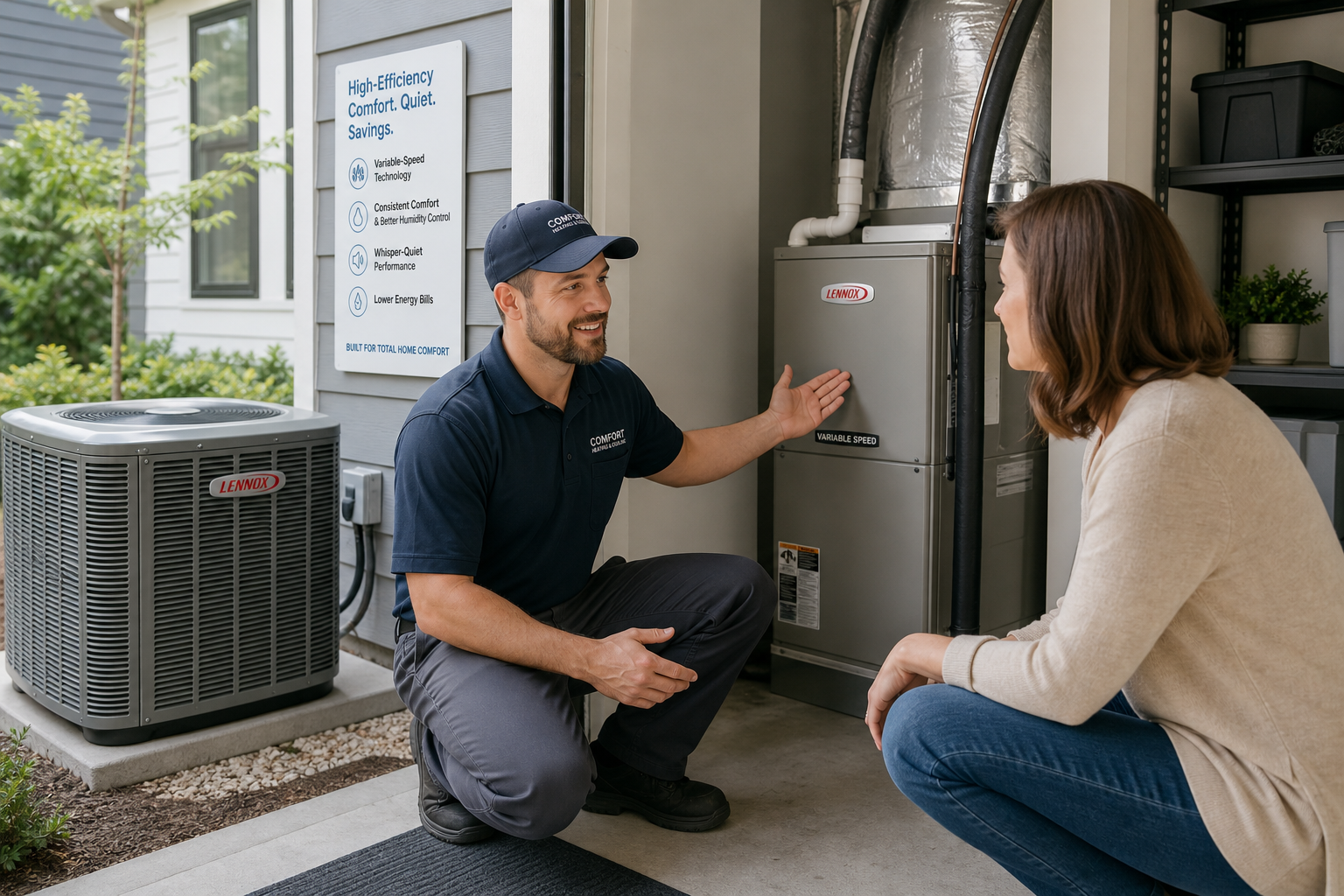
Is a Variable-Speed HVAC System Worth the Extra Cost? A Homeowner’s Guide to Comfort, Humidity Control, Noise, and Payback
If you are comparing HVAC quotes and wondering whether a premium variable-speed system is really worth it, the answer depends less on marketing claims and more on your comfort problems, your home’s layout, your climate, and the quality of the installation.
Variable-speed HVAC systems are often presented as the top shelf option in residential heating and cooling.
They usually cost more than basic equipment, and homeowners are told that they are quieter, more comfortable, better at controlling humidity, and more efficient.
Some of that is true.
But premium equipment is not automatically the best choice for every house.
If your home has major duct leaks, poor airflow, bad insulation, or rooms that were never balanced correctly, a more expensive system may not fix the problem you actually live with every day.
On the other hand, if you have hot and cold swings, sticky indoor air in summer, light sleepers bothered by loud startup noise, or a home where the system runs hard for long stretches, a variable-speed setup can feel meaningfully different.
This guide breaks down what a variable-speed system really does, how it compares with single-stage and two-stage equipment, what kind of comfort improvements are realistic, and how to think about the extra upfront cost without relying on hype.
A variable-speed HVAC system is best understood as a comfort upgrade first and an efficiency upgrade second. In the right home, lower noise, steadier temperatures, and better moisture removal may matter more than utility savings alone.
What does variable-speed actually mean?
The phrase variable-speed can refer to more than one part of an HVAC system, which is why homeowners sometimes get confused during estimates.
In everyday sales conversations, it often means the system can adjust output across a wide range instead of operating at only one fixed setting.
A traditional single-stage air conditioner or furnace is simple: it is either on at full output or off.
A two-stage system adds a middle ground by running at a lower stage part of the time and full output when demand is higher.
A variable-speed system goes further by making smaller adjustments to match what the home needs more closely.
Depending on the equipment, that may involve a variable-speed blower motor indoors, an inverter-driven compressor outdoors, or both.
The practical result is that the system can run longer at lower output instead of blasting on and off in short, louder cycles.
That longer, gentler operation is the main reason people notice better comfort.
It helps reduce temperature swings because the house is being conditioned more continuously.
It can also improve humidity control in cooling season because moisture removal happens over time, not just during brief high-output bursts.
For heating, modulation can help keep rooms from overshooting the thermostat setting and then cooling off before the next cycle.
That said, not every product marketed as advanced performs the same way.
Some systems have a variable-speed indoor fan paired with more limited heating or cooling stages.
Others have fully communicating controls and inverter-driven outdoor equipment that can make very fine output adjustments.
That is why quote comparisons should focus on the actual operating range of the system, not just whether the brochure uses the phrase variable-speed.
How does it affect comfort, humidity, and noise?
This is the part of the conversation where variable-speed equipment often earns its keep.
Homeowners do not experience HVAC systems as engineering diagrams.
They experience them as bedrooms that are too warm at night, sticky air in July, loud outdoor units near a patio, and air that seems to rush hard from vents and then disappear.
A well-matched variable-speed system can improve several of those day-to-day annoyances.
Steadier indoor temperatures
Single-stage systems tend to create more noticeable swings because they run full blast, satisfy the thermostat, shut off, and wait for the home to drift again.
Variable-speed systems are designed to trim those swings by running longer and making smaller corrections.
The home often feels more even because the equipment is maintaining conditions rather than repeatedly recovering from drift.
Better humidity control in cooling season
Humidity is where many homeowners notice the biggest quality-of-life difference.
If your current AC cools quickly but still leaves the house clammy, longer run times at lower capacity may help remove more moisture.
Cooler air alone does not always equal comfort.
When indoor humidity stays lower, the same thermostat setting can feel better.
This can be especially helpful in homes where summer comfort complaints are less about raw temperature and more about a damp, heavy feeling indoors.
Lower noise indoors and outdoors
Variable-speed systems are often quieter because they spend much of their time operating below full output.
You may hear less of the sudden whoosh at supply registers, less dramatic startup noise from the outdoor unit, and less noticeable cycling overall.
That can matter a lot if the condenser sits near a bedroom window, deck, or neighboring property line.
It can also matter indoors if airflow noise has been an irritation in certain rooms.
Potentially better air mixing
Because the blower may run longer at lower speeds, the home can get more consistent air circulation.
That may help reduce stale pockets and improve temperature uniformity between rooms, though duct design and balancing still matter.
A premium system cannot fully overcome poor duct layout.
What it may not fix
A variable-speed system is not a cure-all.
If one upstairs room is always hot because it gets intense afternoon sun and has undersized ductwork, better equipment alone may not solve it.
If your house is very leaky or under-insulated, comfort gains may be limited.
If humidity problems come from a wet basement, crawlspace, or ventilation issue, the air conditioner may help but may not address the root cause.
- Good fit for homeowners bothered by temperature swings.
- Especially appealing where summer humidity is a comfort problem.
- Useful when quieter operation matters near bedrooms or outdoor living spaces.
- Less impactful if major comfort issues are really caused by duct, insulation, or air sealing problems.
Which homes benefit the most?
Not every house gets the same value from premium HVAC features.
The strongest candidates for variable-speed equipment usually have one or more of the following conditions.
Homes in humid climates
If your summers are long and muggy, the improved moisture removal from longer run times can make a real difference.
In those homes, comfort may improve enough that the system feels worth the extra cost even before utility savings are considered.
Homes where noise is a top complaint
If your current system is disruptive when it starts, or if outdoor unit noise affects sleep or outdoor entertaining, lower-speed operation may be one of the most noticeable upgrades.
Homes occupied for long stretches of the day
If people are home most of the time, they are more likely to feel and appreciate the difference between basic and premium comfort performance.
A house sitting empty all day may still benefit, but the lived experience matters most when the home is occupied.
Homes with premium expectations
Some homeowners simply care a lot about how the house feels.
If you are sensitive to indoor comfort, dislike noticeable cycling, and want the system to operate as smoothly as possible, variable-speed equipment may align with your priorities.
Homes replacing very old or oversized equipment
Older systems often ran loudly and inefficiently, and some were oversized to begin with.
When replacing one of those systems, a properly sized variable-speed unit can feel like a major upgrade because it addresses both the age of the equipment and the poor operating behavior of the old setup.
Homes with zoning or more complex layouts
Some larger or more complex homes can benefit from equipment that adjusts output more gradually, especially when paired with controls designed for that setup.
Still, the details matter here.
Zoning, duct design, and airflow strategy need to be evaluated carefully by the installer.
A complicated layout is not a reason to assume the most expensive equipment will automatically perform perfectly.
If your biggest complaint is sticky air, loud cycling, or rooms that feel fine for 10 minutes and then drift, variable-speed equipment is worth a serious look. If your complaint is one room with no airflow, start by asking about duct and design issues too.
Does the extra cost usually pay back?
This is where the answer becomes personal rather than universal.
Yes, variable-speed systems can reduce energy use compared with less advanced equipment in many situations.
But homeowners should be careful about assuming a simple, fast payback based only on marketing examples.
Actual savings depend on your climate, utility rates, thermostat settings, insulation levels, occupancy patterns, maintenance, and how well the system is sized and installed.
Local requirements vary, and so do product options and performance details.
Instead of asking only, “How many years until this pays for itself?” ask a broader question: “What am I buying besides possible efficiency gains?”
Think in terms of four buckets of value
First, there is comfort value.
If your home will feel less clammy, more even, and less drafty, that has real value even if it does not show up neatly on a bill.
Second, there is noise value.
Many homeowners would pay something meaningful for a quieter bedroom or patio environment.
Third, there is operating-cost value.
That may matter more in homes with long heating or cooling seasons.
Fourth, there is feature value.
Some variable-speed systems come with more advanced controls, diagnostics, or comfort settings, which may or may not matter to you.
When payback is more likely to make sense
The extra cost is easier to justify when you expect to stay in the home for years, use the system heavily, and genuinely value comfort improvements.
It also makes more sense when you are already shopping in the middle or upper range of equipment and the price jump to variable-speed is not extreme.
When a simpler system may be the better value
If you are highly budget-sensitive, plan to move soon, or your current home comfort is already pretty good, a well-installed two-stage or even single-stage system may be the smarter choice.
That is especially true if the money saved can go toward duct sealing, insulation, air sealing, or needed electrical or airflow corrections.
A less expensive system installed correctly often beats premium equipment installed poorly.
Avoid treating premium equipment as an automatic investment win
Some homeowners buy the most advanced system expecting it to solve every issue and slash bills dramatically.
That is not a safe assumption.
The more realistic way to view variable-speed equipment is as a comfort-forward upgrade that may also improve efficiency.
If comfort is your main goal, the extra cost can be easier to defend.
If the only goal is the shortest financial payback, the answer is less predictable.
Why installation quality matters as much as equipment
This may be the most important section in the whole article.
A variable-speed HVAC system can be excellent, but only when the system around it supports good performance.
Homeowners sometimes focus so much on equipment tier that they overlook basics that matter just as much.
Proper sizing
If the system is oversized, even premium equipment may not manage comfort and humidity as well as expected.
Ask the contractor how they determined size.
A real load calculation is better than replacing the old unit with the same tonnage by habit.
Ductwork condition and airflow
Variable-speed systems still rely on ductwork to deliver air where it needs to go.
If ducts are leaking, undersized, poorly insulated, or badly balanced, performance can suffer.
That does not mean every installation requires all-new ducts, but it does mean the duct system should be discussed honestly.
Thermostat and controls compatibility
Some advanced systems perform best with matched communicating controls.
Others can work with more conventional thermostats, but not always with the same level of functionality.
Homeowners should understand what controls are included, what features they unlock, and whether they are necessary for the quoted performance.
Setup and commissioning
Even excellent equipment can underperform if refrigerant charge, airflow settings, static pressure, or control configuration are wrong.
Ask what startup checks are performed and whether the installer verifies operation instead of simply turning the system on.
Drainage and moisture management
Because variable-speed systems may run longer in cooling mode, proper condensate management still matters.
The installer should address drain routing, safety switches where appropriate, and service access.
Home envelope issues
If your house has major air leakage, poor attic insulation, or comfort problems tied to sun exposure and room design, equipment alone may not produce the result you expect.
The best contractors will tell you when HVAC is only part of the answer.
- Ask how the system was sized.
- Ask whether your existing ductwork was evaluated.
- Ask what thermostat or control is required for full functionality.
- Ask what startup and commissioning steps are included.
- Ask whether any airflow, insulation, or air sealing issues should be addressed at the same time.
What should you ask before you buy?
When two or three quotes are on the table, homeowners often need better questions, not just more brochures.
Use the conversation to learn whether the recommendation actually fits your house and priorities.
Practical questions to ask the contractor
- What comfort problem is this variable-speed system expected to improve in my home specifically?
- Is the quoted system fully variable-speed, or does only the indoor blower vary?
- How wide is the operating range of the outdoor unit?
- Was the system sized using a load calculation?
- Did you find any ductwork or airflow issues that could limit performance?
- Will the system help with humidity in summer, and why?
- What thermostat or communicating control does this setup require?
- What maintenance access should I expect after installation?
- If I choose a two-stage option instead, what comfort difference should I realistically expect?
- Are there local code, permit, or electrical requirements that may affect the final scope? Local requirements vary.
How to compare quotes fairly
Do not compare by equipment label alone.
Look at included controls, labor scope, duct modifications, drain work, electrical work, filtration, startup procedures, and whether old problems are actually being addressed.
A higher quote may include meaningful corrective work.
A lower quote may leave the old bottlenecks in place.
A good rule of thumb
If you care most about comfort, humidity, and noise, variable-speed equipment often deserves serious consideration.
If you care most about limiting upfront cost while still improving reliability, a simpler but properly designed system may be the better fit.
The right answer is not the same for every homeowner.
Final Thoughts
So, is a variable-speed HVAC system worth the extra cost?
For many homeowners, yes, especially when comfort is the real priority.
The biggest advantages are usually steadier temperatures, better humidity control, and quieter operation rather than a guaranteed quick financial payback.
But premium equipment only performs like premium equipment when it is sized correctly, matched with the right controls, and installed on a duct system that can support it.
If you are considering one, ask contractors to explain what problem the upgrade solves in your home specifically.
That one conversation can tell you more than any marketing label.
Frequently Asked Questions
Is a variable-speed system the same as a two-stage system?
No.
A two-stage system typically has two output levels, while a variable-speed system can adjust more gradually across a broader range.
Exact operation depends on the equipment design.
Will a variable-speed HVAC system lower my energy bills?
It can, but the amount varies by home, climate, usage, utility rates, and installation quality.
It is better to view energy savings as one possible benefit rather than the only reason to buy.
Does variable-speed mean the fan runs all the time?
Not necessarily all the time, but these systems often run longer at lower speeds than basic equipment.
That is part of how they maintain steadier comfort and improve humidity control.
Can a variable-speed system fix hot and cold rooms?
Sometimes it can help, but it depends on the cause.
If the issue comes from duct design, insulation, sun exposure, or room layout, those may need separate attention.
Is variable-speed worth it if I may move in a few years?
Maybe, but the decision becomes more about your near-term comfort than long-term payback.
If budget is tight or you do not expect to stay long, a well-installed mid-tier option may be more sensible.
Find an HVAC Installer Near You
Search the HVAC Installer Network to find local professionals, review installer profiles, and connect with contractors serving your area.
This article is for general informational purposes only and is not a substitute for an in-home evaluation by a qualified HVAC professional.
Equipment performance depends on system design, installation quality, controls, maintenance, and home conditions.
Local codes, permitting, utility programs, and other requirements vary by location.