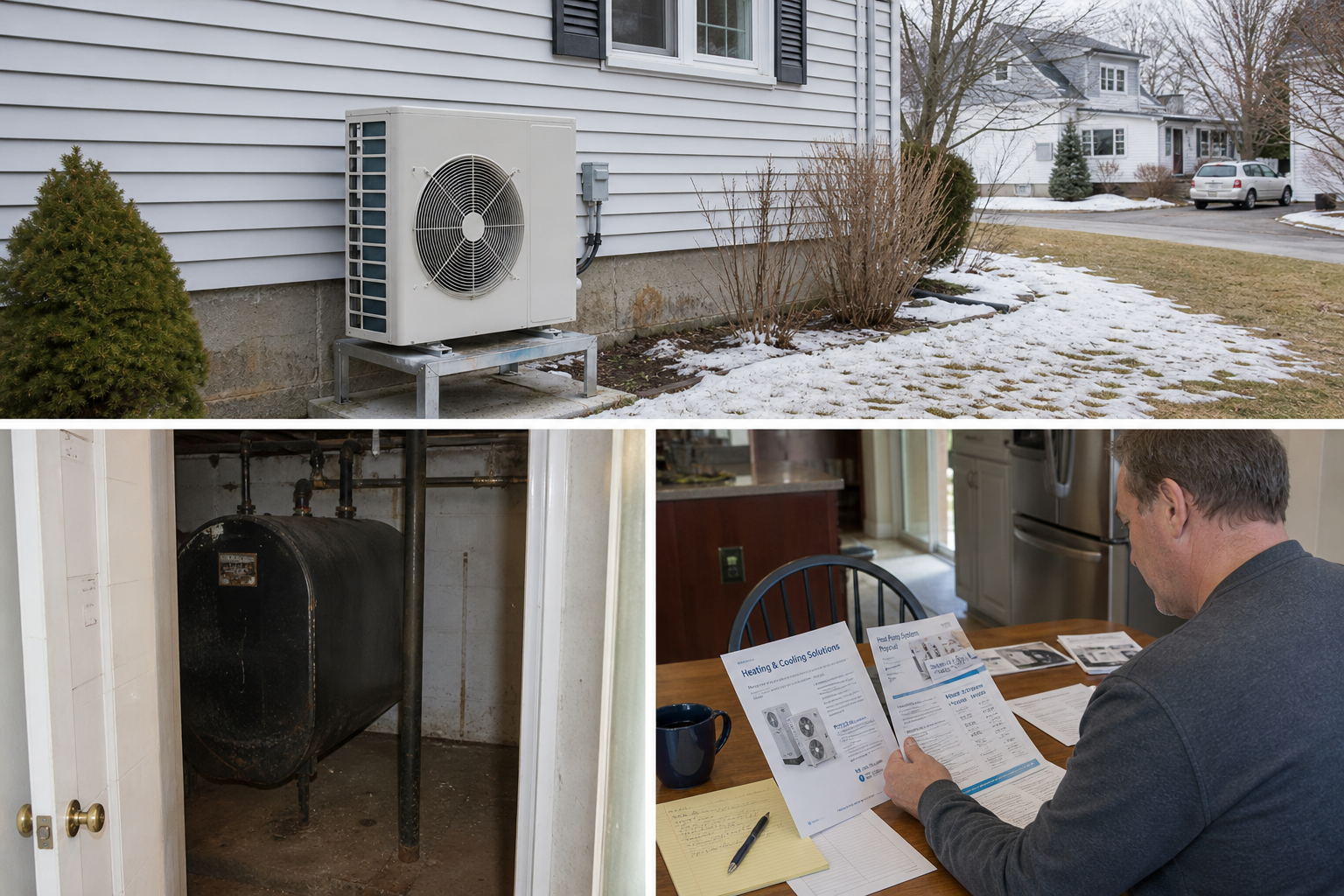
Should You Convert From Oil Heat to a Heat Pump? A Practical Homeowner’s Guide
How to think through operating costs, electrical upgrades, backup heat, comfort, and incentive fine print before replacing an oil-heated system.
If your home is heated with oil, you have probably already wondered whether it is time to move on. Maybe fuel deliveries feel unpredictable, your boiler or furnace is aging, or you want air conditioning without adding a separate system. A heat pump can solve several of those problems at once, but converting from oil heat to a heat pump is not a simple yes-or-no decision.
The best choice depends on how your house loses heat, what electricity costs in your area, whether your electrical panel can support new equipment, and how you want backup heat handled during colder weather. It also depends on whether your current oil system still works well enough to keep as part of a hybrid setup.
This guide walks through the practical questions homeowners should ask before making the switch. The goal is not to push you toward one technology. It is to help you compare options clearly, avoid surprise upgrade costs, and understand where rebate or quote assumptions can go wrong. Local codes, utility rules, and incentive programs vary, so a qualified local contractor should verify details for your specific home.
A heat pump conversion makes the most sense when the decision is based on the whole house, not just the equipment. Insulation, air sealing, electrical capacity, duct design, and your cold-weather expectations all affect whether the project feels like an upgrade or a compromise.
Why do homeowners consider switching from oil to a heat pump?
Most homeowners start looking at a heat pump for one of four reasons: they want lower reliance on delivered fuel, they need central cooling, their oil equipment is aging, or they want a cleaner and quieter comfort system. Oil heat can deliver strong winter warmth, but it also ties you to fuel deliveries, tank condition, burner maintenance, and a combustion-based heating system.
A heat pump changes the conversation because it can heat and cool the home with one system. That means a house that currently has oil heat plus window units or no cooling at all may gain better summer comfort at the same time it modernizes the heating side. For many homeowners, that dual-purpose benefit is one of the biggest reasons to look seriously at conversion.
Another common motivation is reducing maintenance complexity. Oil systems can be dependable, but they come with burners, flues, tanks, filters, and combustion concerns. A well-installed heat pump still needs service, but some homeowners prefer an all-electric approach that removes fuel storage and combustion equipment from the equation.
That said, wanting to leave oil behind does not automatically mean a full conversion is the right answer. In some homes, a hybrid approach that keeps oil as backup may be more practical than removing it immediately.
Can a heat pump really handle an oil-heated home?
Sometimes yes, sometimes not by itself, and sometimes only after other house improvements are made. A lot depends on the heat loss of the home and the distribution system already in place.
If your house already has ductwork from a warm-air oil furnace, adding a ducted heat pump may be relatively straightforward. If your home uses an oil boiler with baseboard or radiators, the path is different. You may need ductless mini-splits, a new duct system, or in some cases a different type of heat pump setup designed to work with hydronic heating. The right answer depends heavily on your home’s layout and existing equipment.
Cold-climate heat pumps have improved a lot, but performance still changes with outdoor temperature. That does not mean they fail in winter. It means capacity and efficiency at lower temperatures should be reviewed carefully instead of assumed. A contractor should calculate the home’s heating load and match equipment to that load rather than relying on rough rules of thumb.
Oil-heated homes are often older and less air-sealed than newer construction. That matters because a leaky, drafty house may have heating demands that make a heat pump work harder or require supplemental heat more often. Before deciding that a heat pump is too small or too expensive to run, it is worth looking at envelope improvements such as air sealing and insulation. Sometimes modest weatherization changes improve heat pump viability more than homeowners expect.
- Ask for a room-by-room or whole-home load calculation, not a guess based on the old oil system size.
- Confirm whether your home is a ducted conversion, a ductless project, or a mixed approach.
- Ask how the proposed system performs during colder outdoor temperatures typical for your area.
- Discuss whether insulation or air sealing should be addressed before final equipment sizing.
How should you compare operating costs?
This is where many homeowners get oversold. A salesperson may say a heat pump will definitely cost less to run than oil, but actual operating cost depends on local electric rates, oil prices, the efficiency of your current oil equipment, the efficiency curve of the proposed heat pump, and how often backup heat runs.
The right way to compare is not to ask which technology is “cheaper” in general. Ask how your specific home is likely to perform with your local utility rates and climate. A good contractor should be able to explain the assumptions behind the estimate. If they cannot explain the assumptions, treat the savings claim cautiously.
Also remember that comfort strategy affects cost. If you keep the house much warmer than before because the new system distributes heat more evenly, your bill may not drop as much as expected even if the equipment is efficient. Likewise, if the thermostat settings change, or if electric resistance backup runs frequently, real-life costs may differ from the sales sheet.
Homeowners should also compare annual ownership cost, not just monthly winter cost. For example, if a heat pump replaces the need for separate air conditioning equipment, that changes the value of the project. If it lets you avoid major repairs on old oil equipment or tank work, that matters too.
A practical cost comparison should include these categories:
- Estimated heating-season electrical use for the heat pump.
- Estimated oil use you would avoid.
- Expected use of backup heat during colder weather.
- Summer cooling cost compared with your current setup.
- Maintenance differences between the old and new systems.
- Any one-time electrical or distribution-system upgrade costs.
If one quote shows dramatic savings and another is more conservative, do not assume the higher-savings quote is better. It may simply be using optimistic assumptions.
What electrical upgrades might be required?
Electrical readiness is one of the biggest practical hurdles in an oil-to-heat-pump conversion. An oil boiler or furnace may not have required much electrical capacity compared with a new all-electric heating system. Depending on the equipment type and backup heat arrangement, your existing panel may or may not have enough space or amperage.
This is especially important if the proposal includes electric resistance strip heat, multiple indoor units, a heat pump water heater, an induction range, or future electric vehicle charging. A panel that looks fine today may become crowded quickly once the house starts electrifying other systems.
Homeowners should ask whether the bid includes a real electrical review or just assumes the panel will work. A proper review may involve checking panel size, available breaker spaces, wire runs, disconnects, service capacity, and any utility-side requirements. In some homes, the heat pump can be installed without a full service upgrade. In others, panel or service changes become a major part of the project cost.
This does not mean you should avoid a heat pump if upgrades are needed. It means you should know early, before choosing equipment based on a quote that did not include all required work.
| Electrical question | Why it matters |
| Does the panel have enough capacity? | Insufficient capacity may require a panel or service upgrade. |
| Is backup heat electric or fuel-based? | Electric backup can increase electrical demand significantly. |
| Are new circuits and disconnects included? | Missing electrical scope can create surprise change orders. |
| Will future electrification be considered? | Planning ahead can avoid multiple upgrades later. |
Local code and utility requirements vary, so the contractor and electrician should confirm what is needed in your area.
What are your backup heat options?
Backup heat is one of the most important design decisions in an oil-to-heat-pump project. Many homeowners hear “heat pump” and assume it must either work alone or fail in cold weather. In reality, backup heat can be handled in different ways, and the choice affects both comfort and operating cost.
One option is an all-electric setup with resistance backup. This can be simple from a system-control standpoint, but resistance heat can draw a lot of power and may be more expensive to run than heat pump heating during milder conditions. Another option is a dual-fuel or hybrid approach where the heat pump handles much of the heating and the oil system takes over below a chosen temperature or during high-demand periods.
The best backup strategy depends on your climate, electric rates, oil pricing, equipment compatibility, and comfort expectations. Some homeowners want full electrification and are comfortable designing around that goal. Others prefer the security of keeping oil available during very cold weather, especially if their existing system is still serviceable.
Ask the installer exactly how the system will decide when backup heat runs. Will it switch by outdoor temperature, demand, lockout settings, or manual selection? Will the backup heat come on only in extreme conditions, or will it assist routinely? These details affect both bills and comfort.
If the proposal includes backup heat, ask for plain-language control logic in writing. You should know what heats the home at mild temperatures, cold temperatures, and emergency conditions before you sign a contract.
Should you remove the oil system completely or keep it?
There is no universal answer here. Some homeowners want the oil tank and equipment gone as soon as possible. Others benefit from keeping the oil system temporarily or long term. The right choice depends on equipment condition, budget, storage issues, and how confident you are in going fully electric right away.
Keeping the oil system can reduce risk during the transition. It may provide backup heat, allow a smaller initial heat pump scope, or give you time to see how the home performs through a full winter before decommissioning the old system. This can be especially helpful in older houses with uncertain insulation levels or with distribution systems that are hard to reconfigure in one step.
Removing the oil system completely can free up space, eliminate tank concerns, and simplify the home’s mechanical setup. But full removal may involve tank abandonment or removal procedures, disposal requirements, flue changes, and other work that should be priced clearly. Local requirements vary.
If there is an oil tank on site, ask for a direct explanation of what happens to it under each option:
- Will the tank remain in place and active?
- Will it remain in place but be disconnected?
- Will it be removed from the basement or yard?
- Who handles any required cleaning, documentation, or disposal steps?
- Is this included in the price or excluded?
Do not assume “conversion” automatically includes tank work. Often it does not.
What installation issues matter most in older homes?
Oil-heated homes are often older homes, and older homes bring installation challenges that can affect both project cost and comfort results. These issues do not make a heat pump a bad idea, but they do make planning more important.
First is distribution. If the home has no existing ductwork, where will new ducts go, or where will indoor heads be mounted if ductless equipment is used? A beautiful equipment proposal can still disappoint if the room-to-room comfort plan is weak.
Second is air leakage. Drafts, uninsulated walls, and attic bypasses can make a heating system seem underpowered when the real problem is the building shell. A good contractor will not ignore the house itself.
Third is noise and placement. Outdoor unit location matters for snow, drainage, service access, and sound near bedrooms or neighbors. Indoor unit location matters for airflow and appearance. Older homes often have fewer obvious installation paths, so line-set routing and condensate management should be discussed in advance.
Fourth is controls integration. If part of the oil system remains, thermostats and control strategy need to be coordinated clearly. Confusing controls lead to unhappy homeowners even when the equipment itself is fine.
Finally, if your current oil system also provides domestic hot water, do not overlook that piece. Replacing heating equipment may affect how hot water is produced, and that should be addressed as part of the project conversation.
Where do rebate and quote mistakes happen?
Incentives can help, but they also create some of the most frustrating misunderstandings in HVAC sales. The safest approach is to treat any rebate, tax-related incentive, utility program, or manufacturer promotion as something that must be verified, not assumed. Availability, eligibility, deadlines, equipment requirements, and documentation rules all vary by location and can change over time.
One common mistake is assuming the quoted price already reflects incentives you are guaranteed to receive. Another is choosing equipment based on a program requirement without confirming that your house, electrical system, or installation path actually supports that configuration. A third is assuming all contractors handle paperwork the same way. Some help heavily with documentation, while others leave most of the process to the homeowner.
Quote mistakes also happen when critical scope items are left vague. That can include electrical work, oil tank handling, patching, thermostat replacement, condensate pumps, line-hide covers, crane needs, permits, and old equipment disposal. The lower quote is not always the better quote if it simply excludes important items.
Before you sign, ask for a written proposal that clearly states:
- What equipment is being installed and where.
- Whether the system is full heat pump or hybrid with oil backup.
- Whether electrical work is included, excluded, or pending review.
- What happens to the existing oil equipment and tank.
- What controls and thermostats are included.
- Which incentives are estimated versus confirmed.
- Who is responsible for permits, inspections, and program paperwork.
If a rebate is central to the project’s affordability, verify the program requirements yourself as well. Local requirements vary, and homeowners should never rely only on a verbal promise.
Frequently Asked Questions
Will a heat pump feel as warm as oil heat?
It can feel different. Oil systems often deliver hotter supply air or hotter baseboards, while heat pumps usually provide steadier, lower-temperature heat over longer cycles. Many homeowners find that comfortable, but it is not the same sensation. Good sizing and airflow design matter a lot.
Can I keep my oil heat as emergency backup?
In many homes, yes, if the existing system is compatible and in serviceable condition. A contractor should explain how the controls will switch between the heat pump and oil backup and whether any extra components are needed.
Do I need to upgrade my electrical panel to install a heat pump?
Not always. Some homes can add a heat pump without a major electrical upgrade, while others need panel work or service changes. The answer depends on the equipment selected, existing capacity, and whether electric backup heat is included.
Is it smarter to convert the whole house at once or in stages?
Either approach can work. A staged plan may make sense if your oil system still has life left, if you want to spread out costs, or if you want to test how the home performs after weatherization improvements. A full conversion may make sense when the oil equipment is at the end of its useful life or when you want one coordinated project.
What if my home has radiators or baseboard heat and no ducts?
You still may be able to install a heat pump, but the design path is different. Ductless indoor units, new ductwork, or other system types may be considered. Homes without ducts need extra attention to room coverage, aesthetics, and installation routing.
Final Thoughts
If you want to convert from oil heat to a heat pump, the decision should be based on your house, not just on broad claims about electrification or fuel savings. In the right home, a heat pump can reduce dependence on oil, add air conditioning, improve steady comfort, and modernize an aging system. In the wrong design, it can lead to surprise electrical costs, disappointing winter performance, or confusion about when backup heat runs.
The strongest projects usually have a few things in common: a real load calculation, a clear electrical review, an honest discussion of backup heat, and a written scope that explains what happens to the oil equipment and tank. If you get those pieces right, you will be in a much better position to compare quotes and choose a system that fits your goals.
Take your time, ask direct questions, and do not let rebates or sales pressure rush the process. Local requirements vary, and the best answer is the one that works for your comfort needs, home layout, and budget over the long term.
Find an HVAC Installer Near You
Search the HVAC Installer Network to find local professionals, review installer profiles, and connect with contractors serving your area.
This article is for general educational purposes only and is not a substitute for an in-home evaluation by a qualified HVAC professional. Equipment selection, electrical needs, code compliance, permits, tank removal requirements, and incentive eligibility vary by location and by home. Verify all project details, operating cost assumptions, and program requirements with licensed local professionals and the relevant utility or program administrator before making a final decision.