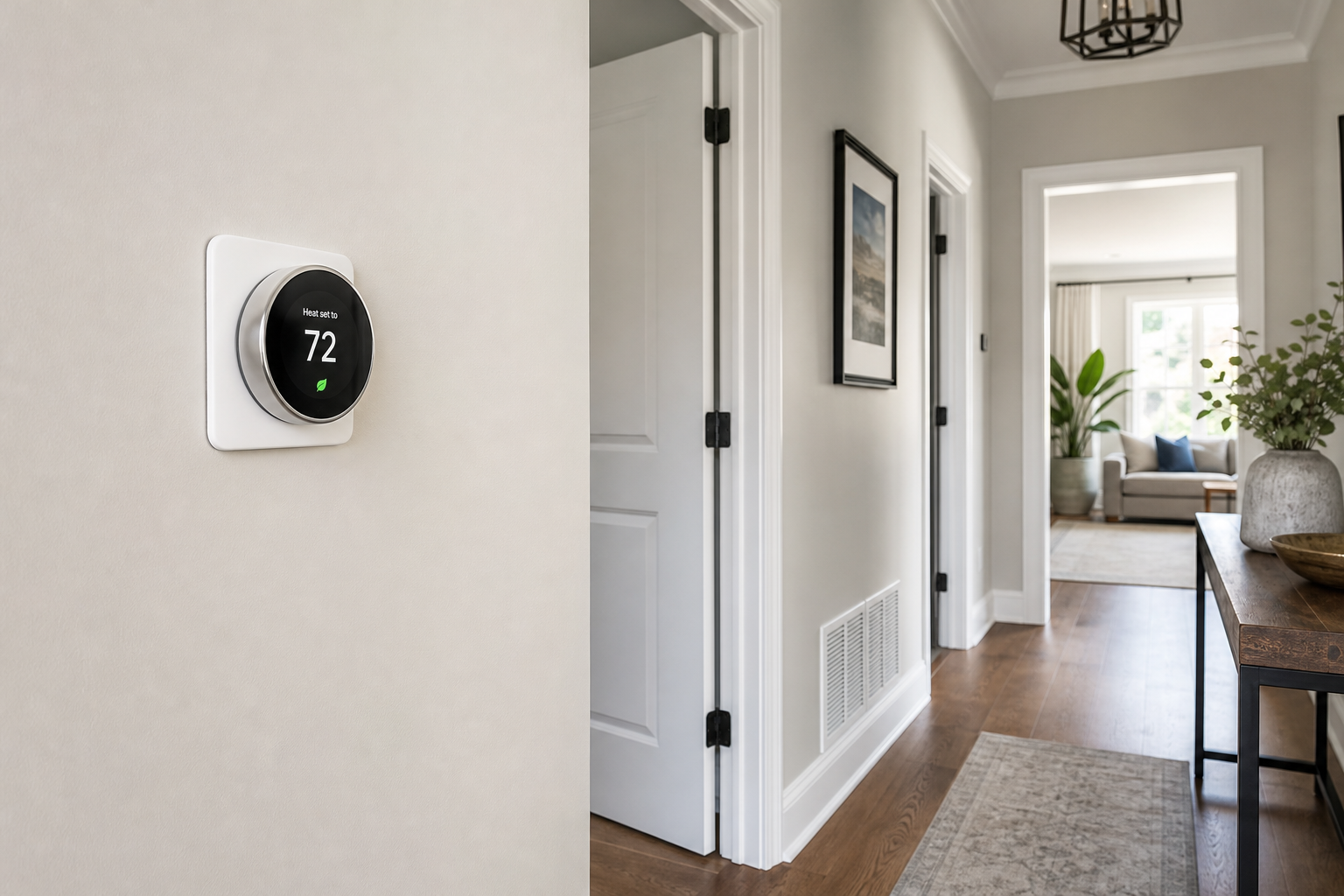
Should You Move Your Thermostat? A Homeowner’s Guide to Bad Thermostat Placement, Comfort Problems, and When Relocation Is Worth It
If your home feels uncomfortable even when the system seems to be working, the thermostat’s location may be part of the problem.
Your thermostat is supposed to represent the temperature of your home, but it only knows the temperature where it is mounted. That sounds obvious, yet it causes a surprising number of comfort complaints. If the thermostat sits in a hot hallway, near a sunny window, above a supply vent, or too close to the kitchen, it may tell your HVAC system to turn on or off at the wrong time.
For homeowners, that can show up as rooms that are always too warm or too cool, an air conditioner that shuts off before the bedrooms feel comfortable, or a furnace that seems to run longer than it should. In some cases, the thermostat is not the real problem at all. Duct issues, insulation gaps, air leakage, oversized equipment, or weak airflow can create similar symptoms.
This is why thermostat relocation should be treated as a targeted fix, not a default upgrade. If the location is clearly misleading the system, moving it can improve comfort and help the equipment respond more sensibly. If the root cause is elsewhere, relocating the thermostat may do little or nothing. The goal is to understand when moving the thermostat is a smart decision, when it is unnecessary, and what to ask before you spend money on the change.
A thermostat does not average your whole house unless it is designed with multiple sensors and set up to use them. In many homes, it is simply reacting to the conditions on one wall.
What bad thermostat placement looks like
Bad thermostat placement usually means the thermostat is being influenced by something other than the general living conditions of the home. The ideal location is a place that reflects normal occupied space, not a temperature extreme.
Common examples include a thermostat installed in direct or partial sunlight. Even a little sun through a nearby window can warm the thermostat enough to make the air conditioner run longer than needed or keep the furnace from starting when it should.
Another common problem is placement near the kitchen. Ovens, stovetops, and even repeated cooking activity can temporarily raise the temperature around the thermostat. During meal prep, the system may think the whole house is warmer than it really is.
Hallways can be good locations, but not all hallways are equal. A narrow hallway with poor air mixing, a nearby exterior door, a return grille pulling air across the wall, or a supply register blowing toward the thermostat can all distort its reading.
Thermostats mounted near windows, exterior walls, fireplaces, lamps, televisions, or appliances may also get false cues from radiant heat or drafts. In winter, a cold exterior wall can influence the thermostat differently than the rest of the room. In summer, warm wall exposure can do the opposite.
Second-floor landings can be tricky too. Because heat rises, upper stair areas often run warmer than the first floor. If the thermostat is there, cooling may continue until the upstairs landing is satisfied, potentially overcooling some lower-level spaces. In heating season, the opposite comfort imbalance can happen.
What symptoms bad placement can cause
The most common symptom is uneven comfort. You set a temperature that seems reasonable, but one part of the house feels fine while another feels noticeably off. Bedrooms may stay warm at night during cooling season, or a family room may feel chilly while the hallway thermostat says everything is on target.
Another symptom is short or awkward system cycles. If the thermostat sits where it warms up quickly, the air conditioner may shut off too soon. If it sits where it stays cool while the rest of the home warms up, the system may run longer than necessary. The same logic applies in heating season.
You may also notice frequent thermostat adjustments. If you are constantly lowering or raising the setpoint to chase comfort, that can be a clue that the thermostat is not sensing a representative area of the home.
Some homeowners assume this means the equipment is the wrong size or failing mechanically. Sometimes that is true, but not always. A badly placed thermostat can make a healthy system look inconsistent because the control point itself is misleading.
Another sign is comfort shifting at predictable times. If problems get worse in late afternoon sun, while cooking dinner, when a fireplace is used, or when exterior doors open frequently, the thermostat may be affected by those localized conditions.
Humidity complaints can overlap with thermostat issues. If the air conditioner shuts off too quickly because the thermostat gets cooled or heated incorrectly, indoor humidity may remain higher than expected. That does not always mean the thermostat location is the cause, but it can contribute.
When thermostat relocation is worth it
Moving your thermostat is usually worth considering when there is a clear, identifiable placement problem and the comfort symptoms match it. In other words, there should be a logical reason to believe the thermostat is reading a false version of the home’s actual conditions.
For example, if your thermostat is in direct sun for part of the day and the house gets too cold during those hours, relocation may make sense. If it is right outside a kitchen that warms up during cooking and the AC overreacts in the evening, that is another strong candidate.
Relocation may also be worthwhile when the thermostat sits above or near a supply register, return grille, or exterior door. Air blowing directly across the device or drafts passing over it can make system behavior erratic.
It can also be worth it during a larger HVAC project. If you are already replacing equipment, upgrading controls, opening walls for other work, or repainting and patching anyway, the added effort of moving the thermostat may be easier to justify than as a standalone job.
In some two-story homes, thermostat relocation can help if the current location strongly favors one level over the other and there is no zoning. That said, moving the thermostat is not the same as solving a true upstairs-downstairs imbalance. It may improve control somewhat, but it will not create separate temperature control for each floor.
If you have a basic older thermostat in an obviously poor location, and a contractor confirms the wiring path allows a better location, a move can be a sensible comfort upgrade. The key is to verify the diagnosis first instead of assuming the thermostat is always the culprit.
When moving it probably will not fix the problem
Thermostat relocation is not a cure-all. If one room is always uncomfortable because it has undersized ductwork, poor insulation, leaky windows, too much west-facing glass, or a closed damper, moving the thermostat may not solve that room’s problem.
The same is true if the equipment itself is oversized, undersized, or struggling with airflow issues. A system that short cycles due to sizing or shuts down on safety controls due to mechanical faults will not be repaired by changing where the thermostat is mounted.
Homes with significant duct leakage or poor return-air design may have comfort problems that mimic thermostat trouble. The thermostat may be innocent while the real issue is that conditioned air is not reaching rooms properly or air is not circulating back effectively.
Relocation is also less likely to be the best answer if your comfort complaint is isolated to one or two rooms and the thermostat area itself seems stable and representative. In that case, room-specific issues such as airflow balancing, insulation, shading, or dedicated solutions may matter more.
If the main complaint is that different parts of the house need different temperatures at the same time, zoning or room-specific control strategies may be more appropriate than simply moving the central thermostat.
This is why a good contractor should ask questions about patterns, measure temperatures, inspect airflow, and look at the home as a system. If the discussion jumps straight to relocation without ruling out other causes, it is worth slowing down.
Where a thermostat should usually go
In many homes, the best thermostat location is an interior wall in a frequently used central area where air moves normally and conditions are not unusually hot, cold, sunny, drafty, or stagnant. The goal is not perfection. The goal is a spot that represents everyday living conditions better than the current one.
That often means a main living area or common hallway near the center of the conditioned space, provided it is not directly affected by supply air, return air, exterior doors, or kitchen heat.
The thermostat should generally be away from direct sunlight, windows, skylights, fireplaces, lamps, televisions, and heat-producing appliances. It should not be hidden behind doors, drapes, furniture, or bookcases that block normal air movement around it.
Install height matters too. A thermostat placed at a typical standing wall-control height tends to perform better than one mounted unusually low or high, especially in spaces where stratification can occur.
In homes with one system serving multiple floors, there is often no perfect single location because upstairs and downstairs loads differ. The thermostat location becomes a compromise. In those cases, a contractor may discuss whether relocating the thermostat, adding remote sensors, adjusting airflow, or considering zoning is the better path.
Local practices, wall construction, and wiring routes vary, so the ideal location on paper may not be the easiest place to install in real life. That is one reason an on-site assessment matters.
- Choose an interior wall when possible.
- Favor a commonly occupied area over a pass-through hot spot.
- Avoid direct sun and nearby heat sources.
- Keep it away from supply registers, return grilles, and exterior doors.
- Do not place it where furniture or decor blocks airflow around it.
- Consider the whole-home comfort pattern, not just one room.
What thermostat relocation usually involves
For a wired thermostat, moving it is usually more involved than just unscrewing it and placing it somewhere else. The contractor may need to run new low-voltage wiring, fish cable through finished walls, patch the old opening, and confirm compatibility with your equipment and thermostat model.
Some moves are simple if the new location is nearby and wall access is easy. Others are more difficult if the new wall is on a different side of the hallway, if the basement or attic access is limited, or if finished surfaces make wire routing harder.
If you have a smart thermostat, power requirements can matter. Some models need a common wire or specific terminal setup. A relocation project may be a good time to verify the control wiring supports the thermostat’s features reliably.
In some cases, a contractor may be able to abandon the old wire path and install new wiring with minimal cosmetic impact. In others, visible patching and paint touch-up may be part of the job. Ask about that upfront so there are no surprises.
Wireless accessories may reduce the need for full relocation in certain setups, but not every system supports the same options. Brand compatibility and control logic vary.
Permits and code requirements can vary by location and by the scope of work. If thermostat relocation is part of a larger HVAC or electrical project, ask the installer what local requirements apply.
Can smart thermostats or remote sensors solve the issue instead?
Sometimes, yes. If your thermostat supports remote room sensors, those sensors may help the system respond to temperatures in the rooms that matter most rather than relying only on the wall thermostat itself. This can be especially useful in bedrooms at night or in homes where the current thermostat location is acceptable but not ideal.
However, remote sensors are not magic. They do not increase airflow to problem rooms, fix bad duct design, or create true independent zoning unless your system is specifically designed for that type of control. They simply improve what temperature information the system uses.
For some homeowners, adding sensors is a practical middle ground. It may avoid wall repair and rewiring while still producing better comfort than a single poorly located control point. For others, especially when the thermostat is in a truly bad spot, physical relocation is still the cleaner long-term fix.
Some smart thermostats can average multiple sensors, prioritize certain rooms by schedule, or let you ignore rooms at different times of day. That flexibility can be useful in homes where occupancy patterns change.
Still, sensor-based solutions work best when the HVAC system itself is otherwise healthy and reasonably balanced. If the house has major airflow or insulation problems, extra sensors may only reveal those issues more clearly rather than solving them.
How to decide whether to move your thermostat
Start by observing patterns. Is the thermostat near a heat source, sunlight, vent, draft, or stairwell? Do comfort problems appear at specific times of day or during certain activities like cooking? Do multiple thermometers in living spaces disagree noticeably with the thermostat reading? Those clues help narrow the diagnosis.
Next, ask whether the discomfort is whole-home or room-specific. If the complaint is mostly one room, relocation may not be the best first step. If the whole house seems to cycle oddly around the thermostat area, moving it becomes more plausible.
Then consider whether a simpler solution exists. If a supply register is blowing directly on the thermostat, redirecting airflow may help. If a lamp or TV is heating the wall, changing the room layout might reduce the issue. If direct sun is the trigger, shading the area could improve performance.
After that, get a professional opinion from a qualified HVAC contractor. A good evaluation should include looking at thermostat location, asking about seasonal patterns, checking equipment operation, and considering airflow and duct conditions. The best answer may be relocation, sensor upgrades, balancing changes, or a combination.
Finally, compare the likely benefit to the disruption and cost. If relocation requires extensive wire fishing and wall repair but sensors can address the comfort issue well enough, that may be the better choice. If the thermostat is obviously in a terrible location and the move is straightforward, relocation may be worth doing.
If you are already replacing your thermostat or HVAC equipment, ask whether the current location still makes sense. It is often easier to improve controls during a larger project than to revisit the issue later.
Questions to ask before approving thermostat relocation
Before moving your thermostat, ask the contractor why they believe the current location is causing the problem. The answer should connect the thermostat’s placement to specific comfort symptoms in a way that makes sense.
Ask what other causes they ruled out. For example, did they look at airflow, insulation, duct leakage, room exposure, and equipment performance? You want confidence that relocation is not being used as a guess.
Ask where the new thermostat location would be and why it is better. A good answer should reference interior wall conditions, occupancy patterns, air circulation, and avoidance of local heat or drafts.
Ask how the wiring will be run and whether wall patching or paint touch-up will be needed. Clarify whether the existing thermostat model will remain or whether a different thermostat or accessories would work better.
Finally, ask whether remote sensors, airflow balancing, or zoning are viable alternatives. Sometimes the best outcome comes from combining improvements rather than relying on one change alone.
Frequently asked questions
Can a bad thermostat location really make that much difference?
Yes. Because the thermostat controls system run time based on what it senses, a misleading location can change when heating or cooling starts and stops. The effect can range from minor annoyance to noticeable comfort problems.
Will moving the thermostat lower energy bills?
It can in some situations, especially if bad placement is causing unnecessary run time. But comfort is usually the main reason to move it. Savings depend on the home, the HVAC system, and the severity of the placement problem.
Can I move a thermostat myself?
Simple battery-powered thermostat replacement is one thing, but relocation is usually a wiring and wall-access job. Many homeowners prefer to have an HVAC professional handle it, especially with smart thermostats or multi-stage equipment.
Is a hallway always a bad place for a thermostat?
No. Many thermostats are located in hallways and work fine. The question is whether that hallway reflects normal living conditions or is affected by drafts, supply air, return air, sunlight, or nearby heat sources.
Should the thermostat be upstairs or downstairs in a two-story home?
There is no universal answer for a single-zone system. It depends on how the home is used and where temperatures tend to drift. In some homes, relocation helps. In others, remote sensors, airflow changes, or zoning are more appropriate.
Can a smart thermostat fix a bad location by itself?
Sometimes, but not always. Smart thermostats with remote sensors may improve control, but they do not automatically correct duct, airflow, or insulation problems. And if the thermostat itself is in a very poor location, relocation may still be the better fix.
Final thoughts
If you are wondering whether to move your thermostat, the best question is not simply where it is now, but whether it is sensing conditions that truly represent how your home feels. A thermostat in the wrong spot can absolutely cause comfort problems, awkward cycling, and constant setpoint adjustments. But it is only one part of the system.
When there is a clear placement issue, relocation can be a practical and worthwhile improvement. When the real problem is airflow, insulation, duct design, or room-specific heat gain, moving the thermostat may only scratch the surface. A careful diagnosis helps you spend money in the place most likely to improve comfort.
Find an HVAC Installer Near You
Search the HVAC Installer Network to find local professionals, review installer profiles, and connect with contractors serving your area.
This article is for general informational purposes only and is not a substitute for an in-home evaluation by a qualified HVAC professional. Equipment compatibility, wiring options, installation methods, and local code or permit requirements vary by home and location.