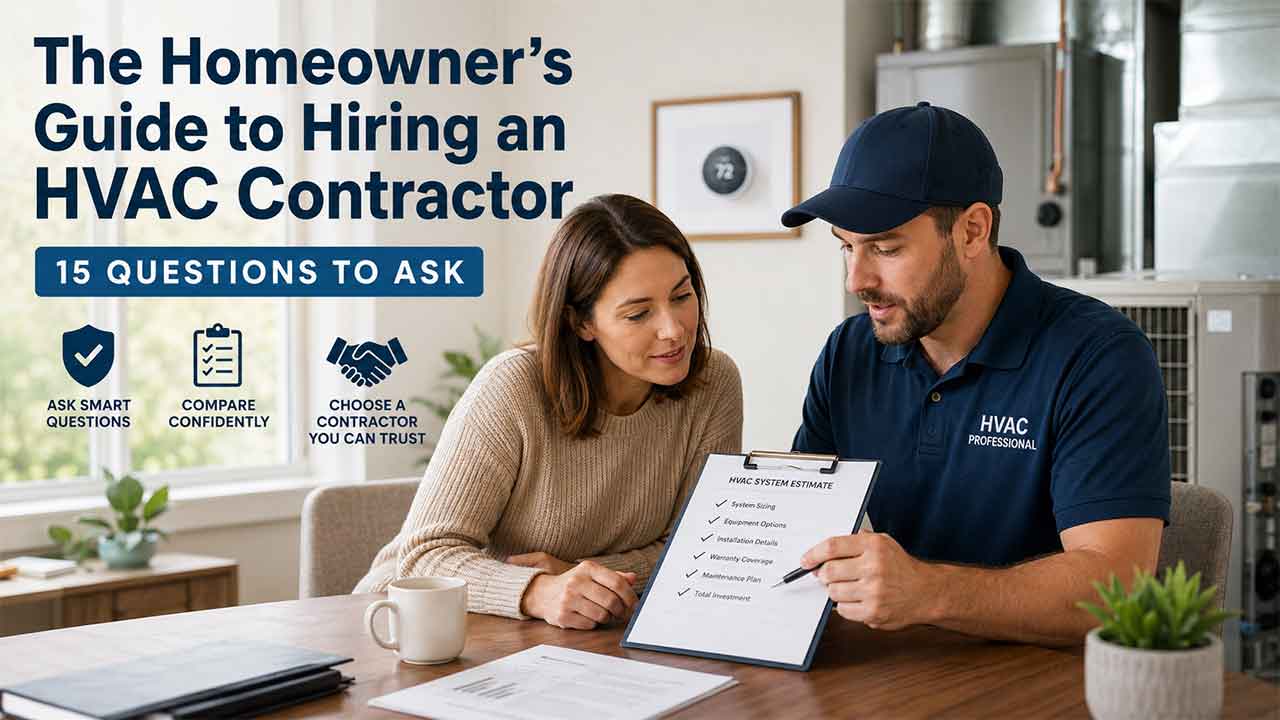
The Homeowner’s Guide to Hiring an HVAC Contractor: 15 Questions to Ask
Learn how to compare contractors, understand HVAC estimates, spot warning signs, and choose an installer you can trust in your home.
Replacing your home’s heating and cooling system is one of the larger investments you may make as a homeowner. It is natural to spend time comparing equipment brands, efficiency ratings, warranties, and prices. However, the company installing that equipment may have an even greater effect on how well the system performs.
A properly selected and installed HVAC system should keep your home comfortable, operate efficiently, drain correctly, and deliver appropriate airflow throughout the house. Even high-quality equipment can struggle when it is oversized, undersized, poorly commissioned, or connected to ductwork that cannot support it.
You do not need to become an HVAC expert before requesting estimates. You do, however, need to know which questions to ask and what a professional answer should sound like.
Are You Licensed and Insured?
Licensing requirements differ by state and municipality, but you should still ask whether the contractor holds the licenses required for your location and the type of work being performed.
Insurance is equally important. General liability coverage can help protect against accidental property damage, while workers’ compensation coverage applies when employees are injured while working.
A Reassuring Answer
“We are licensed for this work and carry both liability and workers’ compensation insurance. We can provide current certificates upon request.”
Reasons to Be Cautious
- The contractor avoids the question.
- Documentation is expired or unavailable.
- You are told insurance is unnecessary.
Will You Perform a Load Calculation?
An HVAC system should be sized for the actual heating and cooling needs of your home. Replacing an old system with equipment of the same capacity is not always the right approach.
A professional load calculation may consider:
- The home’s square footage and layout
- Insulation levels
- Window size, orientation, and construction
- Ceiling height
- Air leakage
- Local design temperatures
- Sun exposure and shading
- The number of occupants
Oversized equipment may reach the thermostat setting quickly but run in short cycles. That can contribute to uneven temperatures, poor humidity removal, additional wear, and unnecessary operating noise.
Undersized equipment may run for long periods without maintaining comfort during extreme weather.
What Equipment Do You Recommend, and Why?
A contractor should be able to connect the equipment recommendation to your priorities. Those priorities might include initial cost, energy efficiency, noise, humidity control, cold-weather performance, warranty coverage, or long-term serviceability.
Ask why a particular brand, efficiency level, or system type is being proposed. The most expensive option is not automatically the best choice, and the least expensive system is not necessarily the best value.
Questions Worth Asking
- Why is this system a good match for my home?
- What alternatives did you consider?
- Are replacement parts commonly available?
- How does this option compare with a higher- or lower-priced system?
- Are the indoor and outdoor components an approved matched combination?
Who Will Actually Install My System?
The person who prepares your estimate may not be part of the installation crew. Ask whether the work will be completed by company employees, subcontractors, or a combination of both.
Subcontracting does not automatically mean the work will be poor. What matters is that responsibility is clearly defined. You should know who supervises the project, who handles concerns, and which company stands behind the labor warranty.
What Is Included in the Written Quote?
A written proposal should contain more detail than a model number and a total price. Without a clear scope of work, comparing estimates becomes difficult.
| Proposal Item | What to Look For |
|---|---|
| Equipment | Complete model numbers and major components |
| Labor | Installation, startup, testing, and cleanup |
| Thermostat or controls | Specific model and included setup |
| Electrical work | Disconnects, breakers, wiring, or upgrades |
| Ductwork | Transitions, plenums, modifications, or repairs |
| Permits | Who obtains them and whether fees are included |
| Old equipment | Removal, disposal, and refrigerant recovery |
| Warranty | Manufacturer coverage and labor coverage |
Ask which items could result in an additional charge and how change orders will be approved.
Will You Obtain the Required Permits?
Permit requirements vary by location, but many HVAC replacements and alterations require permits or inspections. The contractor should know which requirements apply and clearly state who is responsible for them.
Permits help document that work was performed under the applicable local process. They may also matter during a future home sale or insurance claim.
What Labor Warranty Do You Provide?
Manufacturer warranties generally cover qualifying defects in the equipment. They may not cover the labor required to diagnose, remove, or replace a failed part. They also may not cover issues caused by installation.
Ask the contractor:
- How long is the workmanship warranty?
- What parts of the installation does it cover?
- Are diagnostic or trip charges included?
- Is the warranty transferable?
- What could void the warranty?
The warranty terms should appear in writing rather than relying on a verbal promise.
Will You Register the Equipment Warranty?
Some manufacturers offer different warranty terms depending on whether equipment is registered within the required period. Ask whether the contractor completes the registration or whether that responsibility belongs to you.
After registration, keep copies of:
- The installation invoice
- Equipment model and serial numbers
- The registration confirmation
- Labor warranty documentation
- Permit and inspection records
Can You Provide Recent Reviews or References?
Reviews can provide useful information when you look beyond the overall star rating. Read recent comments and watch for patterns in communication, punctuality, cleanliness, follow-up service, and problem resolution.
Photos of recent installations can also be valuable, especially when the contractor regularly works on homes or systems similar to yours.
What to Look for in Reviews
- Did the company arrive when promised?
- Was the estimate explained clearly?
- Was the work area left clean?
- Were post-installation problems addressed?
- Do the reviews describe specific experiences rather than vague praise?
How Will You Protect My Home During Installation?
HVAC installation can involve moving equipment through the home, cutting or modifying sheet metal, drilling, handling refrigerant lines, and removing the existing system.
Professional crews commonly use floor protection, drop cloths, shoe covers, and cleanup procedures. Outdoor areas, walls, stairs, doors, and landscaping may also need protection depending on where the equipment is located.
What Happens if Something Goes Wrong?
Even a well-planned project can uncover unexpected electrical, structural, drainage, ductwork, or equipment issues. What matters is how the contractor communicates and responds.
Ask who you should contact, how service requests are prioritized, and whether the company offers emergency or after-hours support.
A clear process is more reassuring than a promise that nothing will ever go wrong.
How Will You Test the System Before Leaving?
Turning the equipment on is not the same as fully testing and commissioning it. Depending on the system, startup procedures may include checking:
- Airflow
- Temperature change across the equipment
- Refrigerant charge
- Electrical measurements
- Condensate drainage
- Gas pressure and combustion safety
- Thermostat and control operation
- Safety switches and limits
What Maintenance Will the New System Need?
Maintenance needs vary by equipment type, filter design, household conditions, and manufacturer requirements. Ask what you are responsible for and which tasks should be completed by a qualified service professional.
Your contractor should explain:
- Where the filter is located
- Which filter size and type to use
- How frequently to check or replace it
- When professional maintenance is recommended
- Whether maintenance records are needed for warranty purposes
Why Is Your Price Higher or Lower Than Another Quote?
A price difference does not necessarily mean one contractor is overcharging or another is offering a bargain. The proposals may include different equipment, warranties, materials, controls, ductwork, or installation procedures.
| Possible Difference | Questions to Ask |
|---|---|
| Equipment efficiency | Are the systems actually the same efficiency and capacity? |
| System features | Is one system single-stage, two-stage, or variable-capacity? |
| Labor warranty | Does one proposal include longer labor coverage? |
| Duct or sheet-metal work | Are transitions and airflow improvements included? |
| Controls | Are different thermostats or accessories included? |
| Permits and disposal | Are all fees and removal costs included? |
Compare the full scope of work rather than comparing only the final numbers at the bottom of each proposal.
Why Should I Choose Your Company?
This open-ended question gives the contractor an opportunity to explain what separates the company from other options.
Strong answers often focus on:
- Installation quality
- Employee training
- Communication
- Accurate system design
- Responsiveness after the sale
- Written warranties
- A history of serving the local area
Be cautious when the answer relies almost entirely on a limited-time discount or pressure to make an immediate decision.
Common Mistakes to Avoid
- Choosing the lowest bid without comparing the complete scope of work
- Assuming the old system was correctly sized
- Accepting verbal promises that do not appear in the contract
- Failing to ask about labor warranty coverage
- Ignoring ductwork or airflow problems
- Signing under pressure without reviewing the proposal
- Failing to keep warranty and registration records
HVAC Contractor Hiring Checklist
Before signing a contract, confirm that you can check each of these boxes.
- The contractor is properly licensed.
- Current insurance coverage was verified.
- System sizing was explained.
- The equipment recommendation makes sense.
- The installer or installation team is identified.
- The full scope of work is in writing.
- Permit responsibilities are clear.
- The labor warranty is in writing.
- Warranty registration is addressed.
- Recent reviews or references were checked.
- Home-protection procedures were explained.
- The service process is clear.
- Startup testing is included.
- Maintenance requirements were explained.
- Multiple proposals were compared fairly.
Frequently Asked Questions
How Many HVAC Estimates Should I Get?
Two or three detailed estimates are often enough to compare equipment, pricing, warranties, and installation approaches. More estimates are not necessarily more helpful when the proposals are incomplete or difficult to compare.
Is the Cheapest HVAC Estimate Usually the Best?
Not necessarily. A lower estimate may be a good value, but it may also exclude permits, ductwork, controls, disposal, startup procedures, or labor warranty coverage. Compare the complete scope before deciding.
Should I Choose the HVAC Equipment Brand First?
It is reasonable to research brands, but system sizing, equipment matching, installation quality, and post-sale support are also important. A qualified installer should help you compare appropriate options.
How Quickly Should I Make a Decision?
Emergency replacements sometimes require a quick decision, but you should still receive a written proposal and clear answers. Be cautious when artificial deadlines are used to discourage comparison.
What Should I Keep After the Installation?
Keep your invoice, signed proposal, warranty information, model and serial numbers, registration confirmation, permit documents, inspection records, and future maintenance receipts.
Final Thoughts
Choosing an HVAC contractor is about more than finding someone who can connect equipment and turn it on. The contractor should evaluate your home, explain the recommendation, provide a clear scope of work, install the system carefully, and remain available after the project is complete.
The best contractors usually do not object to thoughtful questions. They understand that homeowners want to know what they are purchasing and who they are inviting into their home.
Taking additional time to compare qualifications, installation practices, warranties, and communication can help you make a more confident decision—and may prevent expensive problems later.
Find an HVAC Installer Near You
Search the HVAC Installer Network to find local professionals, review installer profiles, and connect with contractors serving your area.