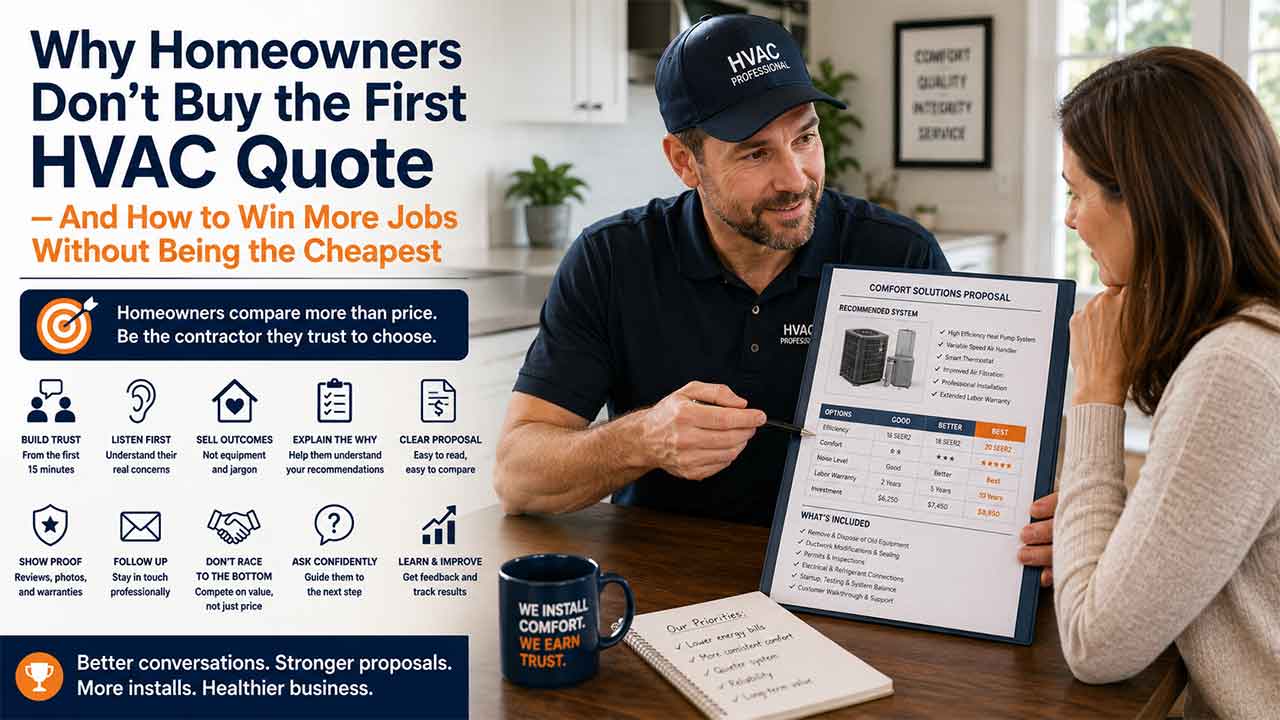
Why Homeowners Don’t Buy the First HVAC Quote—and How to Win More Jobs Without Being the Cheapest
Learn what homeowners are really comparing, how to build trust during the estimate, and how to close more HVAC jobs without automatically lowering your price.
You arrive on time, inspect the system, answer the homeowner’s questions, and prepare what you believe is a competitive proposal. Then nothing happens. The customer stops responding or lets you know that another company won the job.
It is easy to assume that the other contractor was cheaper. Sometimes that is true. However, homeowners rarely compare HVAC proposals using price alone. They are also comparing confidence, communication, professionalism, warranty protection, responsiveness, and how well each contractor helped them understand the decision.
The goal is not to pressure every homeowner into signing during the first appointment. The goal is to make your company the standard against which every other proposal is measured. When the homeowner understands what you recommend, trusts the people behind the work, and can clearly see the value in your proposal, you have a much better chance of winning the job without being the lowest bidder.
Expect Homeowners to Collect Multiple Quotes
Replacing a heating and cooling system is a major household expense. It is reasonable for a homeowner to speak with more than one contractor before making a decision.
Do not treat the fact that they are collecting estimates as an objection or a sign that they are not serious. Instead, assume that your proposal will be compared with at least one other option and make yours easier to understand, easier to trust, and easier to act on.
Become the Quote Everyone Else Is Compared Against
- Arrive when promised and communicate delays before the appointment.
- Ask thoughtful questions before discussing equipment.
- Inspect more than the model number on the existing system.
- Explain your findings in plain language.
- Provide a complete written scope of work.
- Make warranties, payment terms, and next steps easy to find.
- Follow up without applying unnecessary pressure.
Build Trust Before Discussing Equipment
The sales process begins before you explain efficiency ratings or equipment options. Homeowners form opinions based on how your company answers the phone, confirms the appointment, arrives at the property, and treats the home.
Small details can make a large difference because they reduce uncertainty. A homeowner may not be able to judge refrigerant piping or airflow calculations, but they can judge whether you appear organized, respectful, and prepared.
Details Homeowners Notice
- A clearly identified vehicle and professional appearance
- A friendly introduction and confirmation of why you are there
- Shoe covers or floor protection when appropriate
- Permission before entering rooms or moving household items
- Care around pets, children, landscaping, and personal belongings
- Attention during the conversation rather than constant phone use
- A clean work area after the inspection
Trust-Building Behavior
“Before I recommend equipment, I’d like to understand what you like and dislike about the current system and look at the ductwork, electrical setup, and airflow.”
Trust-Damaging Behavior
Walking directly to the outdoor unit, checking the data plate, and presenting a replacement price without asking about comfort problems or inspecting the rest of the system.
Listen Before Recommending a Solution
Many HVAC sales conversations become product presentations too quickly. The contractor starts discussing brands, efficiency levels, rebates, and financing before understanding what the homeowner is trying to solve.
The homeowner may care about a bedroom that never cools, excessive noise, high utility costs, humidity, allergies, unreliable equipment, or the fear of another major repair. Those concerns should shape the recommendation and the way it is presented.
Questions That Reveal What Matters
- Which rooms are difficult to keep comfortable?
- What do you dislike most about the existing system?
- Has the system been reliable?
- Are utility costs a major concern?
- Is noise an issue indoors or outside?
- Does anyone in the household have air-quality concerns?
- How long do you expect to remain in the home?
- Are you more concerned about the initial investment or long-term operating cost?
- Is there a specific budget or monthly payment you are trying to stay within?
Sell Outcomes Instead of Model Numbers
Equipment specifications matter, but most homeowners are not excited about purchasing compressors, coils, blowers, and control boards. They are purchasing comfort, reliability, lower operating costs, quieter operation, and peace of mind.
Translate technical features into outcomes the homeowner can understand. This does not mean oversimplifying or making promises you cannot support. It means connecting the feature to the reason it matters.
| Technical Feature | Homeowner-Focused Explanation |
|---|---|
| Variable-capacity operation | The system can adjust its output instead of operating only at full capacity, which may provide steadier temperatures and quieter operation. |
| Two-stage furnace | The furnace can operate at a lower output during milder weather and use full output when the home needs it. |
| Higher-efficiency blower motor | The blower can use less electricity and may offer better control over airflow than an older basic motor. |
| Improved filtration | The system can capture more airborne particles when the filter and duct design are appropriate. |
| Added return-air capacity | The blower can receive the air it needs more easily, which may reduce noise and improve airflow. |
| Communicating thermostat | The control can coordinate advanced equipment functions and provide more detailed operating information. |
| Surge protection | The added device helps protect sensitive electronic components from certain electrical surges. |
A homeowner is more likely to value an upgrade when they understand how it connects to a problem they already want to solve.
Explain the Reason Behind Every Recommendation
Unexplained recommendations can sound like unnecessary upsells. When you recommend duct modifications, electrical work, a different equipment size, a new thermostat, or an accessory, show the homeowner why it is needed.
Use measurements, photos, observations, and clear explanations. The goal is not to overwhelm the homeowner with technical details. The goal is to make the recommendation understandable and credible.
Clear Explanation
“The return opening is smaller than what this blower needs. Enlarging it should reduce restriction and help the new system move air more effectively.”
Unclear Explanation
“You need a bigger return. We add one to most of our installations.”
Ways to Make Recommendations Easier to Understand
- Show the homeowner a photo of the issue.
- Point out the affected component during the walkthrough.
- Explain what may happen if the issue is not corrected.
- Separate required work from optional improvements.
- Include the recommendation in the written scope.
- Avoid criticizing another contractor when you do not know the full history.
Make the Proposal Easy to Understand
A strong in-home conversation can be undermined by a confusing estimate. The proposal should help the homeowner remember what you discussed and compare your scope with competing quotes.
Do not assume that a customer understands equipment abbreviations, model numbers, warranty terminology, or the difference between included and optional work.
A Professional Proposal Should Clearly Show
- Complete equipment model numbers
- Heating and cooling capacity
- Efficiency ratings when applicable
- Thermostat and accessory models
- Ductwork, electrical, drain, and refrigerant-line work
- Permit and inspection responsibilities
- Removal and disposal of old equipment
- Startup and testing procedures
- Manufacturer and labor warranty terms
- Estimated installation timing
- Payment schedule and financing terms
- Possible exclusions or additional costs
| Weak Proposal Language | Clearer Proposal Language |
|---|---|
| Install new high-efficiency system | Lists each major component, model number, capacity, efficiency, controls, and included accessories |
| Duct modifications included | Identifies the transition, return, supply, sealing, or balancing work that will be performed |
| Standard warranty | Lists manufacturer parts coverage, registration requirements, labor coverage, and exclusions |
| Electrical as needed | Explains which electrical work is included and what would require an added charge |
| Installation included | Defines removal, placement, connections, startup, testing, cleanup, and homeowner orientation |
Offer Clear Options Without Creating Confusion
Providing choices can help homeowners find the right balance of comfort, features, warranty protection, and budget. However, too many options can make the decision harder and delay the sale.
A simple good-better-best structure can work well when the differences are meaningful and explained honestly. Each option should solve the core problem, while upgraded options provide additional benefits.
| Option | How to Position It |
|---|---|
| Essential | A reliable solution that addresses the immediate replacement need and includes a professional installation. |
| Enhanced Comfort | Adds features such as staging, quieter operation, better humidity control, improved filtration, or a stronger labor warranty. |
| Premium Performance | Adds advanced capacity control, communicating controls, higher efficiency, premium accessories, or expanded protection. |
Keep Options Easy to Compare
- Limit the number of choices.
- Use the same categories for every option.
- Explain the practical difference between options.
- Identify which option you recommend and why.
- Show both total price and financing information when appropriate.
- Do not remove essential installation steps from the lowest-priced option.
The homeowner should feel that every option is professionally designed, not that the least expensive choice is intentionally incomplete.
Show Proof of Your Work and Reputation
Homeowners are being asked to trust your company with an expensive system and work inside their home. Claims such as “we provide quality installation” are stronger when supported by evidence.
Useful Forms of Proof
- Recent customer reviews
- Before-and-after installation photos
- Photos showing neat mechanical rooms and equipment connections
- Technician certifications and training
- License and insurance documentation
- Written labor warranty terms
- Examples of completed projects similar to the homeowner’s
- A complete Installer Network profile
- Professional team photos and company information
Choose examples that help the homeowner understand what makes your work different. A gallery of clean, organized installations may communicate more than a long explanation about craftsmanship.
Stop Competing Only on Price
Price matters. Contractors should not pretend otherwise. However, when the homeowner sees no meaningful difference between companies, the lowest price becomes the easiest way to decide.
Your job is not to avoid discussing price. Your job is to help the homeowner understand what the price includes and why the scope, workmanship, warranty, and support may differ from another proposal.
Value You Can Explain
- System sizing and design work
- Duct and airflow evaluation
- Experienced installation crews
- Better materials and installation practices
- Permits and inspections
- Documented startup and commissioning
- Longer labor warranty coverage
- Responsive service after installation
- Employee training and supervision
- Clear communication throughout the project
Value-Based Response
“I may not be able to match that total without seeing the other scope. Let’s compare the equipment, ductwork, permit coverage, startup process, and labor warranty so you know whether the proposals include the same work.”
Price-Only Response
“Tell me their price and I’ll see if my manager will beat it.”
If you immediately discount the job without discussing scope, you may unintentionally confirm the homeowner’s belief that the original price was inflated.
Handle Objections Without Becoming Defensive
An objection is not always a rejection. It may mean the homeowner needs more information, additional time, a different payment structure, or reassurance about the decision.
Listen to the complete concern before responding. Avoid interrupting, criticizing a competitor, or treating the question as a challenge to your expertise.
| Homeowner Concern | Helpful Response |
|---|---|
| “Your price is higher.” | “That is fair to ask about. Let’s compare the equipment, included work, warranty, and testing so we can identify where the difference is.” |
| “I need to think about it.” | “Of course. Is there a particular part of the proposal you would like me to explain before I leave?” |
| “Another contractor recommended a larger unit.” | “I can show you how we arrived at this capacity and discuss the assumptions that might cause two recommendations to differ.” |
| “We cannot afford that payment.” | “Let’s review the available equipment and financing options to see whether there is a solution that still addresses the main comfort problem.” |
| “We want to get another quote.” | “That makes sense. I’ll make sure you have the model numbers, scope, and warranty details so you can compare the proposals accurately.” |
Ask Confidently for the Next Step
Some contractors provide an excellent inspection and presentation but finish with a vague statement such as, “Let me know what you decide.” That leaves the homeowner without a clear next step.
Asking for the sale does not require pressure. It can simply mean helping the homeowner move forward when they are ready.
Low-Pressure Ways to Ask
- “Which of these options feels like the best fit for your home?”
- “Would you like us to reserve an installation date?”
- “Is there anything preventing you from moving forward with this option?”
- “Would it help to review the financing terms together?”
- “Are you comfortable approving the proposal today, or is there additional information you need?”
A direct question can uncover concerns that the homeowner may otherwise leave unspoken. It also gives you an opportunity to clarify the proposal before the customer begins comparing it from memory.
Use a Professional Follow-Up Process
Many contractors lose jobs because they never follow up. Others follow up so aggressively that the homeowner feels pressured. A simple, consistent process can keep your company visible without becoming intrusive.
| Timing | Purpose | Example Message |
|---|---|---|
| Same day | Thank the homeowner and deliver the proposal | “Thank you for meeting with me today. I’ve attached the proposal and included my contact information in case questions come up.” |
| Two or three days later | Offer clarification | “I wanted to make sure you received everything and see whether any part of the recommendation needs clarification.” |
| About one week later | Check the decision status | “I’m checking in to see whether you are still considering the project or need any additional information from us.” |
| Final follow-up | Leave the door open professionally | “I do not want to crowd your decision. I’ll close out my follow-up for now, but I’m happy to help if questions come up later.” |
Follow-Up Best Practices
- Ask which communication method the homeowner prefers.
- Keep messages short and useful.
- Reference specific questions or priorities from the appointment.
- Do not send repeated generic messages.
- Provide updated availability only when it is accurate.
- Respect a clear request to stop contacting the homeowner.
Learn From the Jobs You Lose
Not every qualified lead will become a customer. Price, timing, financing, relationships, availability, equipment preference, or personal comfort may lead the homeowner to choose another company.
When appropriate, ask for brief feedback without trying to reopen the sale or argue with the decision.
A Simple Feedback Request
“Thank you for letting me know. We are always working to improve our process. If you are comfortable sharing, what was the biggest factor in your decision?”
What You May Learn
- The homeowner needed an earlier installation date.
- Another contractor offered better financing.
- The competing proposal was easier to understand.
- The homeowner valued a longer labor warranty.
- Another company had stronger reviews or more project photos.
- The homeowner felt more comfortable with the other salesperson.
- Your follow-up was too slow.
- The customer truly selected the lowest price.
Look for patterns across multiple lost opportunities rather than overreacting to one customer’s response.
Track What Improves Your Close Rate
Closing more jobs requires more than telling the sales team to work harder. Track enough information to understand which leads, representatives, services, and processes produce the best results.
| Measurement | What It Can Reveal |
|---|---|
| Estimates completed | The number of opportunities generated during the period |
| Jobs sold | The number of proposals converted into approved work |
| Close rate | The percentage of estimates that become jobs |
| Average sold price | Whether your team is presenting and selling complete solutions |
| Time to deliver proposal | Whether delays are allowing competitors to gain an advantage |
| Follow-up completion | Whether representatives consistently use the process |
| Lead source | Which marketing channels produce qualified opportunities |
| Reason lost | Common obstacles involving price, timing, financing, trust, or scope |
| Option selected | Which equipment and warranty choices homeowners prefer |
Use the information for coaching rather than punishment. Review successful proposals and conversations to identify habits that other team members can adopt.
Common Reasons a Strong HVAC Proposal Still Loses
- The homeowner did not clearly understand why your recommendation was different.
- The proposal was delivered later than competing estimates.
- Model numbers, warranties, or included work were difficult to find.
- The homeowner could not find enough reviews or recent installation photos.
- The sales conversation focused on equipment instead of the homeowner’s concerns.
- No one asked whether the customer was ready to move forward.
- The company failed to follow up.
- Financing options were unclear or unavailable.
- The proposed installation date did not meet the homeowner’s needs.
- The contractor reduced the price before establishing value.
HVAC Sales Checklist
Use this checklist to create a more consistent homeowner experience during replacement estimates.
- The appointment was confirmed in advance.
- The representative arrived on time or communicated a delay.
- The homeowner’s comfort concerns were discussed first.
- The complete system and visible ductwork were inspected.
- System sizing was evaluated and explained.
- Recommendations were connected to homeowner priorities.
- Required work was separated from optional upgrades.
- Technical features were translated into practical benefits.
- Photos or measurements supported important recommendations.
- The proposal included complete equipment details.
- The installation scope was clearly documented.
- Warranty coverage was explained in writing.
- Options were easy to compare.
- Reviews and project photos were easy to access.
- The representative asked for the next step.
- The homeowner’s preferred follow-up method was recorded.
- Follow-up messages were scheduled.
- Lost-job feedback was requested appropriately.
- The result and reason won or lost were tracked.
Frequently Asked Questions
Why Do Homeowners Get Multiple HVAC Quotes?
HVAC replacement is a significant purchase, and homeowners often want to compare equipment, installation scope, warranty protection, financing, company reputation, and price before deciding.
Should I Lower My Price When a Homeowner Has Another Quote?
Not automatically. First compare the equipment, scope, permits, ductwork, accessories, testing, and warranties. The proposals may not include the same work. Discounting immediately can reduce margin without addressing the homeowner’s actual concern.
How Many Times Should an HVAC Contractor Follow Up?
A small number of useful, respectful follow-ups is generally more effective than repeated generic messages. Confirm the homeowner’s preferred communication method and stop when they clearly decline or ask not to be contacted.
Should HVAC Contractors Offer Good-Better-Best Options?
Options can help homeowners compare comfort, efficiency, warranty, and budget priorities. Keep the choices limited, make the differences clear, and ensure every option includes the work required for a professional installation.
What Should I Say When a Competitor Is Cheaper?
Acknowledge the concern and offer to compare the proposals by equipment, included work, testing, permits, and warranties. Avoid attacking the competitor or claiming the other proposal is inferior without reviewing it.
When Should I Ask for the Sale?
After the homeowner understands the recommendation, options, pricing, and next steps, ask whether they are comfortable moving forward or whether another concern needs to be addressed.
What Is the Best Way to Improve an HVAC Close Rate?
There is no single tactic. Strong results generally come from better lead quality, thoughtful inspections, homeowner-focused communication, clear proposals, useful financing, credible proof, consistent follow-up, and learning from both won and lost jobs.
Final Thoughts
Winning more HVAC replacement jobs does not require becoming the cheapest contractor in the market. It requires helping homeowners understand what they are buying, why you recommend it, and why they can trust your company to install and support it properly.
Listen before presenting equipment. Connect technical features to meaningful outcomes. Document the complete scope. Show proof of your work. Ask confidently for the next step, and follow up in a way that is useful rather than aggressive.
Some homeowners will still select the lowest price. Others will choose based on timing, financing, or an existing relationship. However, when your sales process consistently builds confidence and communicates value, you give your company a much stronger opportunity to win profitable work without racing competitors to the bottom.
Join the HVAC Installer Network
Create an installer listing to help homeowners discover your business, learn about your services, view your company information, and connect with you about installation opportunities in your service area.