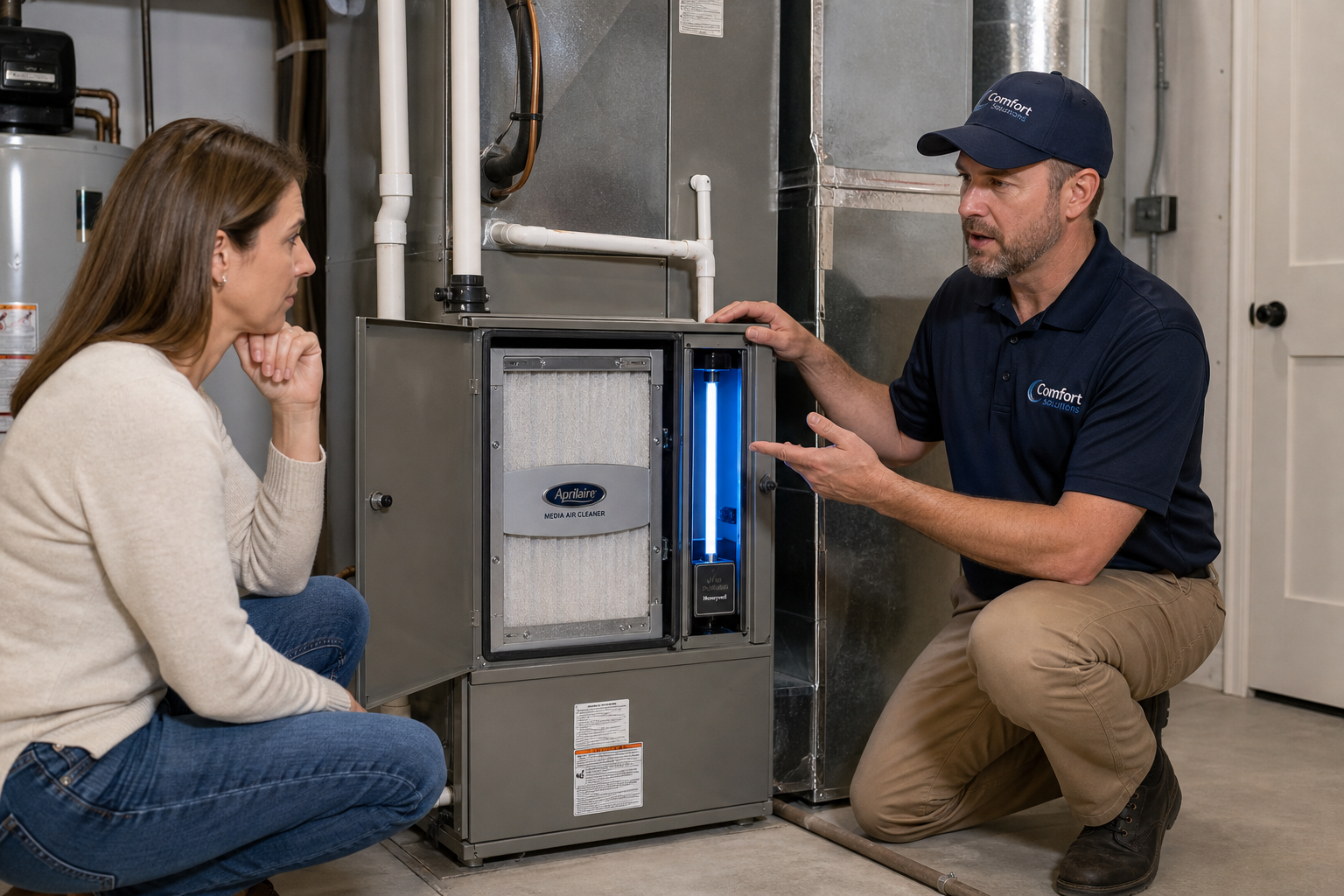
Should You Add an HVAC Air Cleaner or UV Light? What Homeowners Should Know Before Upgrading
A practical guide to what these indoor air quality add-ons actually do, where they can help, and when simpler improvements may matter more.
If you have been looking at ways to improve indoor air quality, you have probably seen HVAC add-ons like media air cleaners, electronic air cleaners, UV lights, and combination systems. On paper, they can sound like easy answers for dust, odors, allergies, germs, and general air quality concerns. In real homes, the answer is more nuanced.
An HVAC air cleaner or UV light can be useful, but neither product fixes every indoor air problem. Some homes benefit from better filtration. Others need humidity control, duct sealing, cleaning habits, source removal, or ventilation adjustments first. And in some cases, a premium add-on may deliver less improvement than a basic correction to airflow, filter choice, or moisture management.
This guide is meant to help you sort through the claims and make a practical decision. We will look at what air cleaners do, what UV lights do, where they overlap, what maintenance they require, and when they are likely to be worth considering.
The most effective indoor air quality plan usually starts with basics: the right filter, a system that moves air properly, controlled humidity, and fewer pollution sources inside the house. Add-on products can help, but they work best when the fundamentals are already in place.
What is the difference between an HVAC air cleaner and a UV light?
An HVAC air cleaner is mainly about filtration or particle capture. It is designed to remove things moving through the air stream, such as dust, pollen, lint, pet dander, and in some cases smaller airborne particles. Depending on the design, this may be done with a thicker media filter, an electronic collector, or a more specialized cabinet attached to the return side of your HVAC system.
A UV light is different. It uses ultraviolet light in specific parts of the HVAC system to target biological growth or microorganisms. In residential systems, UV lights are commonly installed near the indoor coil or drain area, where moisture can support microbial growth. Some products are also marketed for treating moving air inside the duct system, though effectiveness can vary based on exposure time, placement, and system design.
In simple terms, an air cleaner tries to capture particles. A UV light tries to disrupt biological growth or certain microorganisms with light exposure. One is not a substitute for the other, and neither one automatically improves every air quality complaint.
This distinction matters because homeowners often buy the wrong tool for the problem. If your issue is visible dust on furniture, a UV light is unlikely to solve it. If your issue is recurring growth on a wet indoor coil, better filtration alone may not fully address that moisture-related problem.
What problems can these upgrades realistically help with?
The best way to think about these products is to match them to specific problems instead of broad promises. A good air cleaner may help reduce airborne particles circulating through the HVAC system. That can be useful in homes with pets, frequent dust, nearby construction, seasonal pollen, or household members who are sensitive to particulates.
A UV light may help in systems where the indoor coil stays damp and is prone to buildup. In that situation, keeping the coil area cleaner may help maintain airflow and reduce musty conditions developing inside the equipment cabinet. Some homeowners also choose UV products because they want another layer of treatment within the HVAC system, especially when discussed as part of a larger IAQ plan rather than a standalone fix.
There are also homes where both may play a role. For example, a homeowner with pets, a high-efficiency system, and a history of coil moisture issues may reasonably consider better filtration plus coil-focused UV treatment. Even then, the products should be viewed as support measures, not miracle devices.
What they usually do not do is eliminate the need for routine cleaning, moisture control, source removal, and proper maintenance. If a home has strong cooking odors, off-gassing from materials, crawlspace moisture, dirty duct interiors, or poor bathroom ventilation, those root issues often matter more than any add-on in the ductwork.
- Air cleaners are typically most helpful for dust, pollen, pet dander, and circulating particles.
- UV lights are typically most helpful near wet HVAC components where biological growth may develop.
- Neither option replaces source control, humidity control, and regular HVAC service.
- Results depend on product quality, proper installation, and your specific home conditions.
Where do IAQ marketing claims go too far?
This is where homeowners should slow down. Indoor air quality products are often marketed with sweeping language that suggests one upgrade can solve allergies, illness concerns, odors, dust, and cleanliness all at once. In practice, homes are more complicated than that.
For example, reducing airborne particles inside the HVAC system does not necessarily mean every room will suddenly feel dust-free. Some dust settles before it ever reaches the return. Some comes from fabrics, foot traffic, attic leakage, or unsealed duct joints. Likewise, a UV light inside the air handler does not clean your furniture, sanitize every surface, or compensate for standing moisture elsewhere in the house.
Another common issue is confusing laboratory-style claims with whole-home results. Real HVAC systems have varying airflow, cycling times, duct layouts, and moisture conditions. A product that sounds impressive in a brochure may perform differently in a house with short run times, dirty coils, leaky return ducts, or an oversized system.
Homeowners should also be careful about products presented as maintenance-free. Filters need replacement. Electronic systems may need cleaning. UV bulbs do not last forever. If upkeep is ignored, performance can drop and the value of the upgrade goes with it.
A good contractor should be willing to explain limitations, not just benefits. If someone suggests a high-priced IAQ package without asking about your actual concerns, that is a sign to ask more questions.
When does an HVAC air cleaner make sense?
An HVAC air cleaner makes the most sense when your main concern is particle reduction and your existing filter setup is limited. Many homes rely on a basic 1-inch filter slot, which can be adequate in some situations but may not offer the same dust-holding capacity or filtration performance as a deeper media cabinet designed for better airflow and surface area.
If you constantly notice fine dust, have multiple pets, live in a high-pollen area, or want a cleaner return-air setup than a thin disposable filter can provide, a properly matched media air cleaner may be worth considering. In many homes, this is the most practical IAQ upgrade because it is simple, familiar, and directly tied to a common complaint.
That said, stronger filtration is not always better if the system is not designed for it. A filter that is too restrictive can reduce airflow and create comfort or efficiency problems. This is why the cabinet design, filter size, and pressure drop matter. The goal is to improve filtration without choking the system.
Electronic air cleaners are another category. Some homeowners like them because they can target finer particles, but they also tend to involve more cleaning and maintenance than passive media filters. Whether they are a good fit depends on how willing you are to keep up with that maintenance and whether the system is well matched to the product.
An air cleaner may be especially reasonable if your contractor identifies one or more of the following conditions.
- Your current filter arrangement is undersized or poorly sealed.
- You have recurring dust or pet dander concerns despite regular housekeeping.
- Household members are sensitive to airborne particles.
- Your system has room for a properly sized media cabinet or approved filtration upgrade.
- You want a lower-maintenance IAQ upgrade than some electronic or active treatment devices.
In many cases, the smart move is not the fanciest air cleaner available. It is the one that improves filtration while preserving healthy airflow and staying easy to maintain.
When does a UV light make sense?
A UV light usually makes the most sense when there is a moisture-related reason for adding one. The most common example is an indoor coil or nearby cabinet area that tends to stay damp and is difficult to keep clean. If a contractor has documented buildup in that area, a UV light aimed at the coil section may be part of a reasonable plan.
This can be especially relevant in warm, humid climates or in systems that run long enough for condensation to be a persistent factor. If your concern is a musty smell near the equipment, visible buildup on wet components, or repeated maintenance around the coil area, UV may deserve a closer look.
Where UV gets less clear is when it is sold as a broad whole-home cure-all. A light installed in the equipment can only affect what passes through that treatment zone, and only under the conditions created by your system. It does not replace cleaning dirty ducts, fixing drainage issues, sealing a damp crawlspace, or controlling indoor humidity.
Homeowners should also know that placement matters. Coil-surface UV and in-air-stream UV are not identical use cases. A product intended to irradiate a wet coil surface serves a different purpose than one marketed for moving air treatment. Ask exactly where the light will be installed and what problem it is meant to address.
A UV light is more likely to be worth considering when the recommendation sounds specific rather than generic. If the proposal is tied to coil cleanliness, moisture exposure, and access limitations inside the equipment, that is more credible than a vague claim that it will solve every indoor air issue in the home.
What maintenance should homeowners expect?
No IAQ upgrade is truly set-and-forget. Before you buy, it is worth understanding the maintenance habits each option requires.
With media air cleaners, the main task is replacing the filter on the schedule recommended for your home conditions and system use. Homes with pets, construction dust, or heavy runtime may need more frequent checks. A neglected filter can become restrictive and reduce system performance.
Electronic air cleaners often require cleaning collector components rather than simply replacing a filter. If that cleaning is skipped, efficiency can drop. Some homeowners are happy to keep up with that routine, while others prefer the simplicity of a media cabinet.
UV lights require bulb replacement at intervals based on the product design and manufacturer guidance. The light may still appear to glow even when its effective output has declined, so replacement timing matters. The equipment area should also still be inspected during normal HVAC maintenance to confirm the coil, drain, and surrounding surfaces are in good condition.
You should also ask whether access for service is straightforward. A good installation should allow future maintenance without turning a simple visit into a major disassembly job.
If you know you are unlikely to keep up with extra maintenance, choose the simplest solution that addresses your main problem. A well-sized media filter cabinet that actually gets serviced often delivers more real-world value than a more advanced device that is ignored.
As for cost, pricing varies by product type, system layout, labor requirements, and local market conditions. Local requirements vary as well, especially if electrical modifications are needed for UV equipment or if access changes are involved. Instead of focusing only on upfront price, compare the total picture: installation, replacement parts, maintenance time, and expected benefit for your specific concern.
What should you check before buying either upgrade?
Before paying for an air cleaner or UV light, make sure the rest of the system is not undermining the result. Many indoor air complaints trace back to problems that should be corrected first.
Start with the filter setup you already have. Is the filter the correct size? Does it fit tightly, or is air bypassing around it? Is the return ductwork sealed well? Is airflow healthy across the system? If the answer to any of these is no, a premium add-on may underperform until those basics are fixed.
Next, think about moisture. If indoor humidity is high, or if the system has drainage, insulation, or airflow issues that leave components wet for long periods, address those causes directly. UV may support a moisture-prone coil area, but it should not be used to avoid fixing drainage or humidity problems.
Then consider pollution sources inside the home. Pets, smoking, candles, attached garages, renovation materials, cleaning products, and cooking habits all affect air quality. If the source remains strong, treatment inside the HVAC system may only provide partial relief.
It is also smart to confirm that the upgrade fits your equipment and service habits. A contractor should evaluate available space, airflow impact, electrical needs, and long-term maintenance access. If the proposal skips those details, ask for clarification.
- Verify your current filter setup is properly sized and sealed.
- Address drainage, moisture, and humidity issues first.
- Look at pollution sources inside the home, not just HVAC accessories.
- Ask how the product affects airflow, access, and routine service.
- Choose the upgrade that matches your specific complaint rather than the broadest marketing promise.
What questions should you ask an HVAC contractor?
A good IAQ recommendation should be tied to your home, not just a sales sheet. Asking a few practical questions can quickly tell you whether the recommendation is thoughtful.
First, ask what exact problem the product is supposed to address. If the answer is general and unfocused, keep probing. You want to hear a clear link between the recommendation and your concern, such as dust load, pet dander, coil hygiene, moisture, or a poor existing filter arrangement.
Second, ask what simpler fixes have already been ruled out. For example, would a better sealed media cabinet solve most of the issue? Does humidity need attention first? Is the return leaking attic or crawlspace air? If a contractor jumps straight to accessories without checking fundamentals, be cautious.
Third, ask about maintenance. Who replaces filters or bulbs, how often should they be checked, and what happens if maintenance is skipped? This matters as much as the equipment itself.
Finally, ask where the product will be installed and whether it affects airflow, service access, or future repair complexity. A quality installation should improve the system, not make routine service harder.
- What problem in my home is this meant to solve?
- Why is this option better than simply improving my current filter setup?
- How will this affect airflow and system performance?
- What maintenance will I need to handle each year?
- Where exactly will it be installed?
- What results should I realistically expect, and what will it not do?
Frequently Asked Questions
Is a UV light better than a high-quality HVAC filter?
They do different jobs. A high-quality filter or media air cleaner is usually the first place to focus if your concern is dust, pollen, or pet dander. A UV light is more situation-specific and is often considered when moisture around the coil or cabinet area is part of the problem.
Will an HVAC air cleaner get rid of dust in my house?
It may help reduce circulating airborne particles, but it will not eliminate all dust. Some dust comes from surfaces, fabrics, foot traffic, building leaks, and everyday living. Better filtration is useful, but housekeeping, duct sealing, and source control still matter.
Do UV lights in HVAC systems require maintenance?
Yes. UV bulbs need periodic replacement according to product guidance, and the surrounding equipment still needs normal inspection and cleaning. They are not maintenance-free.
Can I install an air cleaner or UV light on any HVAC system?
Not always. The system needs enough space, proper airflow, and suitable electrical and service access. Some homes are good candidates, while others need a different approach. A contractor should verify compatibility before recommending an upgrade.
Should I get both an air cleaner and a UV light?
Only if there is a clear reason for both. Some homes do benefit from improved filtration plus coil-focused UV treatment, but many homeowners will get better value from addressing one main issue well rather than buying a bundle of accessories they do not really need.
Final Thoughts
If you are deciding between an HVAC air cleaner or UV light, the right answer depends on the problem you are trying to solve. Air cleaners are generally better suited to particle concerns like dust, pollen, and pet dander. UV lights are usually more compelling when moisture-prone HVAC components need targeted treatment. Neither upgrade should be treated as a one-box answer to every indoor air quality complaint.
For most homeowners, the smartest path is to start with fundamentals: proper filtration, sealed returns, clean equipment, good drainage, manageable humidity, and fewer indoor pollution sources. Once those basics are in place, an IAQ add-on may be worthwhile if it addresses a clearly identified issue and comes with realistic expectations.
If a contractor can explain what problem the product solves, how it will be installed, what maintenance it needs, and what results you should reasonably expect, you are much more likely to make a decision that improves your home instead of just adding hardware.
Find an HVAC Installer Near You
Search the HVAC Installer Network to find local professionals, review installer profiles, and connect with contractors serving your area.
This article is for general informational purposes only and is not a substitute for in-home evaluation by a qualified HVAC professional. Product performance depends on system design, installation quality, maintenance, and home conditions. Local requirements vary, and any equipment changes should be reviewed for compatibility, access, and safety.