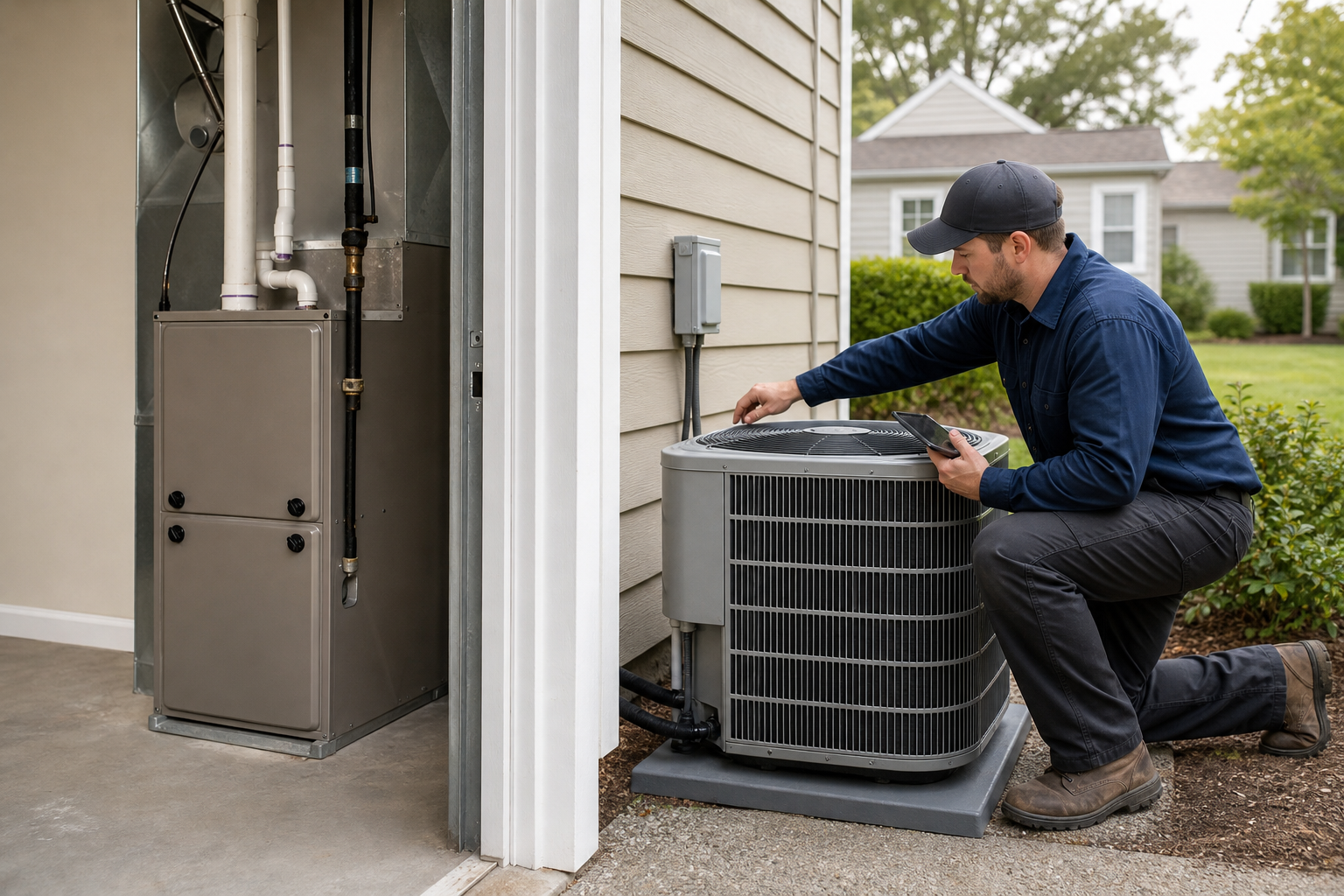
Should You Replace Your Furnace and Air Conditioner at the Same Time?
A practical guide to deciding based on system age, repair history, efficiency, compatibility, comfort, and budget.
Many homeowners face this question when one part of the system starts failing: if the furnace is old, should the air conditioner go too, or vice versa? It is a fair question because heating and cooling equipment often work as a matched system, even though they are different pieces of equipment.
In some homes, replacing both at the same time is the smartest move. In others, it can be unnecessary and more expensive than it needs to be. The right choice depends on how old each piece is, how well they have been maintained, whether they are properly matched, what refrigerant the AC uses, and how long you plan to stay in the home.
This guide will help you think through the decision in plain language. It is not about pushing a full replacement every time. It is about understanding when a combined replacement makes sense, when a one-sided replacement may still be reasonable, and what questions to ask before you sign anything.
If your furnace and AC are close in age, both are out of warranty, and one major component has already failed, a dual replacement is often worth serious consideration because it can reduce compatibility problems and help you avoid paying for two separate major projects within a short time.
Why do homeowners replace both systems together?
The main reason is simple: timing. In many homes, the furnace and air conditioner were installed together. That means they have been exposed to the same years of use, the same maintenance habits, and the same home conditions. If one is reaching the end of its useful life, the other may not be far behind.
Another reason is system matching. The outdoor air conditioner and the indoor evaporator coil need to be compatible to deliver the performance the equipment is designed for. In many furnace replacements, the contractor is already working around the indoor coil, refrigerant connections, drain setup, venting, controls, and airflow. Replacing everything together can simplify the job and reduce the chance that an old component limits the performance of a new one.
Some homeowners also choose a combined replacement to avoid disruption. One installation means one project, one crew visit, one round of scheduling, and one period of learning a new thermostat or system setup. If you already know both pieces are aging, it can be more practical to handle it all at once instead of paying for another major install a year or two later.
That said, replacing both together is not automatically the best decision. If one unit is much newer, in good condition, and fully compatible with a replacement on the other side, you may not need a full system changeout.
When is replacing both usually the better choice?
A combined replacement is often the stronger option when both systems are older and one has already had a major failure. If your furnace and AC were installed around the same time and are both showing their age, replacing only one can leave you with an awkward in-between system that may not perform as well or last as long as you hoped.
It also makes sense when you have repeated repair costs. One expensive repair on its own may not justify replacing everything. But if the furnace has needed service, the AC has struggled through recent summers, and you are starting to lose confidence in both, doing both together can be the more practical decision.
Another common reason is refrigerant transition. If your air conditioner uses an older refrigerant and major AC components are failing, you may find that repair options become less attractive. In those cases, homeowners sometimes decide that if they are already replacing the cooling side, it is worth evaluating the heating side too, especially if the furnace is old enough that replacement is likely in the near future.
Comfort issues can also point toward a full replacement. If your home has weak airflow, humidity problems, noisy operation, or uneven performance and the equipment is old, installing matched new components may give the contractor a better opportunity to improve airflow settings, control strategy, and overall system operation. The equipment alone does not solve every comfort problem, but a fresh matched system can create a better starting point.
- Both furnace and AC are older and close in age.
- One system has failed and the other is not far behind.
- You have had multiple repairs in recent seasons.
- The AC uses older refrigerant and major cooling repairs are looming.
- You want one installation project instead of two separate disruptions.
- You plan to stay in the home long enough to value long-term reliability.
When might it be reasonable to replace only one?
Replacing only one component can still be a sensible choice when the other part of the system is meaningfully newer, in solid condition, and compatible with the replacement equipment being proposed. For example, if the air conditioner is only a few years old and the furnace heat exchanger has failed, it would be reasonable to ask whether the furnace can be replaced without changing the cooling equipment.
The same can be true in reverse. If a furnace is operating safely and reliably but the outdoor condensing unit has suffered a major failure, a cooling-side replacement may be possible without replacing the furnace. The key is making sure the indoor coil, blower, controls, and performance targets can support the new cooling equipment.
Budget is another real factor. Homeowners do not always have the option to replace everything at once, and that is okay. A partial replacement is not automatically a mistake. The important thing is to understand the tradeoffs. You may save money now, but you could face another major project sooner than you would like. You may also end up with some efficiency or compatibility compromises depending on the equipment combination.
Short-term ownership can matter too. If you expect to move relatively soon, you may prioritize a safe, functional, and cost-conscious repair or partial replacement instead of investing in a full system overhaul. There is no universal answer. The best decision fits your home, your timeline, and your budget.
How do age and repair history affect the decision?
Age matters because HVAC equipment usually becomes more failure-prone over time, even if it still runs. Older systems often lose efficiency, develop airflow or ignition issues, and become harder or more expensive to repair. If both pieces were installed together, the age of one tells you something useful about the likely stage of life of the other.
Repair history matters just as much as age. A ten-year-old system with strong maintenance records and very few issues may be a better bet than a younger system with repeated breakdowns, corrosion, or poor installation history. When homeowners focus only on age, they can miss the bigger picture.
Try looking at the last few years honestly. Have you had routine maintenance only, or have you been paying for service calls, control boards, blower motors, inducer motors, refrigerant work, or compressor-related issues? One isolated repair is normal. A pattern of repairs usually signals that replacement deserves serious consideration.
It also helps to think in terms of risk tolerance. Some homeowners are comfortable repairing older equipment if the immediate cost is manageable. Others would rather avoid the stress of another summer or winter failure. Neither approach is wrong. But if reliability has become a concern and both units are aging, replacing both at once can be easier to justify.
A good rule of thumb is to stop looking at a furnace or AC as a single repair decision and start looking at the total pattern: age, safety, breakdown frequency, comfort complaints, and whether you trust the system for the next few seasons.
Why do compatibility and matching matter so much?
Homeowners often hear that HVAC systems should be matched, but the reason is practical, not just technical. Your air conditioner depends on the indoor evaporator coil and the blower inside or attached to the furnace to move the right amount of air and transfer heat correctly. If those components are poorly matched, you can end up with reduced efficiency, weaker humidity control, more noise, and uneven performance.
That does not mean every mixed-age system is a problem. Plenty of homes operate with equipment installed at different times. The question is whether the specific combination is approved, properly sized, and able to deliver acceptable airflow and performance. This is where a knowledgeable contractor matters.
Furnace blower performance is especially important. If the blower cannot support the cooling requirements of a newer air conditioner or heat pump coil setup, the system may not deliver the comfort you expect. In some cases, the installer can make adjustments or recommend compatible components. In other cases, trying to keep one old piece may create too many compromises.
Controls and venting can matter too. Newer equipment may have different staging, communication, electrical, condensate, or venting needs. A contractor should be able to explain whether the proposed equipment is a clean match or whether keeping the older component forces limitations.
For homeowners, the takeaway is simple: do not assume partial replacement is either impossible or automatically fine. Ask whether the exact equipment combination is a proper match, what performance tradeoffs exist, and whether the contractor would choose the same approach in their own home.
What about efficiency, comfort, and monthly operating costs?
Replacing both systems together can improve efficiency, but homeowners should be careful about expecting dramatic savings without context. Real-world energy use depends on your climate, ductwork, thermostat settings, insulation, air leakage, maintenance, and how well the equipment is sized and installed. A new matched system can reduce operating costs, but there is no single savings number that applies to every home.
Comfort may be the more important benefit. A newer blower and properly matched cooling components can improve airflow consistency, reduce short cycling, and help with humidity control during cooling season. A modern furnace may also offer quieter operation or better temperature consistency depending on the equipment type selected.
Still, equipment is only part of the comfort story. If the home has undersized ductwork, major leakage, poor return design, hot upstairs rooms, or inadequate insulation, replacing the furnace and AC alone may not solve those issues. That is why a thoughtful contractor should evaluate the system as a whole instead of selling replacement as a magic fix.
If one unit is much older than the other, replacing only the failing side may leave some efficiency gains on the table. The older remaining component can act as a bottleneck. But if the other unit is still relatively new and in good shape, the difference may not justify replacing it early. The right answer depends on how much useful life remains and whether the matched performance is acceptable.
- Ask how the proposed equipment will affect airflow and humidity control.
- Ask whether the system will be fully matched or partially matched.
- Ask if your ductwork or returns may limit comfort improvements.
- Ask for realistic operating-cost expectations rather than broad promises.
- Ask whether thermostat or control upgrades are needed for the proposed setup.
How should you compare upfront cost versus long-term value?
This is often the hardest part of the decision. Replacing both the furnace and air conditioner at the same time costs more upfront than replacing only one piece. For many households, that alone can determine the path forward. But if both systems are aging, the lower initial price of a partial replacement can be misleading if you end up paying for another major install soon after.
Think of it in terms of project timing and risk. If the remaining older unit fails next season, you may pay for another round of labor, another permit process if required locally, another day or two of disruption, and possibly a less coordinated equipment strategy. Local requirements vary, and your contractor can explain what applies in your area.
There is also value in peace of mind. Many homeowners are willing to spend more now to reduce the chance of another major breakdown in extreme weather. Others need the smallest immediate expense and are comfortable accepting future uncertainty. Again, neither approach is universally right.
One practical way to compare options is to request two or three clear paths from your contractor. For example: repair the failed unit, replace only the failed side, or replace both systems together. Then compare not just price, but expected remaining life of the other equipment, likely comfort outcome, compatibility, and future risk.
Be cautious with hard sales pressure. If someone insists that you must replace both without clearly explaining why, slow down and ask for specifics. A trustworthy contractor should be able to show you the reasoning in plain language and explain the pros and cons of each option.
What should you ask an HVAC contractor before deciding?
The best decision usually comes from better questions. Homeowners do not need to become HVAC experts, but you do want enough clarity to understand whether replacing both is a practical recommendation or just the biggest possible sale.
Start by asking about the condition of each component separately. How much useful life does the contractor think each one has left? What visible wear, test results, or repair history support that opinion? If only one side failed, is the other side actually near the end, or is it still in solid working order?
Then ask about system matching. If you replace only one component, will the remaining equipment be fully compatible with the new equipment? Will there be limits on efficiency, comfort, airflow, or controls? Is the proposed setup manufacturer-approved or otherwise commonly accepted by the contractor for this application?
You should also ask whether there are house-related issues beyond the equipment. If your home has duct problems, return limitations, insulation shortcomings, or drainage concerns, those factors may affect how much value you get from a simple equipment swap.
Finally, ask the contractor to rank the options honestly. Which choice would they make if they planned to stay in the house for several years? Which choice makes sense for a tighter budget? Which choice carries the most future risk? Their answers can tell you a lot.
- How old is each unit, and how much useful life is realistically left?
- What repairs are needed now, and what failures are likely next?
- If I replace only one piece, will the system be properly matched?
- Will the remaining equipment limit efficiency or comfort?
- Does my ductwork or airflow need attention too?
- Are there local permit or inspection requirements for this job?
- What would you recommend if this were your own home?
Frequently Asked Questions
Is it cheaper to replace a furnace and air conditioner together?
It can be more cost-effective in the long run when both systems are older, but it is not always the lowest immediate price. Replacing both at once may reduce repeat labor and future disruption, yet a partial replacement may still be the right move if the other component is newer and in good condition.
Do furnace and AC always need to be replaced together?
No. They do not always need to be replaced together. The decision depends on age, condition, compatibility, efficiency goals, and budget. Some homes do well with a one-sided replacement, while others benefit more from a matched full system replacement.
If my AC fails, should I replace the furnace too?
Possibly, but not automatically. If the furnace is old, has a history of repairs, or may limit the performance of the new cooling equipment, replacing both can make sense. If the furnace is relatively new and compatible, replacing only the AC side may be reasonable.
What if my furnace is fine but my air conditioner is old?
If the furnace is operating safely, has a good blower setup for the new cooling system, and is not near the end of its life, you may be able to replace only the cooling equipment. A contractor should confirm compatibility and explain any tradeoffs.
Will a new furnace and AC fix uneven temperatures in the house?
Not always. New equipment can improve overall performance, but uneven temperatures may also be caused by duct design, airflow restrictions, insulation issues, window exposure, or return-air limitations. A full evaluation is important before assuming equipment alone will solve comfort problems.
Final Thoughts
If you are trying to decide whether to replace your furnace and air conditioner at the same time, the most useful answer is this: sometimes yes, sometimes no, and the difference usually comes down to age, condition, compatibility, and how much future risk you are willing to accept.
Replacing both together often makes the most sense when the systems are close in age, one has already failed, and the other is not far behind. It can also be the cleaner choice when you want a matched setup, one installation process, and fewer surprises in the next few years.
But if one side is still relatively new, reliable, and compatible, a partial replacement may be completely reasonable. The key is to make the decision with clear information rather than pressure. Ask for the tradeoffs, compare your options, and choose the path that fits your home and budget.
Find an HVAC Installer Near You
Search the HVAC Installer Network to find local professionals, review installer profiles, and connect with contractors serving your area.
This article is for general informational purposes only and is not a substitute for an in-home evaluation by a qualified HVAC professional. Equipment compatibility, repairability, sizing, efficiency, venting, refrigerant considerations, and permit or inspection requirements can vary by home and by location. Local requirements vary, so always confirm recommendations with a licensed contractor serving your area.