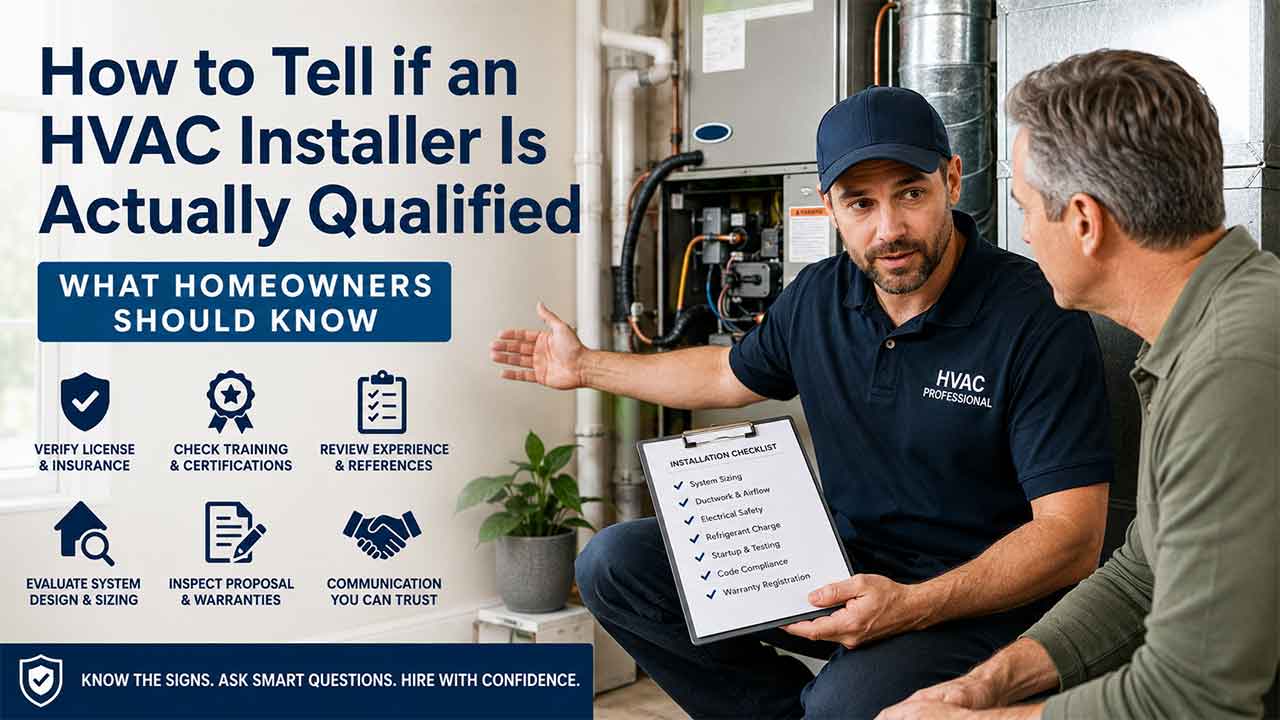
How to Tell if an HVAC Installer Is Actually Qualified
Learn how to evaluate an HVAC contractor’s licensing, training, experience, installation practices, warranties, and reputation before inviting them into your home.
Most homeowners can recognize a clean uniform, a professional-looking truck, and a polished website. Those things may create a good first impression, but they do not necessarily prove that an HVAC installer is qualified to design and install a heating or cooling system correctly.
A qualified installer should understand more than how to connect equipment. The contractor should be able to evaluate your home, calculate its heating and cooling needs, account for airflow, follow manufacturer requirements, comply with local codes, safely handle refrigerant and electrical work, and test the completed system before leaving.
That may sound like a lot to evaluate, especially if you do not work in the HVAC industry. Fortunately, you do not need to inspect every tool or quiz the contractor on technical formulas. You can learn a great deal by asking focused questions, reviewing the proposal carefully, and watching how the company approaches the job.
Verify the Contractor’s License
Licensing rules vary significantly by state, county, and city. Some areas require a statewide HVAC contractor license, while others regulate the work at the local level. Certain types of electrical, gas, plumbing, or refrigeration work may also require separate credentials.
Ask the company which licenses apply to your project and who holds them. When possible, verify the license through the appropriate state or local licensing agency rather than relying only on a number printed on a business card.
What to Confirm
- The license is active and has not expired.
- The company name matches the licensed business.
- The license covers the type of work being proposed.
- The license holder is connected to the company performing the installation.
- There are no serious unresolved disciplinary actions.
Confirm the Company Is Properly Insured
A legitimate contractor should carry insurance appropriate for the work being performed. General liability insurance may help protect against accidental property damage, while workers’ compensation coverage may apply if an employee is injured during the project.
Ask for current documentation rather than accepting a verbal statement that the company is “fully insured.” The certificate should identify the insured business, policy dates, and coverage provider.
A Reassuring Response
“We carry general liability and workers’ compensation coverage. We can provide current certificates before the project begins.”
Reasons to Be Cautious
- The company refuses to provide documentation.
- The certificate is expired.
- The business name does not match the contractor.
- You are told that homeowners insurance will cover everything.
Look for Certifications That Match the Work
Certifications can demonstrate additional training, but not every badge or logo carries the same meaning. Some certifications involve formal testing and continuing education, while others may simply indicate that a contractor attended a short product presentation.
One important federal requirement involves refrigerant handling. Technicians who service, maintain, repair, or dispose of equipment that could release regulated refrigerants generally need the appropriate EPA Section 608 certification.
Manufacturer training can also be valuable when the contractor installs advanced equipment such as inverter-driven heat pumps, communicating controls, zoning systems, or variable-capacity equipment.
Useful Questions to Ask
- Which certifications do the technicians working on my project hold?
- Does the installation crew receive continuing technical training?
- Has the company installed this exact equipment family before?
- Does the manufacturer require special startup or commissioning procedures?
- Who will configure the controls and verify operation?
Evaluate Relevant Experience, Not Just Years in Business
A company that has been operating for many years may have valuable experience, but the total age of the business does not tell the entire story. The specific crew assigned to your home may have different experience than the company owner or salesperson.
Ask about experience that relates directly to your project. Installing a standard gas furnace and air conditioner is different from installing a cold-climate heat pump, dual-fuel system, mini-split, zoning system, or communicating variable-capacity system.
Experience Questions That Matter
- How often do you install this type of system?
- Have you worked in homes similar to mine?
- Who will lead the installation crew?
- How long has the lead installer been performing this type of work?
- Can you show photos of comparable installations?
- Who handles technical support if the crew encounters a problem?
Relevant experience becomes especially important when the project includes unusual ductwork, limited access, older electrical service, fuel conversion, hydronic components, zoning, or major equipment relocation.
Ask How the Contractor Will Size the System
A qualified installer should not select equipment capacity based only on square footage, the size of the existing system, or a quick visual estimate. Proper sizing should account for how much heat the home gains during warm weather and loses during cold weather.
A residential load calculation may consider insulation, windows, air leakage, orientation, ceiling height, local design temperatures, occupancy, and other characteristics of the home.
Replacing the existing equipment with the same capacity may be appropriate, but the contractor should be able to explain why. Older systems are sometimes oversized, and home improvements such as new windows, added insulation, or air sealing may have changed the load.
| Sizing Approach | What It May Indicate |
|---|---|
| “We always use one ton per 500 square feet.” | A rough rule of thumb that may ignore important home-specific factors |
| “We will install the same size you already have.” | The existing system may be used without confirming whether it was sized correctly |
| “We measured the home and evaluated insulation, windows, leakage, and local conditions.” | A more complete effort to match equipment capacity to the home |
| “We also checked whether the duct system can support the required airflow.” | The contractor is considering both equipment capacity and air distribution |
Make Sure the Contractor Evaluates Ductwork and Airflow
New equipment cannot perform properly if the duct system cannot deliver and return the required amount of air. Restricted airflow can affect comfort, efficiency, noise, humidity control, equipment reliability, and in some cases system safety.
A qualified contractor should at least inspect visible ductwork, filter arrangements, supply registers, return-air pathways, and the transitions connecting the equipment to the ducts.
Possible Airflow Concerns
- Rooms that are consistently too hot or too cold
- Whistling registers or noisy return grilles
- Very small or restrictive filters
- Crushed, disconnected, or poorly supported flexible duct
- Inadequate return-air capacity
- Large air leaks around plenums and transitions
- Ductwork that was sized for smaller equipment
The contractor may recommend duct sealing, added returns, larger transitions, balancing adjustments, or other improvements. Those recommendations should be explained and included clearly in the written proposal.
Review the Detail in the Written Proposal
A qualified contractor should provide a written proposal that allows you to understand what is being installed and what work is included. A single total with no equipment models or scope details makes it difficult to compare contractors or resolve disagreements later.
| Proposal Detail | Why It Matters |
|---|---|
| Complete equipment model numbers | Allows you to confirm capacity, efficiency, features, and equipment matching |
| Thermostat and accessory models | Prevents confusion about controls, filtration, humidifiers, or other add-ons |
| Scope of labor | Defines installation, removal, startup, testing, and cleanup responsibilities |
| Ductwork or electrical modifications | Clarifies whether required supporting work is included |
| Permit responsibility | Identifies who obtains permits and pays related fees |
| Warranty terms | Separates manufacturer coverage from contractor labor coverage |
| Payment schedule | Explains deposits, progress payments, and final payment timing |
| Exclusions and possible extra charges | Reduces the risk of unexpected costs during the project |
Confirm the Contractor Follows Permit and Code Requirements
Permit requirements vary by jurisdiction, but a qualified local contractor should know which permits and inspections apply to the proposed work. The contractor should not encourage you to avoid a required permit to reduce cost or speed up the installation.
Code compliance may involve equipment clearances, combustion air, venting, electrical protection, disconnects, drain routing, gas piping, refrigerant line protection, condensate overflow safeguards, and other details.
A permit does not guarantee perfect workmanship, but it provides an additional layer of oversight and creates documentation that may matter during a future home sale or insurance review.
A Professional Approach
“We will confirm the permit requirements, include the applicable fees in the proposal, schedule the inspection, and address any corrections related to our work.”
A Concerning Approach
“Permits are just a way for the city to make money. We can save you some cash if we do not involve them.”
Ask How the Completed System Will Be Tested
A system that turns on is not necessarily a system that has been installed and configured correctly. A qualified installer should perform startup checks and commissioning steps appropriate for the equipment.
Depending on the system, testing may include:
- Verifying supply and return airflow
- Measuring temperature changes across the equipment
- Checking refrigerant charge according to manufacturer procedures
- Confirming electrical voltage and current
- Testing thermostat and control communication
- Checking condensate drainage and overflow protection
- Verifying gas pressure, venting, and combustion safety
- Confirming staging or variable-capacity operation
- Testing safety switches and limits
- Documenting startup readings
Understand Both Equipment and Labor Warranties
Manufacturer warranties and contractor labor warranties are not the same. Manufacturer coverage generally applies to qualifying equipment defects, while a contractor’s labor or workmanship warranty may cover certain installation-related issues and service labor.
Ask for both warranties in writing and review the conditions carefully.
Questions to Ask About Coverage
- How long is the manufacturer parts warranty?
- Does the equipment need to be registered?
- Who will complete the registration?
- How long is the contractor’s labor warranty?
- Are diagnostic or travel charges covered?
- Does annual maintenance affect coverage?
- Is the labor warranty transferable to a future homeowner?
- Who provides service if the original installer is unavailable?
A qualified contractor should be able to distinguish clearly between manufacturer obligations and the company’s own promises.
Read Reviews for Patterns, Not Just Star Ratings
Online reviews can be useful, but the overall rating does not tell you everything. Read recent comments and look for repeated themes involving communication, punctuality, workmanship, cleanliness, pricing, and post-installation support.
Positive Patterns to Look For
- The company explains options without applying pressure.
- Crews arrive when promised and communicate delays.
- Installations are neat and the work area is cleaned.
- Customers understand how to operate their new systems.
- The company responds when problems arise after installation.
- Reviews mention specific technicians or installation details.
Negative Patterns to Investigate
- Repeated complaints about missed appointments
- Unexpected charges not included in proposals
- Difficulty obtaining warranty service
- Poor communication after payment
- Installations left incomplete or untidy
- Pressure to remove or change negative reviews
No company will have a perfect record, especially after serving many customers. Pay attention to how the company responds to criticism and whether it makes a reasonable effort to resolve legitimate concerns.
Evaluate How the Company Communicates
Technical skill matters, but communication has a major effect on your experience. A qualified contractor should explain recommendations clearly, answer reasonable questions, provide written documentation, and set realistic expectations.
Notice how the company communicates before you sign a contract. The estimating process often provides a preview of what you can expect during installation and future service.
Signs of Professional Communication
- Appointments and arrival windows are confirmed.
- The contractor listens before recommending equipment.
- Technical explanations are understandable and not dismissive.
- Questions receive direct answers.
- Changes are documented in writing.
- You are given a clear point of contact.
- The company explains what will happen before, during, and after installation.
Watch for Qualification Red Flags
One concern does not always prove that a contractor is unqualified, but several warning signs together should make you slow down and investigate further.
- The contractor cannot provide required license information.
- Insurance documentation is unavailable or expired.
- Equipment is sized only by square footage or the existing unit.
- The company does not inspect ductwork or discuss airflow.
- The proposal lacks equipment model numbers or scope details.
- Required permits are dismissed as unnecessary.
- The contractor pressures you to sign immediately.
- A large cash payment is demanded before materials or work begin.
- Warranty promises are verbal rather than written.
- The installer cannot explain how the system will be tested.
- The company has no clear process for handling callbacks or warranty service.
- You are discouraged from seeking additional estimates.
Compare Contractors Using the Same Standards
It is difficult to compare HVAC contractors when each proposal includes different equipment, accessories, warranties, and installation work. Before choosing, place the important details side by side.
| Qualification Item | Contractor A | Contractor B | Contractor C |
|---|---|---|---|
| License verified | Yes / No | Yes / No | Yes / No |
| Insurance verified | Yes / No | Yes / No | Yes / No |
| Load calculation explained | Yes / No | Yes / No | Yes / No |
| Ductwork inspected | Yes / No | Yes / No | Yes / No |
| Complete model numbers provided | Yes / No | Yes / No | Yes / No |
| Permits included | Yes / No | Yes / No | Yes / No |
| Startup testing described | Yes / No | Yes / No | Yes / No |
| Labor warranty length | _____ | _____ | _____ |
| Recent reviews checked | Yes / No | Yes / No | Yes / No |
| Total installed price | $_____ | $_____ | $_____ |
This comparison helps separate price differences from differences in equipment, workmanship, warranty protection, and included services.
Qualified HVAC Installer Checklist
Before hiring a contractor, confirm that the company meets the standards that apply to your project and location.
- The required contractor license is active.
- General liability insurance was verified.
- Workers’ compensation coverage was addressed.
- Technicians have appropriate refrigerant certification.
- The company has experience with the proposed system.
- The equipment sizing method was explained.
- The home’s ductwork and airflow were considered.
- Complete equipment model numbers are listed.
- The scope of work is detailed in writing.
- Permit responsibilities are clearly stated.
- Startup and commissioning procedures were explained.
- Manufacturer warranty terms were provided.
- Labor warranty terms are in writing.
- Recent reviews show consistent service quality.
- The company has a clear post-installation support process.
- You were not pressured to make an immediate decision.
Frequently Asked Questions
Does an HVAC Contractor Have to Be Licensed?
Licensing requirements depend on the state and local jurisdiction. Some locations require a statewide HVAC license, while others regulate contractors through counties or municipalities. Confirm the rules for the property where the work will be performed.
Is EPA Certification the Same as an HVAC Contractor License?
No. EPA Section 608 certification relates to handling regulated refrigerants. A contractor license may cover broader business, mechanical, electrical, gas, or HVAC work requirements. A technician may need refrigerant certification in addition to any required contractor licensing.
How Much Experience Should an HVAC Installer Have?
There is no single number that guarantees quality. Relevant experience with your type of equipment and home is more useful than years alone. Ask about the lead installer, the crew’s training, and completed projects similar to yours.
Should an HVAC Contractor Perform a Load Calculation?
A load calculation is an important part of selecting equipment capacity for many replacement and new-installation projects. The contractor should be able to explain how the home’s heating and cooling needs were evaluated rather than relying only on square footage or the old equipment size.
Are Manufacturer-Authorized Dealers Always Better?
Manufacturer authorization may indicate product training, sales volume, or program participation, but it should not be the only qualification considered. Also evaluate licensing, insurance, system design, installation practices, warranties, reviews, and post-sale support.
What Is the Most Important Sign of a Qualified Installer?
No single sign proves qualification. The strongest contractors generally combine proper licensing and insurance, relevant training, thoughtful system design, detailed written proposals, careful installation, documented testing, and dependable support after the sale.
Final Thoughts
A qualified HVAC installer should be able to do more than recommend a brand and provide a price. The contractor should evaluate your home, select appropriate equipment, account for airflow, follow code and manufacturer requirements, install the system carefully, and verify that it operates correctly.
Professional appearance and strong marketing can be positive signs, but they should be supported by verifiable licensing, insurance, technical knowledge, relevant experience, detailed documentation, and a history of taking care of customers.
Taking the time to evaluate those qualifications can help you avoid installation problems, protect your warranty, improve comfort, and get more value from the equipment you purchase.
Find a Qualified HVAC Installer Near You
Search the HVAC Installer Network to review local installer profiles and connect with professionals serving your area.