How HVAC Contractors Can Build a Simple Post-Installation Follow-Up Process That Reduces Buyer’s Remorse and Increases Referrals
A practical framework for staying in touch after the install, reinforcing the homeowner’s decision, catching small issues early, and creating more review and referral opportunities.
The installation day often feels like the finish line, but from the homeowner’s perspective it is usually the start of a new learning curve. They have spent a meaningful amount of money, they are listening to a system that sounds different than the old one, and they may be waiting to see whether comfort actually improves in the rooms that bothered them before. That gap between installation and confidence is where buyer’s remorse can grow.
A simple post-installation follow-up process helps close that gap. It reassures the customer that your company did not disappear after collecting payment, gives them a clear path for questions, and creates chances to solve minor concerns before they turn into online complaints or awkward callback requests. Just as important, it positions your business as organized, responsive, and referral-worthy.
The good news is that this process does not need to be complicated. Most HVAC contractors can build a strong follow-up system with a few scheduled touchpoints, a short checklist, clear ownership inside the office, and consistent documentation in the CRM or customer file. The goal is not more busywork. The goal is to make every completed installation feel fully finished to the homeowner.
A strong post-installation follow-up process for HVAC contractors is less about selling and more about reinforcement. You are helping the homeowner feel confident that they made the right decision, understand how to operate the system, and know exactly who to contact if something feels off.
Why does post-installation follow-up matter so much?
Most installation companies focus heavily on lead handling, estimating, financing conversations, scheduling, and job completion. All of that matters, but many overlook the emotional side of a replacement purchase. Homeowners often second-guess major purchases after the crew leaves, even when the installation was excellent. They may wonder whether they bought the right size system, whether normal operating sounds are signs of a problem, or whether the airflow should feel stronger in every room immediately.
Without follow-up, those doubts have space to grow. A customer who was happy on install day can become uncertain a week later if no one checks in. That uncertainty can lead to avoidable service calls, delayed final payments, lower review rates, and fewer referrals. In some cases, it can also create conflict because the customer assumes the contractor is hard to reach or uninterested once the job is done.
Follow-up also protects your operations. Small post-installation issues are much easier to address when caught early. A thermostat setting misunderstanding, a filter access question, a drain line concern, or a room comfort complaint is easier to manage through a calm outreach sequence than through a frustrated incoming complaint. Early contact gives your company a chance to frame the conversation before the customer tells friends, neighbors, or online reviewers that the new system is not what they expected.
For contractors, the real value is that follow-up improves retention and reputation at the same time. It helps you keep the customer connected to your company, supports future maintenance agreement enrollment, and creates a natural bridge to asking for referrals once the homeowner is comfortable and satisfied.
What should a simple post-installation process look like?
The best process is one your team will actually follow every time. That usually means a short sequence with clear ownership, set timing, and standard questions. You do not need a complex automation stack to make this work. You need consistency.
A practical process often includes four stages. First, there is the install-day handoff. Second, there is a next-day or two-day check-in. Third, there is a one-to-two-week follow-up after the homeowner has lived with the system. Fourth, there is a later request for a review, referral, or maintenance relationship once confidence has been established.
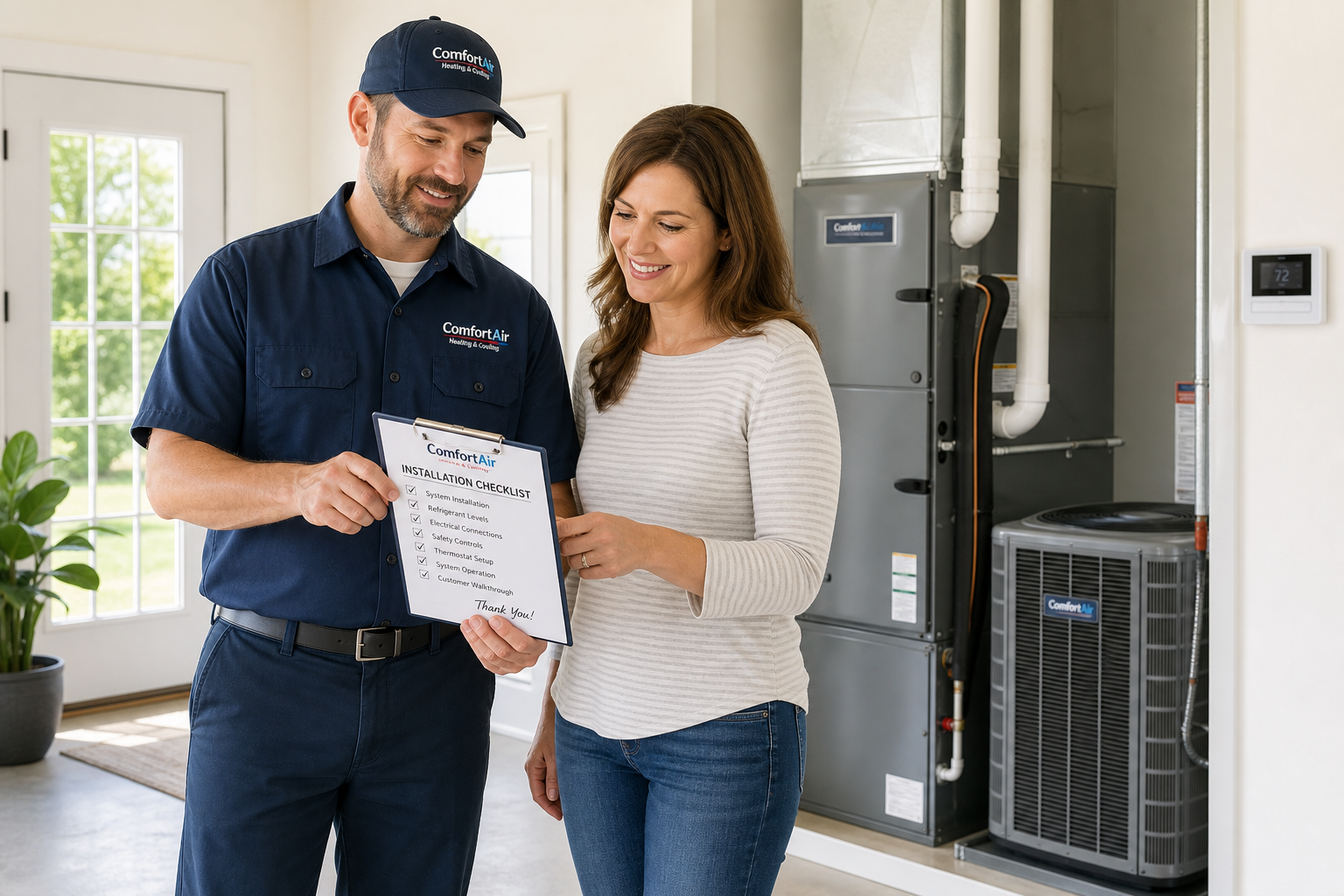
The install-day handoff should happen before the crew leaves. Someone explains basic operation, thermostat use, filter access, what normal sounds and cycles may be expected, and what the homeowner should do if a concern comes up. This moment matters because it sets the tone. If the crew rushes out, the homeowner may feel abandoned even if the workmanship is solid.
The next-day check-in can be a phone call, text, or email depending on your customer communication style and preferences. The message should be short and human. Ask whether the system is operating properly, whether the homeowner has any immediate questions, and whether the home felt comfortable overnight.
The one-to-two-week follow-up is where you learn the most. By then, the customer has experienced more run cycles, more temperature changes, and more daily use. This touchpoint should focus on comfort, noise, airflow, thermostat confidence, and overall satisfaction. If there are concerns, they can be triaged before they become resentment.
Finally, once the customer confirms satisfaction, you can ask for the next step. That may be a review, a referral, a maintenance plan conversation, or all three in a measured way. The order matters. Do not ask for advocacy before you have earned confidence.
- Assign one owner for every follow-up sequence, whether that is the installer lead, service manager, comfort advisor, or office team member.
- Schedule follow-up tasks before the job is marked complete in your system.
- Use the same core script and checklist on every installation.
- Document all customer responses and open concerns in one place.
- Set a standard response path for issues that require a callback or adjustment visit.
- Ask for reviews and referrals only after confirming satisfaction.
What should contractors cover during each follow-up touchpoint?
Each touchpoint should have a purpose. If your team simply asks, “Everything okay?” you will get vague answers and miss useful information. Better questions lead to better customer feedback.
On install day, focus on orientation. Show the homeowner how to use the thermostat, where the filter goes, how often to check it, which breakers or disconnects relate to the equipment, and what conditions warrant calling your office. If accessories were installed, explain them in plain language. If local requirements or inspection timing affect final steps, explain that clearly and note that local requirements vary.
On the first check-in, focus on immediate usability. Ask whether the system started and ran as expected, whether the thermostat is easy to use, and whether there were any unexpected sounds or alerts. This is also a good moment to ask whether the crew left the work area as expected. That lets you address any cleanup concerns quickly.
On the one-to-two-week follow-up, focus on lived experience. Ask whether the main comfort problem that triggered the project has improved. Ask whether any rooms still feel too warm or too cool. Ask if humidity, airflow, recovery time, or noise are where the homeowner expected them to be. If they mention something specific, avoid defending the installation immediately. Clarify what they are experiencing and decide whether the issue is operational, educational, or technical.
This stage is also a chance to reinforce what was promised versus what requires more time or a separate solution. For example, if duct limitations or insulation issues were discussed during the sales process, this is where your notes matter. You can remind the homeowner of those conversations without sounding dismissive.
After concerns are addressed, your final touchpoint should confirm closure. Ask whether the customer feels comfortable operating the system and whether there is anything else your team can clarify. This is the cleanest moment to ask for a review or referral because the homeowner has had support, not just a sales transaction.
How can follow-up reduce buyer’s remorse?
Buyer’s remorse usually grows when expectation and experience are out of sync. The homeowner may have expected instant perfection, lower utility bills right away, silent operation, or even temperatures in every room despite unresolved duct or building-envelope issues. The follow-up process gives your company multiple chances to align expectations with reality in a calm, proactive way.
One of the most effective ways to reduce remorse is to restate the “why” behind the purchase. During follow-up, remind the customer what problem the new system was intended to solve. Maybe the old equipment was unreliable, oversized, noisy, or near the end of service life. Maybe the new system improved staging, efficiency, or comfort control. Reconnecting the homeowner to the original decision helps shift the conversation away from second-guessing the price.
Another important step is normalizing the adjustment period. A new system may sound different, cycle differently, or deliver air at a different feel than the old one. If your team explains this upfront and repeats it during follow-up, many “problems” stop being problems. The homeowner realizes the equipment is behaving normally rather than incorrectly.
You can also reduce remorse by making support feel easy. If customers are not sure who to call, when to call, or whether they will be taken seriously, they often keep concerns to themselves until they become more frustrated. A direct contact path, a simple post-installation email, or a clear phone extension can make a big difference.
Finally, speed matters. The longer a concern sits unresolved, the more emotional it becomes. Even if you cannot fully solve an issue on the first response, acknowledging it promptly and outlining next steps protects trust. Homeowners are usually more patient when they believe your company is engaged and accountable.
How do you turn a good follow-up process into more reviews and referrals?
Referrals rarely come from the technical quality of an installation alone. They come from the total experience. Customers refer contractors when they feel cared for, informed, and confident recommending the company to friends and neighbors. Post-installation follow-up is where that confidence is built.
The first rule is timing. Ask too early and the request feels transactional. Ask after you have checked in, answered questions, and confirmed satisfaction, and the request feels natural. A simple line works well: if the homeowner says they are happy, thank them and let them know referrals and reviews are always appreciated.
The second rule is simplicity. Do not make the homeowner work hard to support your business. If you want a review, send one clear link. If you want referrals, tell them the kind of homeowner you help best, such as neighbors considering replacement, families dealing with hot and cold spots, or anyone comparing heat pump and furnace options. People refer more often when they know exactly who to think of.
The third rule is consistency. Every satisfied installation customer should get the same opportunity to leave a review or refer someone. If your company only asks occasionally, your results will be uneven and tied to whichever salesperson or project manager remembers to bring it up.
Some contractors also use follow-up to strengthen future touchpoints. If the customer enrolled in maintenance, note the first visit timing and remind them your company will stay connected. If they did not enroll, you can introduce ongoing service support without sounding pushy. The idea is to move from one-time project company to trusted long-term resource.
When done well, follow-up creates a better kind of referral source. Instead of customers simply saying you were “fine,” they can say your company installed the system, explained everything clearly, checked in afterward, and handled questions quickly. That story is far more persuasive than any ad.
What common mistakes weaken a follow-up process?
One common mistake is making follow-up dependent on memory. If the office has to remember who got installed last week and who still needs a call, jobs will slip through the cracks. The process should be task-based and scheduled before job closeout.
Another mistake is using follow-up only to ask for a review. Homeowners can tell when the real purpose of the call is marketing rather than service. Confirm satisfaction first, resolve concerns second, and ask for public feedback only after support has been delivered.
Some companies also create confusion by having too many people contact the homeowner with no coordination. The installer lead, salesperson, dispatcher, and service manager may all reach out separately, but if none of them shares notes the customer experiences it as disorganization rather than attentiveness. One record and one process owner prevent this.
A fourth mistake is getting defensive when concerns come up. Post-installation questions are normal. If your team responds by arguing, overexplaining, or immediately blaming the house, ductwork, or user settings, trust drops fast. Train staff to acknowledge first, clarify second, and solve third.
Finally, many contractors fail to close the loop internally. If a callback was needed, document the cause. Was it education, setup, airflow balancing, thermostat programming, accessory operation, or workmanship correction? Over time, these patterns help improve sales communication, install checklists, and commissioning practices.
If you want more referrals, do not just finish jobs. Finish the customer experience. The companies that win repeat business are often the ones that stay present for the questions homeowners ask after the truck leaves.
What is a practical workflow a small HVAC company can start using right away?
For a small or mid-sized contractor, the easiest workflow is usually a three-contact system plus documentation. On install day, the lead installer completes a homeowner handoff checklist and confirms the best follow-up phone number and email. The office then schedules two follow-up tasks in the CRM or calendar before the invoice is finalized.
The first task happens within one business day. An office team member or project coordinator sends a short message or makes a brief call. The purpose is immediate reassurance and issue spotting. If the homeowner raises a concern, it is assigned that day rather than waiting.
The second task happens around one week later, or slightly longer if weather conditions need more time to reveal system behavior. This call is more detailed and includes comfort questions, operating questions, and overall satisfaction. If the homeowner is pleased, the coordinator sends a review link and mentions referrals in a friendly way.
A simple workflow like this is easy to train, easy to track, and easy to improve. You do not need complicated segmentation on day one. You need the discipline to do the basics every time.
- Install day: complete handoff, answer questions, verify contact details.
- Day 1 or 2: check startup experience, thermostat use, and immediate concerns.
- Day 7 to 14: ask about comfort, noise, airflow, and satisfaction.
- If satisfied: send review link and mention referrals.
- If not satisfied: assign next step, document owner, and set resolution deadline.
- After resolution: confirm closure before asking for any review.
Frequently asked questions
Who should own the follow-up process in an HVAC company?
The best owner is the person or role most likely to execute it consistently and document outcomes. In many companies that is an install coordinator, office manager, or project coordinator. What matters most is clear responsibility, not title.
Should follow-up be done by phone, text, or email?
Any of those can work. Phone calls often uncover more nuance, while text and email are easier to standardize. Many contractors use a mix, starting with the customer’s preferred contact method and escalating to a call if there are concerns.
How soon should contractors ask for a review after installation?
Ask only after the homeowner confirms satisfaction and any early concerns have been resolved. For some jobs that may be within days. For others it may take longer. The right timing depends on the customer’s experience, not your invoice date.
What if a homeowner says they are not fully satisfied?
Do not push for a review or referral. Clarify the issue, document it, assign ownership, and communicate the next step clearly. A well-handled concern can still become a future referral source if the customer feels heard and supported.
Can this process be automated?
Parts of it can be automated, such as task creation, reminders, and review-link delivery. But at least one human touchpoint is usually worth keeping, especially for replacement jobs where customer confidence matters. Automation should support the experience, not replace it entirely.
Should maintenance agreements be part of post-installation follow-up?
Yes, when it fits your business model and the timing is right. The key is to present ongoing service as support rather than as another immediate sale. Local program details and service structures vary by company and market.
Final thoughts
A simple post-installation follow-up process for HVAC contractors can do more than reduce complaints. It can improve customer confidence, uncover issues sooner, strengthen your reputation, and generate more consistent referrals. The contractors who benefit most are not necessarily the ones with the fanciest automation. They are the ones with a clear system that gets used on every completed job.
If you want better long-term results from your installation work, look closely at the days after the install. That is where homeowners decide whether your company was merely competent or truly trustworthy. Build a process that reassures, educates, documents, and follows through, and the return will show up in reviews, referrals, and stronger customer relationships.
Join the HVAC Installer Network
Create an installer listing to help homeowners discover your business, learn about your services, view your company information, and connect with you about installation opportunities in your service area.
This article is for general informational purposes and is not legal, tax, warranty, rebate, or code compliance advice. Equipment features, manufacturer requirements, documentation practices, and customer communication methods vary by company and product line. Permit, inspection, and other local requirements vary by location, so contractors should confirm applicable standards in their market.