Should You Repair or Replace Leaky HVAC Ductwork? A Homeowner’s Guide to Comfort, Air Loss, and Cost
If some rooms never feel right, your utility bills seem higher than expected, or your attic feels better conditioned than your living room, leaky ductwork may be part of the problem. Here is how to decide whether a focused duct repair is enough or a full replacement is the smarter long-term move.
When homeowners think about HVAC problems, they usually picture the furnace, air conditioner, or thermostat first. But the duct system matters just as much. Ductwork is the path that carries heated and cooled air through your home. If those pathways leak, disconnect, sag, or were poorly installed, your system can lose comfort and efficiency before air ever reaches the rooms where you need it.
That creates a frustrating situation. Your equipment may be running normally, but certain rooms still feel stuffy, hot, cold, or slow to respond. You might notice weak airflow from some vents, more dust than usual, or higher operating costs without a clear explanation. In many homes, the real issue is not only the equipment itself. It is the duct system serving it.
The good news is that leaky ductwork does not always mean you need a full replacement. In some homes, professional sealing and targeted repairs can solve the main problem at a reasonable cost. In others, especially where duct runs are damaged, undersized, badly laid out, or difficult to access, replacement may deliver better comfort and better long-term value.
This guide walks through how to evaluate the situation in practical terms. You will learn the most common signs of duct leakage, when repairs usually make sense, when replacement is often the better answer, and what project factors tend to affect cost. Since every house is different, local requirements vary, and a qualified contractor should inspect the system before recommending a final scope of work.
Important practical point: a leaky duct system can affect comfort even if the furnace or air conditioner is still working. Replacing equipment without addressing major duct issues may leave the same room-to-room problems in place.
What does leaky ductwork actually do to your home?
Duct leaks allow conditioned air to escape before it gets to the intended room. In cooling season, that means some of the air you paid to cool may end up in the attic, crawl space, basement, garage, or wall cavity instead of your bedroom or family room. In heating season, warm air can be lost the same way.
Leaks also work in reverse. Return ducts can pull in air from unconditioned or dirty spaces. That can introduce dust, insulation particles, odors, or humid air into the system. As a result, your HVAC equipment may run longer to satisfy the thermostat while comfort stays uneven in the rooms that matter most.
In practical terms, leaky ductwork often leads to a mix of symptoms rather than one dramatic failure. You may have a back bedroom that is always warmer in summer. You may have a second floor that struggles on very hot afternoons. You may also notice that airflow seems strong near the furnace or air handler but weak at distant vents.
Not every comfort issue is caused by ducts alone. Insulation, window exposure, home layout, equipment sizing, and thermostat placement can all play a role. Still, if the duct system is leaking or poorly built, it can magnify every other weakness in the house.
What are the most common signs your ducts are leaking?
Homeowners usually do not see the duct leaks directly because much of the system is hidden in an attic, crawl space, soffit, basement ceiling, or inside walls. Instead, they notice the effects.
- Some rooms are consistently hotter or colder than the rest of the home.
- Airflow from certain vents feels weak even when the system is running normally.
- Your HVAC system seems to run longer than expected to reach the set temperature.
- Dust levels seem unusually high, especially after the system turns on.
- You notice musty, attic-like, or crawl-space odors coming from vents.
- Duct sections in accessible areas look crushed, sagging, disconnected, or poorly sealed.
- Utility costs feel out of line compared with past seasons or similar weather.
- Some spaces are noisy from air rushing through gaps or damaged connections.
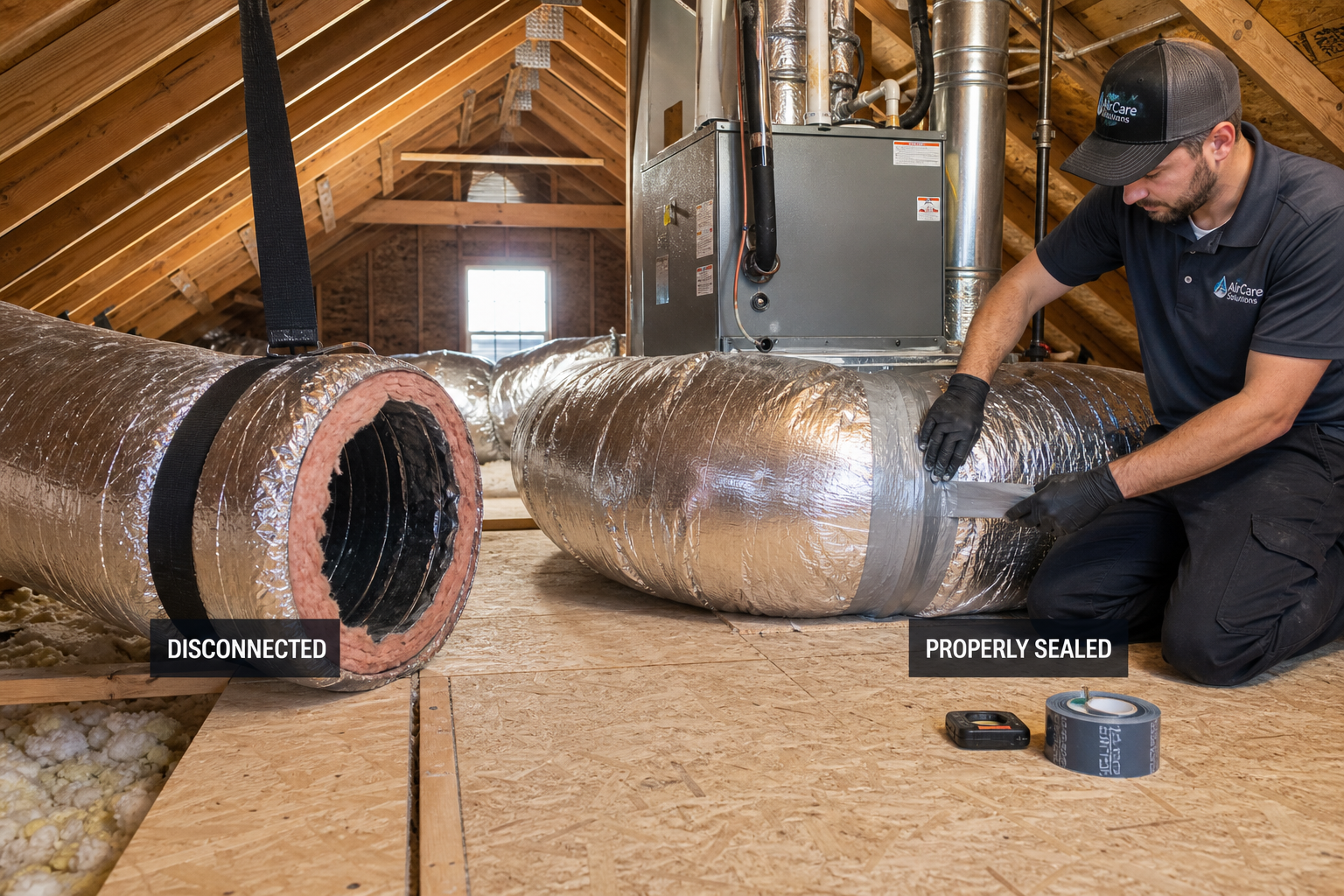
Flexible duct often shows its problems visually. You may see torn outer jackets, kinks, sharp bends, detached collars, or long unsupported runs that sag. Metal duct systems can develop loose joints, failed tape, disconnected takeoffs, or gaps at boots and plenums. Older duct board systems can also deteriorate over time depending on location and condition.
One of the biggest clues is inconsistency. If your HVAC equipment was serviced recently and appears to be operating correctly, but comfort remains uneven in the same rooms year after year, the duct system deserves a closer look.
When is duct repair usually enough?
Duct repair is often the right first option when the overall duct system is still in decent shape and the problems are localized. In many homes, a contractor can improve performance significantly by sealing joints, reconnecting separated sections, replacing short damaged runs, supporting sagging flex duct properly, and correcting a few obvious airflow restrictions.
Repair is usually more attractive when the ducts are not very old, the layout is generally sound, and access is reasonably good. For example, if an attic duct trunk is intact but several branch connections are leaking, targeted sealing may restore a meaningful amount of airflow to the affected rooms without rebuilding the whole system.
Likewise, if one flex duct run was crushed by stored items in the attic or came loose near a register boot, the solution may be straightforward. The same is true if return duct leakage is concentrated at a plenum connection or at seams near the air handler.
Professional duct sealing can also make sense when the home’s comfort complaints are limited in scope. If one or two rooms are underperforming, and the rest of the house feels acceptable, targeted repair may be the most sensible place to start.
That said, repair only works well when the remaining system is worth saving. Sealing visible joints will not solve bigger design issues like severely undersized trunks, too many long restrictive runs, poor return air paths, or extensive hidden deterioration. Good contractors should be honest about that distinction.
When is duct replacement the smarter choice?
Replacement becomes more compelling when leaks are only part of the problem. If the duct system is old, badly deteriorated, poorly sized, or laid out in a way that fundamentally limits airflow, continued patchwork repairs may cost money without delivering a satisfying result.
For example, if large portions of flex duct are torn, compressed, kinked, or sagging throughout the attic, repairing one section after another may not create a dependable system. If trunk lines are undersized or the return side is inadequate, airflow issues can persist even after leaks are sealed. In those cases, replacement may allow the contractor to redesign critical parts of the layout rather than merely patching symptoms.
Replacement is also worth serious consideration when ducts are difficult to access and repeated service work would be disruptive or inefficient. If the system is buried under insulation, routed through tight framing, or spread across multiple hard-to-reach spaces, there may be value in doing one more complete project instead of chasing failures over time.
Another common trigger is major HVAC equipment replacement. If you are already replacing the furnace, air handler, or heat pump, that can be the right moment to evaluate the duct system honestly. Installing new equipment onto a very poor duct system can limit the comfort benefits you expect from the upgrade.
In plain language, replacement often makes sense when your issue is not just leakage. It is leakage plus age, layout problems, damaged materials, or chronic comfort complaints that repairs are unlikely to solve completely.
How do contractors inspect and diagnose duct problems?
A good duct evaluation starts with more than a quick glance. Contractors should listen to your comfort concerns room by room, inspect accessible duct sections, look at the supply and return sides, and consider how the equipment and duct layout work together.
In accessible spaces, they may check for loose joints, disconnected boots, deteriorated insulation, crushed flex duct, unsupported spans, and signs of air leakage around plenums and takeoffs. They may also measure airflow at registers, evaluate static pressure, inspect filter conditions, and look for restrictions that affect delivery.
Some contractors use pressure testing or other diagnostic methods to estimate leakage levels. Others may combine visual findings with airflow and system performance observations to determine whether repair or replacement is the better path. The exact process varies by company, home layout, and local practice.
If replacement is being discussed, ask how the recommendation was reached. Is the problem isolated to a few visible leaks, or is the entire system underperforming? Are certain runs too long or poorly routed? Is there enough return air? Is insulation around the ducts damaged? These questions help separate a true system issue from a simple repair need.
You should also ask what is realistically accessible. Some duct sections may be easy to repair while others are hidden behind finished surfaces. Local requirements vary, and any changes involving permits, insulation, or code-related details should be discussed with your contractor before work begins.
Useful question to ask during an estimate: If we do the recommended repair, what comfort improvement do you reasonably expect, and what limitations might still remain because of the existing duct design?
What cost factors matter when comparing repair vs replacement?
There is no single universal price for duct repair or replacement because homes differ too much in size, layout, access, and system design. Instead of focusing on a generic number, it is more useful to understand what drives the scope.
For duct repair, costs often depend on how many problem areas exist, how accessible they are, what materials are involved, and whether the issues are limited to sealing and reconnecting or also require replacing damaged sections. A simple attic repair with open access is very different from work in a cramped crawl space or inside finished chases.
For full or partial replacement, the biggest cost factors usually include the amount of ductwork being replaced, the type of duct material used, insulation needs, the complexity of the layout, whether supply and return improvements are both required, and how difficult the installation area is to work in. Homes with tight attics, limited crawl space clearance, or finished areas that complicate routing generally require more labor.
Another factor is whether the contractor is simply replacing like for like or redesigning portions of the system to improve airflow. Better design work can be valuable, but it changes the scope. If balancing, return air improvements, or significant rerouting are part of the proposal, make sure those items are explained clearly.
When comparing quotes, focus on what is actually included. Does the proposal mention sealing methods, insulation condition, support of flex runs, register boot connections, return-side work, cleanup, testing, or balancing? A lower quote may reflect a narrower scope rather than a better value.
| Decision factor | Repair may make sense when | Replacement may make sense when |
| Age and condition | The duct system is mostly sound with isolated failures. | The system is broadly worn, deteriorated, or repeatedly failing. |
| Leak locations | Leaks are visible, localized, and easy to access. | Leaks are widespread or hidden throughout the system. |
| Airflow design | Layout is generally workable and only needs corrections. | Runs are badly routed, undersized, or missing needed return capacity. |
| Comfort complaints | Problems are limited to a small part of the home. | Comfort issues affect multiple rooms or the whole house. |
| Project timing | You need a focused fix without major disruption. | You are already replacing HVAC equipment or planning broader upgrades. |
How can you make a confident decision without overbuying?
The best approach is to think in terms of outcomes, not just components. You are not buying ductwork for its own sake. You are trying to solve comfort, airflow, and operating issues in a durable way.
Start by describing the specific problems you want fixed. Which rooms are uncomfortable? When does the issue happen most? Has it gotten worse over time? Do you hear air noise, notice dust, or see visible damage? The more specific your symptoms, the easier it is for a contractor to match the recommendation to the real problem.
Next, ask whether the proposed work addresses both leakage and airflow design. A good repair plan should explain what is being sealed or replaced and why that should help. A good replacement plan should explain what was wrong with the original layout and how the new design improves delivery and return air performance.
If you receive multiple estimates, compare them line by line. One contractor may recommend sealing and selective replacement. Another may recommend full replacement. Neither is automatically right or wrong. The key is whether each proposal explains the condition of the current system and the expected result of the work.
It is also fair to ask about phased options. In some homes, a homeowner may choose to repair the most obvious leakage now and revisit larger redesign work later. In other homes, especially where access is difficult or deterioration is extensive, doing the full job once may be more practical.
- Ask the contractor to identify the specific duct problems they found.
- Ask whether the issue is mainly leakage, airflow design, or both.
- Ask what portion of the system is accessible and verifiable.
- Ask what improvement you should reasonably expect in comfort and airflow.
- Ask whether any rooms may still have issues because of insulation, windows, or layout.
- Ask what is included in the scope so you can compare estimates fairly.
- Ask whether local permit or code requirements apply, since local requirements vary.
If the recommendation sounds vague, keep asking questions. Homeowners should understand whether they are solving a few repairable leaks or replacing a system that no longer performs well enough to justify continued patching.
Final Thoughts
Leaky ductwork is easy to overlook because it is mostly out of sight, but it can have a major effect on comfort. If your HVAC system seems to run but the house still feels uneven, the duct system may be where the real losses are happening.
Repair is often the right answer when the issues are isolated and the overall duct system is still in good shape. Replacement is often the better investment when the system has widespread damage, poor layout, chronic airflow problems, or age-related deterioration that sealing alone will not fix.
The smartest next step is a thorough inspection by a qualified HVAC professional who can evaluate both leakage and airflow design. Once you understand whether the problem is local or system-wide, the choice between repair and replacement becomes much clearer.
Frequently Asked Questions
Can leaky ducts really make one room much hotter or colder?
Yes. If the duct run serving that room is leaking, disconnected, crushed, or poorly routed, less conditioned air may reach the space. A room-specific comfort issue can also involve insulation, sun exposure, or return air limitations, so the full situation should be evaluated.
Can I seal duct leaks myself?
Homeowners may be able to spot obvious issues in accessible areas, but professional evaluation is often worth it because many duct problems involve hidden sections, airflow restrictions, or return-side issues that are not easy to diagnose visually. Improper materials or incomplete sealing may not solve the underlying problem.
Should I replace ductwork when I replace my HVAC equipment?
Not always, but it is a good time to inspect it carefully. If the duct system is in good condition and sized appropriately, it may only need repairs or sealing. If it is deteriorated or poorly designed, leaving it in place can limit the benefits of the new equipment.
What is better, repairing some ducts now or replacing everything later?
That depends on the overall condition of the system. If the main issues are localized and accessible, targeted repair may be a practical first step. If the system has widespread problems, repeated repairs may add up without delivering lasting comfort improvements.
Find an HVAC Installer Near You
Search the HVAC Installer Network to find local professionals, review installer profiles, and connect with contractors serving your area.
This article is for general informational purposes only and is not a substitute for an in-person evaluation by a qualified HVAC professional. System condition, duct access, insulation, home construction, and equipment compatibility vary by property. Local requirements vary, so ask your contractor what applies in your area before approving repair or replacement work.