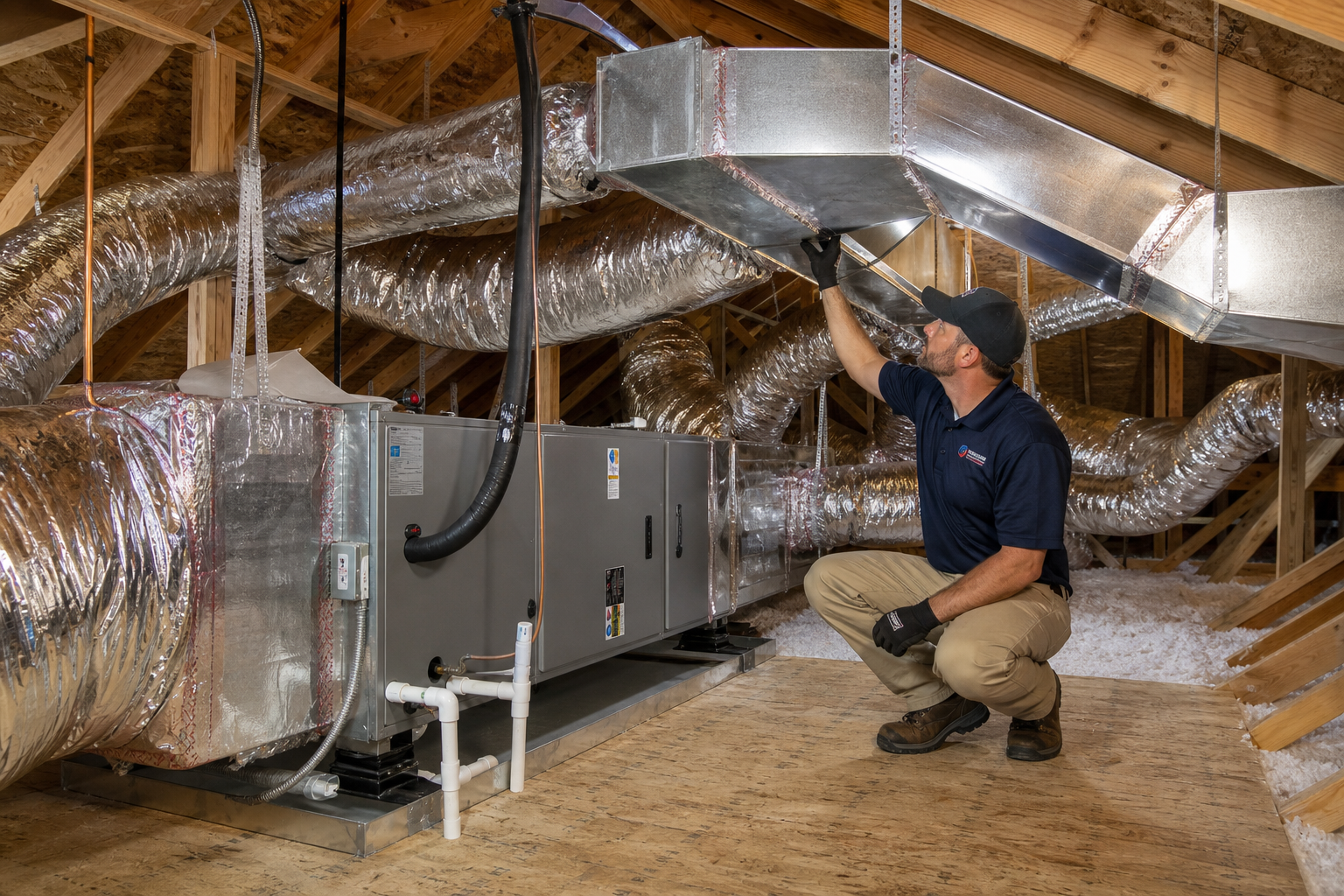
Should You Replace HVAC Ductwork During a System Changeout? A Homeowner’s Guide to Cost, Comfort, and When It’s Worth It
A practical look at when existing ductwork can stay, when it should be upgraded, and how that decision affects comfort, airflow, and the performance of your new HVAC system.
If you are replacing your furnace, air conditioner, or heat pump, it is natural to focus on the new equipment first.
But the duct system is what carries heated or cooled air through the house, and if it is leaking, poorly sized, damaged, or badly laid out, even a high-quality new system may not deliver the comfort you expect.
That leaves many homeowners asking an important question: should you replace HVAC ductwork during system changeout, or can you keep what is already there?
The honest answer is that it depends on the condition of the ducts, the layout of the home, your comfort problems, and how extensive the equipment replacement is.
In some homes, existing ducts are in solid shape and only need sealing, insulation, or minor modifications.
In other homes, keeping old ductwork can lock in airflow problems, noisy operation, dusty rooms, hot and cold spots, and disappointing performance from the new system.
This guide will help you understand when ductwork replacement is worth serious consideration, when repair may be enough, and what to ask an HVAC contractor before you move forward.
If your current HVAC system struggled with weak airflow, room-to-room temperature differences, excessive dust, or noise, a system changeout is the best time to investigate the ducts instead of assuming new equipment alone will solve the problem.
Why does ductwork matter during a system changeout?
Your heating and cooling equipment creates conditioned air, but the duct system is responsible for delivering it where it needs to go.
Think of the new HVAC unit as the engine and the ductwork as the road network.
If the road network is undersized, full of leaks, disconnected, crushed, uninsulated, or poorly routed, the engine cannot perform the way it should.
That matters because many homeowners replace HVAC equipment hoping for better comfort, lower operating costs, quieter performance, or improved humidity control.
Those goals often depend just as much on airflow as on the equipment itself.
During a changeout, contractors already have access to key connection points around the air handler, furnace, evaporator coil, plenum, and return system.
That makes it easier to inspect and improve the ductwork than it would be later as a separate project.
Replacing or upgrading ductwork at the same time can also help avoid a situation where a brand-new system is attached to old ducts that were designed for different equipment or different comfort expectations.
In short, the duct system matters because it influences airflow balance, system strain, indoor air quality, noise, and how evenly your home heats and cools.
What signs suggest your ducts may need replacement?
Not every duct system needs to be torn out just because the equipment is being replaced.
However, there are clear warning signs that should put duct replacement or significant duct upgrades on the table.
- Some rooms are consistently hotter or colder than the rest of the house.
- Airflow from supply registers feels weak in multiple rooms.
- Your home gets dusty quickly even after cleaning.
- You hear rattling, whistling, popping, or booming from the duct system.
- Duct sections in the attic, crawl space, basement, or utility area are visibly damaged, crushed, kinked, or disconnected.
- Insulation around ducts is deteriorated or missing in unconditioned spaces.
- You can see heavy rust, loose joints, failing tape, or sagging runs.
- There have been past moisture issues, pest activity, smoke damage, or contamination concerns.
- The home has had additions, renovations, or room conversions that changed airflow needs.
- The old system never seemed to heat or cool the house evenly no matter how often it was serviced.
Age can also be part of the conversation, though age alone should not make the decision for you.
Some older metal duct systems remain serviceable if they are well designed and in good condition.
On the other hand, some flexible duct systems can develop airflow restrictions, torn outer jackets, compression, sagging, or poor support that hurts performance long before the equipment itself fails.
If an HVAC contractor looks at your ducts and simply says they are old, ask for specifics.
You want to know what is wrong, how it affects performance, and whether repair is realistic.
When is duct repair, sealing, or modification enough instead of full replacement?
Sometimes homeowners hear “you need new ductwork” when the real answer is more nuanced.
Full replacement is not always necessary.
If the main duct layout is sound and the materials are still in good shape, targeted repairs may provide most of the benefit at a lower cost and with less disruption.
Examples of situations where repair or partial upgrades may be enough include accessible leaks at joints and connections, limited insulation problems, one or two damaged branch runs, poor return air at a specific location, or transitions near the equipment that need to be rebuilt.
Sealing can matter a lot when ducts run through attics, crawl spaces, garages, or other unconditioned areas.
If conditioned air leaks before it reaches your living space, your system has to work harder to make up the difference.
Likewise, if return ducts pull in hot attic air, dusty crawl-space air, or garage air, comfort and indoor air quality can suffer.
Minor redesign can also help.
For example, a contractor may recommend adding a return, resizing a few critical runs, correcting a restrictive filter setup, or replacing short problem sections while keeping the rest.
The key is making sure the recommendation matches the actual condition of the system instead of defaulting to all-or-nothing thinking.
How do old or poorly sized ducts affect comfort, equipment performance, and indoor air quality?
Duct problems often show up as comfort complaints first, but the effects can go beyond room temperatures.
If ducts are too small, airflow can be restricted and static pressure can rise.
That can make the system noisier, reduce delivered comfort, and place unnecessary stress on components.
If ducts are too large in the wrong places or poorly balanced, some rooms may get too much air while others are starved.
That creates the familiar pattern of one bedroom feeling stuffy, one hallway feeling drafty, and one side of the house always lagging behind.
Return-side duct issues can be especially important.
Without enough return air, the system may struggle to circulate air properly, doors may slam or pull shut when the system runs, and certain rooms may feel pressurized or stagnant.
Leaky return ducts can also draw in dust and other unwanted air from spaces you do not want connected to your breathing air.
Poor insulation around ducts in hot or cold spaces can reduce the temperature of the air before it reaches the room.
That means your supply vents may technically be working, but the delivered air is not doing the job you paid for.
During cooling season, badly insulated or leaking ducts can also contribute to condensation concerns in some situations.
And if your old duct design was marginal for the previous system, a new variable-speed or higher-performance system may still be limited by the same duct bottlenecks.
That is why a system changeout should include a real duct evaluation rather than assuming the air distribution side is fine.
Should you replace all the ductwork or only part of it?
Many homeowners assume the choice is either keep everything or replace everything.
In reality, partial replacement is common and often makes sense.
You may have a home where the trunk lines are solid metal and in decent condition, but several branch runs are damaged, undersized, or poorly installed.
Or maybe the supply side is acceptable, but the return side needs major improvement.
In other homes, the ducts closest to the air handler may need redesigned transitions, while the rest of the system can remain.
Partial replacement can be a good fit when the contractor can clearly identify which parts are causing the biggest problems.
It can also make sense when some ducts are accessible and others would require major finish work, framing changes, or disruption to reach.
That said, partial work should still be part of a complete airflow plan.
You do not want random sections changed in ways that create new imbalances or leave old bottlenecks untouched.
Ask the contractor how the proposed scope will affect supply airflow, return airflow, noise, and room balance.
If the answer is vague, keep asking questions.
A thoughtful recommendation should explain why certain sections are staying, why others are being replaced, and what improvement you should realistically expect.
What should you ask during HVAC estimates before deciding?
If you are getting quotes for a system changeout, this is the time to find out whether the contractor actually evaluated the ductwork or just glanced at it.
The quality of the conversation often tells you a lot.
Here are good questions to ask.
- Did you inspect both the supply and return ductwork?
- Are there visible leaks, disconnections, crushed runs, rust, or insulation problems?
- Do you see signs that the ducts are undersized or poorly balanced?
- Will the new equipment require duct modifications near the unit or plenum?
- Are there airflow issues that could limit the performance of the new system?
- Which comfort problems in the home are likely equipment-related versus duct-related?
- Can you recommend repair, partial replacement, and full replacement options if more than one path is reasonable?
- What parts of the duct system are accessible, and what parts may be difficult to reach?
- Will any local permit, code, insulation, or testing requirements apply? Local requirements vary.
- How will your proposal improve airflow, comfort, and system performance in practical terms?
You do not necessarily need a long technical lecture.
You do need a contractor who can explain the problem in plain language and connect the proposed work to the issues you are trying to solve.
If one bidder says the ducts are fine and another says full replacement is required, ask both to walk you through the evidence.
Photos, pressure readings, airflow observations, and room-by-room comfort patterns can all help ground the conversation.
How should you think about cost, disruption, and long-term value?
Ductwork replacement adds cost to a system changeout, and in some homes it can add meaningful labor and disruption too.
That is why many homeowners hesitate, especially if the ducts are hidden in attics, crawl spaces, walls, or soffits.
The better way to think about the decision is not just “how much does new ductwork cost,” but “what happens if I keep ductwork that is limiting the new system?”
If your existing ducts are genuinely in good shape, there is no benefit in replacing them just for the sake of replacing them.
But if they are a major source of airflow loss, comfort imbalance, contamination concerns, or operational noise, keeping them may undercut the value of the new equipment.
Homeowners often regret spending for premium HVAC equipment when the home still has the same hot rooms, weak airflow, or dust issues afterward.
That does not mean every imperfect duct system requires a full replacement project.
It does mean the ductwork deserves the same level of attention as the outdoor unit, furnace, air handler, or thermostat.
In practical terms, replacing or upgrading ducts during the same project may be worth it when:
- The home has long-standing comfort issues the old system never solved.
- The ductwork has visible damage, major leakage, or failing materials.
- The equipment type or size is changing in a way that requires better airflow planning.
- There are indoor air quality concerns tied to return leaks, contamination, or insulation breakdown.
- Access is easier now than it would be later as a standalone job.
- You plan to stay in the home and want the new system to perform as intended.
It may be less urgent when:
- The duct system is well built, properly sized, and in good condition.
- Your comfort has generally been good and inspections show only minor repair needs.
- The contractor can address performance issues with sealing, insulation, balancing, or limited modifications.
The right answer depends on what problem you are trying to solve.
If your goal is only to replace failed equipment and the ducts are healthy, replacement may not be necessary.
If your goal is better whole-home comfort and the ducts are part of the problem, ignoring them can be a costly shortcut.
Frequently Asked Questions
Will new HVAC equipment automatically fix airflow problems?
Not always.
If the root issue is leaking, undersized, damaged, or poorly balanced ductwork, new equipment may still struggle to deliver even comfort throughout the house.
How can I tell if my ductwork is undersized?
Common clues include noisy airflow, weak air delivery, temperature swings between rooms, and a system that seems to run but does not distribute comfort well.
A qualified contractor can evaluate airflow and static pressure to identify restrictions.
Is duct cleaning the same as duct replacement?
No.
Cleaning addresses debris inside the ducts, while replacement addresses physical condition, leakage, sizing, insulation, and layout problems.
If ducts are damaged or badly designed, cleaning alone will not solve those issues.
Can I replace only the return ducts or only the supply ducts?
Sometimes, yes.
Partial replacement is common when one side of the system is the main problem.
The important part is making sure the final design works as a complete airflow system.
Do building codes require duct replacement during a system changeout?
Requirements vary by location and by project scope.
Your contractor should explain any local permit, code, insulation, or testing rules that apply in your area.
Final thoughts
If you are wondering whether to replace HVAC ductwork during system changeout, the best answer is to evaluate the ducts as carefully as the equipment.
Do not assume old ducts are automatically bad, and do not assume they are automatically fine.
Look at the comfort history of the home, the visible condition of the duct system, the airflow design, and whether past heating and cooling problems point to distribution issues.
A well-installed new HVAC system connected to poor ductwork can only do so much.
But when the duct system is in good shape or thoughtfully upgraded at the same time, your new equipment has a much better chance of delivering the comfort, efficiency, and consistency you are paying for.
If you are reviewing estimates, ask each contractor to explain not only what equipment they recommend, but how they assessed the ducts and why their proposed approach makes sense for your home.
Find an HVAC Installer Near You
Search the HVAC Installer Network to find local professionals, review installer profiles, and connect with contractors serving your area.
This article is for general educational purposes only and is not a substitute for an in-home evaluation by a qualified HVAC professional.
System design, duct accessibility, material condition, and local code or permit requirements vary by home and location.
Always confirm recommendations, scope of work, and applicable local requirements with a licensed contractor serving your area.