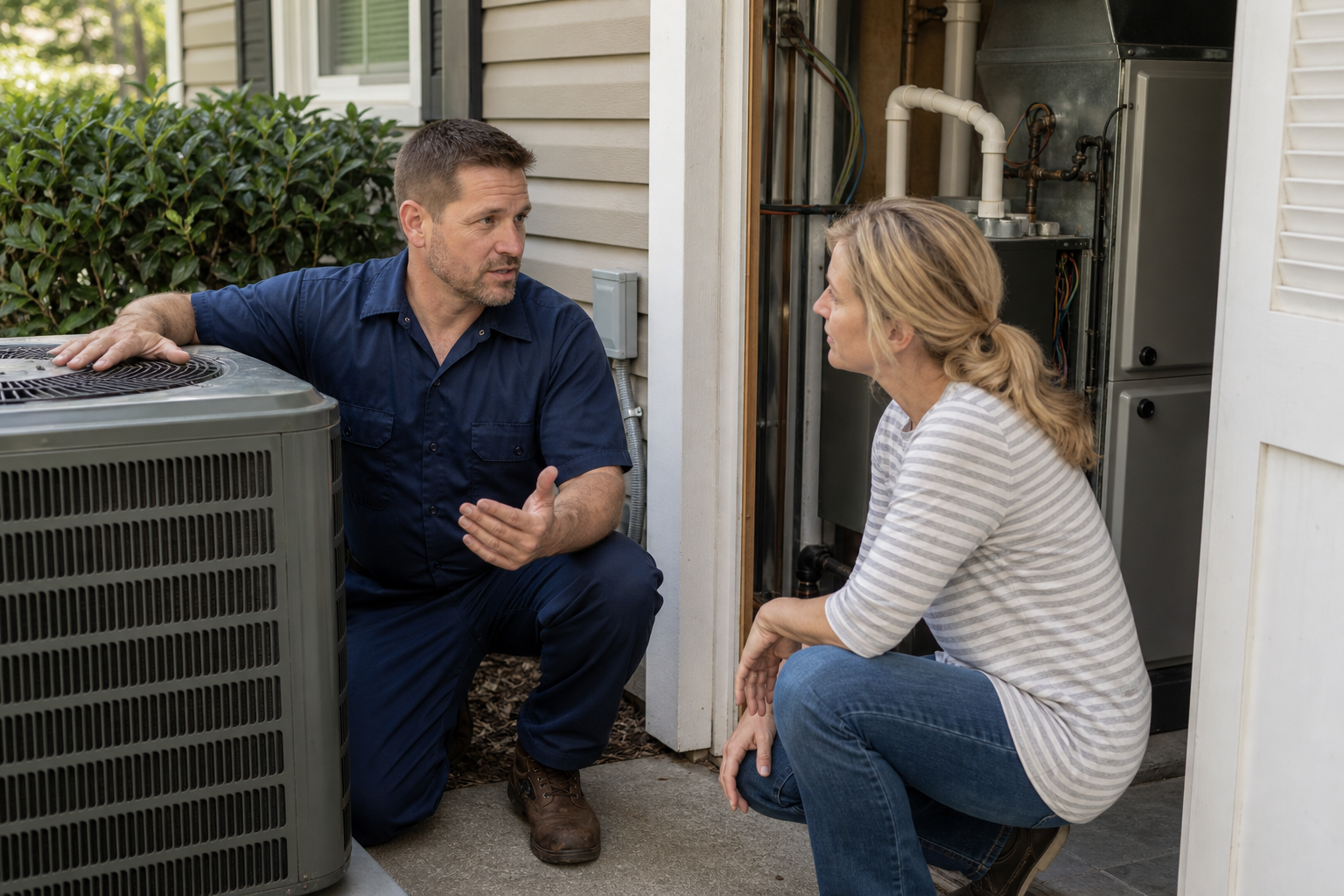
Should You Replace Just the Outdoor AC Unit or the Entire System?
A practical guide to deciding when a condenser-only replacement may work and when a full matched system is the safer long-term move.
If your air conditioner is failing, the outdoor unit is often the part everyone notices first.
It is noisy, exposed to weather, and usually the component a technician points to when a compressor fails or a coil is damaged.
That naturally leads many homeowners to ask a simple question: can you replace only the outside AC unit and keep the rest of the system?
Sometimes the answer is yes.
Very often, the better answer is not just what can be done, but what should be done.
Central air systems are designed to work as a matched pair, with the outdoor condenser and the indoor evaporator coil working together.
When one side is much newer than the other, performance, efficiency, reliability, and even basic compatibility can become a problem.
At the same time, there are situations where replacing only the outdoor unit may be a practical short-term or budget-driven option.
This guide walks through how the decision usually works, why matching matters, and what questions to ask before you approve either a partial replacement or a full system changeout.
If a contractor recommends replacing both the outdoor condenser and the indoor coil together, that is usually not upselling by itself.
In many homes, it is the most practical way to keep the system compatible, efficient, and easier to service later.
What parts are involved in a central AC system?
A typical split air conditioning system has two main sections.
Outside, you have the condenser unit, which contains the compressor and outdoor coil.
Inside, you have the evaporator coil, which is usually paired with your furnace or air handler.
These parts are connected by refrigerant lines and are designed to move heat from inside your home to the outdoors.
Even though many homeowners think of the outdoor unit as the air conditioner, the indoor coil is just as important to how the system cools, dehumidifies, and operates efficiently.
That is why replacing only one half of the system is not always as simple as unplugging an old appliance and dropping in a new one.
The indoor and outdoor equipment must be compatible in capacity, refrigerant type, metering components, and performance characteristics.
When they are not, the system may still run, but it may not run well.
Why can replacing only the outdoor AC unit create problems?
The biggest issue is that air conditioners are engineered as matched systems.
The manufacturer tests specific indoor and outdoor combinations to verify how they perform together.
If you pair a brand-new condenser with an older indoor coil, several things can go wrong.
First, the refrigerant may not match.
Older systems may use a different refrigerant than current equipment.
If your old indoor components were built around a refrigerant that the new condenser does not use, a simple outdoor swap may not be realistic.
Even when an adapter strategy is technically possible in some cases, it may add complexity and may not be the best long-term solution.
Second, the capacity and metering setup may not match properly.
A three-ton condenser does not automatically work correctly with any three-ton indoor coil.
Differences in coil design, expansion devices, and airflow requirements can affect cooling output and humidity removal.
Third, efficiency claims usually depend on a matched system.
If a contractor installs a high-efficiency outdoor unit onto an older indoor section, you may not get the comfort or energy performance you expected.
Fourth, reliability can suffer.
New equipment connected to aging coils, line sets, or controls may inherit old problems.
The result can be nuisance breakdowns, hard-to-diagnose performance issues, or a system that never quite cools the way it should.
Finally, future service can become more complicated.
Mixed systems can create confusion about compatible parts, ratings, and setup details, especially if the paperwork from the original installation is incomplete.
Does the indoor evaporator coil usually need to be replaced too?
In many cases, yes.
If the outdoor condenser is being replaced because of age, compressor failure, refrigerant issues, or efficiency goals, the indoor coil is often replaced at the same time.
This helps create a matched system.
It also gives the installer a better chance of setting refrigerant charge, airflow, and overall performance correctly.
Homeowners are sometimes surprised by this because the indoor coil is out of sight and may not seem broken.
But HVAC decisions are not only about what is visibly damaged.
They are also about whether the complete system will operate properly after the repair or replacement is finished.
If your furnace or air handler is still in good condition, a contractor may recommend replacing the outdoor condenser and evaporator coil while keeping the indoor blower section.
That can be a middle-ground option when the heating equipment still has useful life left.
When might replacing only the outdoor AC unit make sense?
There are some situations where a condenser-only replacement may be reasonable.
One example is when the existing system is relatively new and the indoor coil is confirmed to be compatible with the replacement outdoor unit.
Another is when the outdoor unit was damaged by storms, physical impact, or another isolated event, but the indoor coil and the rest of the system remain in solid condition.
A partial replacement may also come up when a homeowner needs the lowest possible upfront cost and understands the tradeoffs.
That does not make it the best long-term choice, but it may still be a realistic short-term decision.
In these cases, the key word is compatible.
The contractor should be able to explain whether the existing indoor coil matches the new condenser in a way that is acceptable for performance and serviceability.
The decision should not be based only on whether the pipes can physically connect.
It should be based on whether the completed system is appropriate to operate in your home.
- The indoor coil is in good condition and not near the end of its expected life.
- The refrigerant type and components are compatible with the replacement equipment.
- The system size is correct for the home and airflow is adequate.
- The line set can be properly reused or replaced as needed.
- You understand that a partial replacement may limit efficiency or future flexibility.
When is replacing the entire AC system usually the smarter choice?
A full system replacement is often the better path when the existing equipment is older, mismatched, leaking, unreliable, or built around outdated components.
If your air conditioner has had repeated repairs, the outdoor unit has failed, and the indoor coil is of similar age, replacing only one piece may postpone rather than solve the problem.
A full replacement is also commonly recommended when refrigerant compatibility is an issue.
Even if a partial fix can be engineered, many homeowners prefer the cleaner, simpler result of a modern matched system.
You may also want a complete replacement if comfort has been disappointing for years.
If the house feels clammy in summer, cooling is uneven, or the system seems to run constantly, keeping half of an old setup may preserve some of those same performance frustrations.
Replacing the whole system gives the contractor a better opportunity to correct equipment matching, airflow concerns, and control setup.
It can also make sense if you plan to stay in the home for a long time.
While the upfront cost is higher, many homeowners prefer investing once rather than paying for a series of partial fixes that never quite deliver the result they want.
How do cost and long-term value factor into the decision?
It is completely reasonable to start with budget.
For many homeowners, replacing only the outdoor unit looks attractive because the initial price is lower than a full system changeout.
But the least expensive option today is not always the least expensive option over the next several years.
If the indoor coil is older and fails soon after the condenser is replaced, you may end up paying for labor, refrigerant work, and additional disruptions twice.
If the mixed system operates inefficiently or struggles with humidity control, you may also feel the cost in comfort and operating expenses.
That does not mean a full replacement is always the right answer.
It means you should compare short-term savings against the likelihood of future repair costs and whether the remaining indoor equipment is still worth building around.
A good contractor should be able to show you more than one option and explain the tradeoffs of each without pressuring you.
Local installation requirements vary, and details such as electrical updates, drain modifications, line set condition, and permit expectations can also affect the final scope and price.
What role do the refrigerant lines and other existing components play?
Even when homeowners focus on the outdoor unit and indoor coil, there are other pieces that matter.
The refrigerant line set may be reusable in some situations, but not always.
Its size, condition, length, cleanliness, and compatibility with the new equipment all matter.
If the line set is contaminated, damaged, poorly routed, or the wrong size, reusing it can undermine the new installation.
The condensate drain, electrical disconnect, breaker sizing, pad, thermostat, and indoor airflow setup may also need attention.
This is one reason replacing an outdoor AC unit is not really a stand-alone decision.
The rest of the system and supporting components affect whether the finished installation will be dependable.
Homeowners sometimes hear a low replacement quote that sounds appealing until they learn that important supporting work is excluded.
That is why it helps to ask exactly what is being replaced, reused, cleaned, tested, and verified.
What questions should you ask an HVAC contractor before deciding?
You do not need to become an HVAC expert before approving a job, but you should ask clear questions.
The goal is to understand whether the recommendation is based on system compatibility and long-term value, not just quick installation convenience.
- Is my existing indoor coil compatible with the proposed outdoor unit?
- If you recommend replacing both, what specific problem does that solve?
- Will the new equipment be a matched system?
- Are the refrigerant lines being reused or replaced, and why?
- What condition is the indoor coil, blower, and drain system in?
- Will this option affect cooling performance or humidity control?
- What parts of the installation are included in the quote?
- Are there local permit or code requirements that may affect the job?
- If I replace only the outdoor unit now, what are the likely next weak points?
- What are the pros and cons of doing the full replacement instead?
If a contractor cannot explain these answers clearly, get another opinion.
This is especially important when the recommendation is a partial replacement on an older system.
Are there signs that a condenser-only replacement is probably not the best idea?
Yes.
Several warning signs suggest that replacing only the outdoor unit may be throwing good money at a larger problem.
- The indoor coil is old, corroded, leaking, or difficult to confirm as compatible.
- The system has a history of refrigerant leaks or repeated repairs.
- Your home has ongoing comfort complaints that were never fully resolved.
- The equipment is old enough that other major parts may fail soon.
- The contractor cannot offer a clearly matched replacement path.
- The quote leaves out important items such as line set work, setup, or verification.
- You plan to stay in the home and want a more dependable long-term solution.
Any one of these does not automatically mean you must replace the entire system.
But together they can point to a partial fix that may disappoint you later.
So which option is right for most homeowners?
For many homeowners, replacing the outdoor AC unit and the indoor evaporator coil together is the most balanced solution when the air conditioner has reached the end of its useful life.
It preserves the benefits of a matched cooling system without automatically requiring furnace replacement if the heating side is still in good shape.
A full heating-and-cooling replacement may make even more sense if both sections are older, the blower is worn, or you want a more complete reset of the system.
Replacing only the outdoor unit can still be appropriate in select cases, especially when the rest of the system is newer and proven compatible.
But it should usually be the result of a careful evaluation, not a reflex choice based on the idea that the outside box is the whole air conditioner.
The practical answer is this: if the system is older or compatibility is uncertain, the safer investment is often more than just the condenser.
If the system is newer, the damage is isolated, and the components are properly matched, a partial replacement may be perfectly reasonable.
Frequently Asked Questions
Can I replace just my outside AC unit and keep the same furnace?
Yes, in many homes you can keep the same furnace if it is still in good condition.
What often matters more is whether the new outdoor condenser can be properly matched with a compatible indoor evaporator coil and blower setup.
Do I always have to replace the indoor coil when I replace the condenser?
Not always, but it is common.
If the existing coil is older, incompatible, or in poor condition, replacing it along with the condenser is often the better choice.
Is replacing only the outdoor unit cheaper?
Usually yes in upfront cost.
However, it may not be the best overall value if the older indoor equipment creates performance, compatibility, or repair issues later.
Will a new outdoor unit make my old system more efficient?
Not necessarily.
Efficiency depends on the indoor and outdoor components working together as a matched system, along with proper airflow and installation quality.
Should I get a second opinion?
Yes, especially if one contractor recommends a simple condenser swap on an older system and another recommends replacing additional components.
A second opinion can help clarify whether the issue is compatibility, budget, or installation philosophy.
Final Thoughts
When your air conditioner fails, replacing only the outdoor unit can sound like the obvious money-saving move.
Sometimes it is.
But central air systems rarely perform their best when one aging half is asked to carry the other.
The smartest decision usually comes down to age, compatibility, refrigerant considerations, repair history, and how long you expect to stay in the home.
If your contractor is recommending a full matched replacement, that may be because it truly offers the cleanest path to reliable cooling.
If a condenser-only replacement is being proposed, make sure the explanation includes more than price.
You want to know how the complete system will work after the job is done, not just whether the outdoor unit can be changed.
Find an HVAC Installer Near You
Search the HVAC Installer Network to find local professionals, review installer profiles, and connect with contractors serving your area.
This article is for general homeowner education only and is not a substitute for an in-home evaluation by a licensed HVAC professional.
Equipment compatibility, refrigerant requirements, installation details, and local code or permit expectations vary by system and location.
Always ask a qualified contractor to inspect your existing equipment before deciding whether to replace only the outdoor AC unit or the entire system.