Should You Add a Whole-Home Dehumidifier? A Practical Guide for Humid Houses
If your home feels clammy, smells musty, or stays damp even with the air conditioner running, a whole-home dehumidifier may solve a comfort problem your thermostat alone cannot fix.
Some homes cool down without ever feeling truly comfortable.
You set the thermostat lower, the air conditioner runs, and yet the house still feels sticky.
You may notice window condensation, a damp basement smell, towels that never seem to dry, or rooms that feel heavy in late spring and summer.
In many cases, the issue is not temperature alone.
It is humidity.
A whole-home dehumidifier is designed to remove excess moisture from indoor air across the house, not just in one room.
For homeowners dealing with persistent indoor dampness, it can be a practical upgrade that improves comfort, supports indoor air quality, and helps the air conditioning system do its job more effectively.
That said, not every home needs one.
This guide will help you decide when a whole-home dehumidifier makes sense, where it helps most, what installation usually involves, and what to ask a contractor before making a decision.
If your house feels damp even when the temperature is acceptable, lowering the thermostat may treat the symptom without solving the moisture problem.
What does a whole-home dehumidifier do?
A whole-home dehumidifier removes moisture from the air throughout the house.
It is typically installed as part of the HVAC system or connected to ductwork so it can treat air from multiple rooms instead of only one area.
As humid indoor air passes through the unit, moisture is pulled out and drained away.
The drier air is then sent back into the home.
This matters because comfort depends on both temperature and moisture level.
When indoor air is too humid, the home can feel warmer than the thermostat reading suggests.
That is one reason a house can feel muggy at a reasonable temperature setting.
A whole-home dehumidifier does not replace your air conditioner.
Instead, it addresses a different part of the comfort equation.
Your AC is built mainly to cool the home, and while it removes some moisture during normal operation, it may not remove enough in certain houses or weather conditions.
A dedicated dehumidifier is intended to control moisture more directly and more consistently.
What are the signs your home may need one?
Many homeowners live with excess indoor humidity for years without realizing it is a fixable problem.
They may assume the house is just naturally sticky in summer or that the basement always smells a little musty.
But repeated moisture-related symptoms usually point to a broader indoor humidity issue.
- Rooms feel clammy or sticky even when the AC is running.
- You notice a musty odor in the basement, crawl space, closets, or main living areas.
- Condensation shows up on windows, glass doors, or cool surfaces.
- Bedding, towels, or stored fabrics feel damp.
- The house feels uncomfortable unless you set the thermostat lower than you want.
- You see signs of mildew growth on vents, around bathrooms, or in storage areas.
- Wood floors, trim, or furniture seem affected by moisture swings.
- A portable dehumidifier fills quickly or needs frequent emptying.
One sign by itself does not always mean you need a whole-home system.
For example, a bathroom with poor ventilation may have a localized moisture issue.
But if multiple areas of the house feel damp or if the problem keeps returning season after season, it is worth having the home evaluated.
An HVAC professional can check how the air conditioner is performing, look at airflow and duct conditions, and discuss whether the house would benefit from dedicated humidity control.
Why might your air conditioner not control humidity well enough?
Homeowners often assume that if the AC is working, humidity should not be a problem.
Sometimes that is true.
Sometimes it is not.
Air conditioners remove moisture as part of the cooling process, but their ability to do that depends on how the system is sized, how long it runs, the outdoor weather, the insulation level of the home, air leakage, and the amount of moisture being generated indoors.
In a humid climate, shoulder seasons can be especially frustrating.
The outdoor air may be very damp, but the temperature may not be hot enough to make the AC run long enough to remove much moisture.
The house may not feel hot, yet it still feels uncomfortable.
Some homes also have oversized cooling equipment.
When an AC system cools the house too quickly, it may shut off before it removes as much moisture as needed.
That can leave the home cool but clammy.
Other houses have moisture sources that exceed what the AC can reasonably handle.
Examples include a damp basement, a crawl space issue, frequent cooking, long showers, many occupants, or outside air leakage.
In these cases, adding a whole-home dehumidifier may be more effective than simply lowering the thermostat.
How is a whole-home dehumidifier different from a portable unit?
Portable dehumidifiers can help in a single room or small area, and for some homeowners they are a useful short-term solution.
But they also come with tradeoffs.
They take up floor space, they can be noisy, they often require bucket emptying unless they are set up with a drain, and they usually treat only the space immediately around them.
A whole-home dehumidifier is designed for a broader job.
Instead of chasing humidity from room to room, it works through the home’s air distribution system or a dedicated duct arrangement to reduce moisture more evenly.
That usually means less day-to-day involvement for the homeowner and better coverage across the house.
It may also provide a cleaner look since the equipment is installed out of the living space.
This does not mean portable units are always the wrong choice.
If the problem is limited to one workshop, one finished basement room, or one temporary damp area, a portable option may be enough.
But if you are using multiple portable units, emptying them often, or still feeling uncomfortable in the main living areas, a whole-home dehumidifier may be the more practical long-term approach.
Which homes benefit most from a whole-home dehumidifier?
Not every house needs dedicated dehumidification, but some homes are much more likely to benefit from it.
Homes in humid regions are an obvious example, especially where outdoor moisture remains high for long stretches of the year.
Still, climate is only one factor.
The design and condition of the home matter too.
- Homes with basements that smell musty during warm weather.
- Homes with crawl spaces or areas prone to dampness.
- Tighter newer homes where moisture can build up indoors.
- Older homes with air leakage that lets humid outdoor air enter.
- Homes where occupants prefer moderate temperatures but still feel sticky.
- Homes with oversized AC equipment that short cycles.
- Homes with recurring condensation or mildew concerns.
- Homes where one-room dehumidifiers have not solved the broader problem.
People with sensitivity to damp, stale, or musty indoor conditions may also appreciate the improvement in everyday comfort.
And homeowners who spend time protecting flooring, stored belongings, instruments, or other moisture-sensitive materials often value more stable indoor conditions.
Still, a contractor should look beyond symptoms.
If the main problem is a bulk water intrusion issue, poor drainage, an unsealed crawl space, or a ventilation problem, those root causes may also need attention.
A dehumidifier can be part of the solution, but it should not be used to ignore building-related moisture problems.
How does installation usually work?
Installation varies by home and equipment layout, so local requirements vary and the final design should be based on your house.
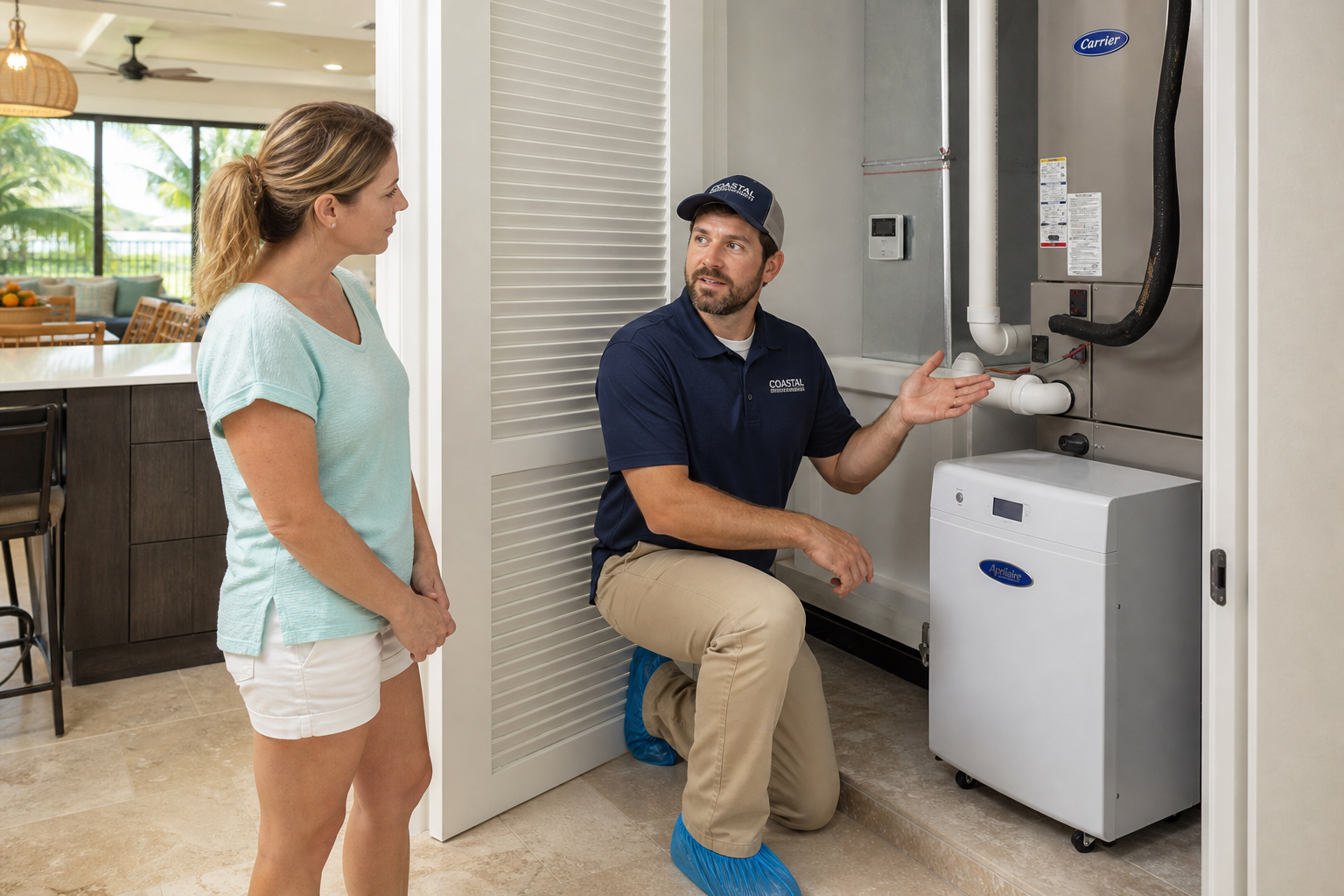
In many cases, a whole-home dehumidifier is installed near the existing indoor HVAC equipment.
It may tie into return or supply ductwork, or it may use a dedicated duct configuration depending on the home and the installer’s design approach.
The unit also needs a way to drain the collected moisture.
That may involve a condensate drain or pump, depending on where the equipment sits.
Controls matter as well.
Some systems use a dedicated humidistat, while others integrate with compatible HVAC controls or smart thermostats.
The goal is to monitor indoor humidity and operate the dehumidifier when moisture levels rise above the desired range.
An installer should evaluate whether your existing duct system can support the added equipment properly.
They may also look at filter access, service clearance, airflow impact, and where the dry air should be delivered.
If your home has comfort issues that vary from one floor to another, the installer may also talk with you about duct balancing or related improvements.
This is why a site-specific assessment matters.
The best installation plan depends on the home’s layout, the existing HVAC setup, and where the humidity problem is most noticeable.
What should you ask before buying a whole-home dehumidifier?
A good purchase decision usually starts with better questions.
Rather than asking only for a price, ask how the contractor determined that a whole-home dehumidifier is the right fix for your house.
You want to understand the problem, not just the product.
- What signs suggest my home has a whole-house humidity issue rather than a single-room issue?
- Is my current air conditioner removing enough moisture, or is there a sizing or runtime concern?
- Are there building or moisture-entry problems that should be addressed first?
- Where will the unit be installed, and how will it connect to the ductwork?
- How will the system drain collected water?
- What controls will be used to monitor and manage humidity?
- What maintenance will I need to handle regularly?
- Will the installation affect airflow, filter access, or service access around my existing equipment?
- What indoor humidity range do you recommend for my home conditions?
- Are any permits or code-related steps required locally?
The answers should feel clear and practical.
If a contractor cannot explain why the unit is needed, where it will go, or how it will be controlled, keep asking questions.
A quality recommendation should connect the equipment choice to your actual comfort problem.
What results can you realistically expect?
A whole-home dehumidifier can make the air feel less sticky, reduce that heavy or clammy sensation, and help the home feel more comfortable at normal thermostat settings.
It may also reduce musty odors linked to excess moisture and improve conditions in areas such as basements, hallways, and storage rooms.
For many homeowners, the biggest benefit is not dramatic.
It is steady comfort.
The home simply feels drier, cleaner, and easier to live in during humid weather.
That said, it is important to keep expectations realistic.
A dehumidifier will not solve standing water, foundation leaks, plumbing leaks, or major building envelope problems by itself.
It also will not fix every comfort complaint if the house has poor airflow, severe duct leakage, insulation issues, or a badly performing HVAC system.
Think of it as a targeted tool.
When excess moisture is part of the problem, a whole-home dehumidifier can be very effective.
When moisture is only one of several issues, it may need to be combined with other corrections.
What maintenance does a whole-home dehumidifier need?
Like other HVAC-related equipment, a whole-home dehumidifier needs periodic maintenance.
The exact schedule depends on the model and installation, but homeowners should expect some routine attention.
- Check and replace or clean filters as recommended for the specific unit.
- Make sure the drain line or pump is clear and functioning properly.
- Keep the area around the equipment accessible for inspection and service.
- Ask during annual HVAC maintenance whether humidity-control equipment should also be checked.
- Pay attention to new noises, water around the unit, or signs that humidity is rising again indoors.
Maintenance is one more reason professional installation matters.
The unit should be placed where it can be serviced without creating unnecessary hassle.
A contractor should also explain what maintenance you can handle yourself and what should be left to a technician.
Frequently asked questions
Will a whole-home dehumidifier make my house colder?
Its main job is to remove moisture, not to lower the thermostat reading the way an air conditioner does.
However, drier air often feels more comfortable, so many homeowners feel better at the same temperature or with less need to overcool the house.
Can I just use bathroom fans and kitchen ventilation instead?
Good ventilation is important, and local exhaust fans should be used where needed.
But they do not always solve a whole-house humidity problem, especially when damp outdoor air, basements, crawl spaces, or HVAC-related issues are involved.
Is a whole-home dehumidifier only for basements?
No.
Basements are a common reason homeowners ask about them, but these systems can also improve humidity control in the main living space, upstairs rooms, hallways, and storage areas when the issue affects the house more broadly.
How do I know whether I need a portable unit or a whole-home system?
If the issue is limited to one room, a portable unit may be enough.
If multiple rooms feel humid, musty odors spread through the house, or the AC is not keeping the home comfortable, a whole-home evaluation is the better next step.
Do I need permits for this kind of installation?
Local requirements vary.
Your installer should tell you whether permits, inspections, or code-related steps apply in your area.
Final thoughts
A whole-home dehumidifier is not a must for every house, but it can be a smart upgrade for homes that stay damp, sticky, or musty even when the cooling system is running.
If your comfort problem seems tied to moisture rather than temperature alone, this kind of equipment may offer a more direct solution than turning the thermostat down further.
The key is diagnosing the house correctly.
Before you buy, make sure an HVAC professional looks at the full picture, including your existing cooling system, the condition of the home, likely moisture sources, and how the equipment would be installed and controlled.
When the recommendation matches the actual problem, a whole-home dehumidifier can make humid months feel much more manageable.
Find an HVAC Installer Near You
Search the HVAC Installer Network to find local professionals, review installer profiles, and connect with contractors serving your area.
This article is for general informational purposes only and is not a substitute for an in-home evaluation by a qualified HVAC professional.
Equipment selection, installation methods, drainage options, controls, permits, and code requirements vary by home and by location.
Always confirm local requirements and product details with your installer before making a final decision.