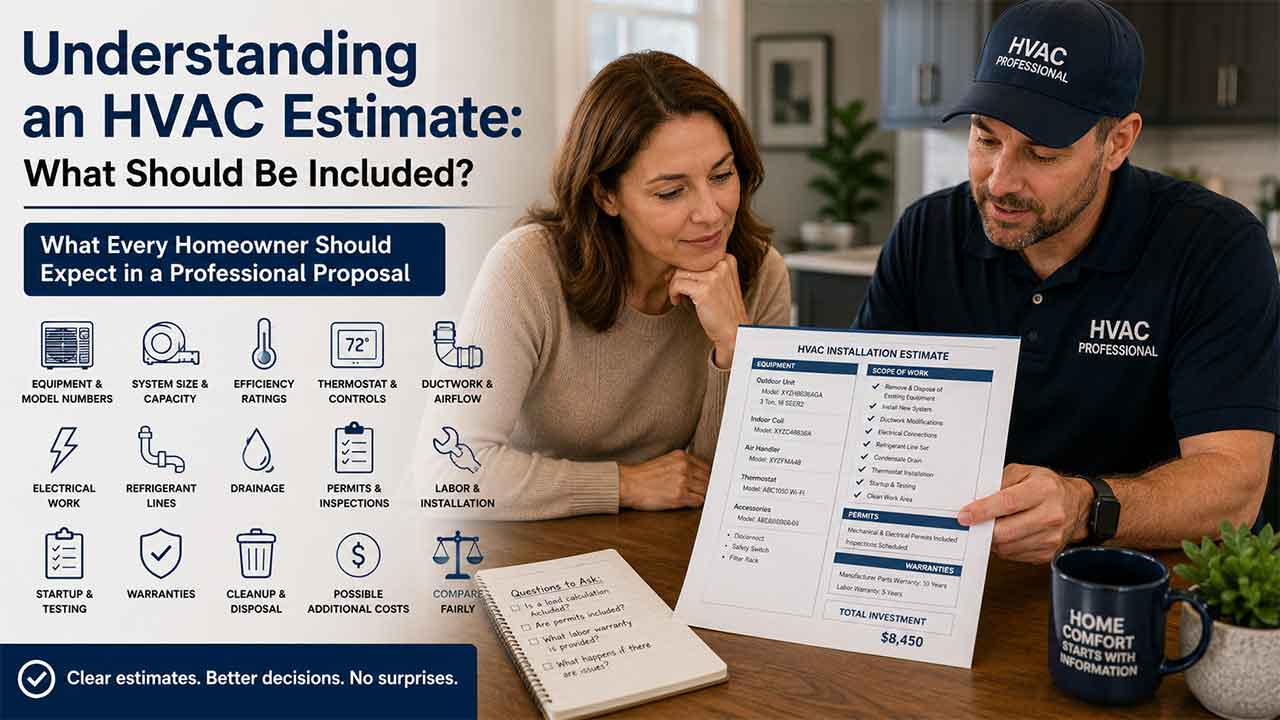
Understanding an HVAC Estimate: What Should Be Included?
Learn how to read an HVAC estimate, compare proposals fairly, identify missing details, and avoid unexpected installation costs.
Receiving multiple HVAC estimates can be confusing. One contractor may recommend a basic system for one price, while another proposes different equipment, additional ductwork, upgraded controls, and a much higher total.
The difference does not always mean one contractor is overpriced or another is offering a bargain. The proposals may include completely different equipment, installation methods, warranties, accessories, permits, and supporting work.
Before comparing the totals at the bottom of each page, make sure you understand exactly what each contractor is offering. A professional HVAC estimate should clearly describe the equipment, labor, materials, testing, warranties, and responsibilities included in the project.
Complete Equipment Model Numbers
An estimate that says only “three-ton air conditioner” or “high-efficiency furnace” does not provide enough information to identify the equipment being proposed.
A detailed estimate should list the complete model numbers for the major system components. These may include the outdoor condenser or heat pump, indoor coil, furnace, air handler, packaged unit, thermostat, and major accessories.
Why Model Numbers Matter
- They identify the exact equipment being installed.
- They allow you to confirm capacity and efficiency ratings.
- They help verify whether the indoor and outdoor equipment are properly matched.
- They allow you to compare competing proposals accurately.
- They reduce the chance of receiving different equipment than expected.
A Detailed Description
Outdoor heat pump model, indoor air handler model, electric heat kit model, thermostat model, and any included accessories are all listed separately.
An Incomplete Description
“Install one new high-efficiency heat pump system” with no model numbers, capacity, efficiency, or accessory details.
System Size and Capacity
The estimate should identify the heating and cooling capacity of the proposed equipment. Cooling capacity is commonly expressed in BTUs or tons, while furnace heating capacity may be listed as input and output BTUs.
The contractor should also explain how the system size was selected. Replacing existing equipment with the same capacity may be appropriate, but it should not be assumed automatically.
Questions to Ask
- What is the cooling capacity of the proposed system?
- What is the furnace or heat pump heating capacity?
- Was a load calculation completed?
- Has the home changed since the existing system was installed?
- Can the existing ductwork support the required airflow?
Indoor and Outdoor Equipment Matching
Most split HVAC systems use multiple components that must work together. An air conditioner or heat pump is paired with an indoor coil, furnace, or air handler.
The estimate should identify the complete equipment combination rather than listing only the outdoor unit. Proper matching can affect efficiency, capacity, comfort, control compatibility, and warranty coverage.
Ask whether the proposed combination has been tested and rated together. For higher-efficiency systems, the exact indoor and outdoor pairing may be necessary to achieve the efficiency stated in the proposal.
Efficiency Ratings
The proposal should identify the applicable efficiency ratings for the complete matched system. Depending on the equipment type, these may include SEER2, EER2, HSPF2, AFUE, or other performance measurements.
Do not assume that a model family name guarantees a specific efficiency. The final rating may depend on the exact combination of indoor and outdoor equipment.
| Rating | What It Describes |
|---|---|
| SEER2 | Seasonal cooling efficiency under updated testing procedures |
| EER2 | Cooling efficiency under specific operating conditions |
| HSPF2 | Seasonal heating efficiency for heat pumps |
| AFUE | Annual fuel utilization efficiency for furnaces or boilers |
| COP | Heat pump output compared with electrical energy input under specific conditions |
Ask whether the contractor can provide the rated performance for the exact equipment combination listed in the estimate.
Thermostat and Controls
A thermostat may seem like a minor part of the proposal, but it can affect comfort, staging, humidity control, remote access, energy use, and the operation of advanced HVAC equipment.
The estimate should list the thermostat model and explain whether it is included, installed, configured, and connected to any mobile application or home network.
Details to Confirm
- The exact thermostat or control model
- Whether new thermostat wiring is required
- Whether Wi-Fi setup is included
- Whether the control supports all system stages and features
- Whether zoning controls are included
- Whether the old thermostat will be removed
Communicating and variable-capacity equipment may require manufacturer-specific controls. A basic thermostat may prevent advanced features from operating as intended.
Ductwork and Airflow Modifications
New equipment often requires changes to the sheet-metal transitions, plenums, return-air connections, filter racks, or supply ductwork surrounding the system.
The estimate should explain which duct modifications are included and whether the contractor identified any airflow problems that should be corrected.
Possible Ductwork Items
- New supply or return plenums
- Equipment transitions
- Additional return-air capacity
- Duct sealing
- Flexible duct repair or replacement
- Register or grille replacement
- Airflow balancing
- Insulation around ducts in unconditioned spaces
Electrical Work
HVAC replacement may require electrical work at the indoor equipment, outdoor equipment, electrical panel, thermostat, or accessory circuits.
The proposal should clarify which electrical items are included and whether a separate licensed electrician will be required.
| Electrical Item | Questions to Ask |
|---|---|
| Outdoor disconnect | Will the existing disconnect be reused or replaced? |
| Electrical whip | Is a new weather-resistant connection included? |
| Circuit breaker | Does the proposed equipment require a different breaker size? |
| Indoor wiring | Are new power or control wires needed? |
| Electric heat kit | Does the panel have sufficient capacity for the required heater size? |
| Surge protection | Is equipment surge protection included or optional? |
If electrical panel upgrades are not included, the estimate should state that clearly and explain how those costs will be handled if they become necessary.
Refrigerant Lines and Accessories
The refrigerant line set connects the indoor and outdoor sections of a split air-conditioning or heat-pump system. Depending on the equipment, the existing line set may be reused, cleaned, resized, modified, or replaced.
The estimate should explain what will happen to the existing refrigerant lines and whether new insulation, fittings, line-hide covers, supports, or wall penetrations are included.
Questions to Ask
- Will the existing refrigerant line set be reused?
- Is the existing line set the correct size for the new equipment?
- Will the lines be flushed or cleaned if reused?
- Will damaged or missing insulation be replaced?
- Are new line covers or exterior sealing included?
- Is additional refrigerant included if the line length requires it?
Condensate Drainage
Air conditioners, heat pumps, high-efficiency furnaces, and certain accessories produce water that must be drained safely.
The estimate should describe how condensate will be handled and whether the project includes new drain piping, traps, vents, pumps, overflow protection, or drain-pan improvements.
Drainage Items That May Be Included
- Primary condensate drain
- Secondary drain or overflow pan
- Float switch or overflow shutoff
- Condensate pump
- Drain trap and vent
- Insulation on drain piping where needed
- Termination point outside the home
Poor condensate drainage can lead to water damage, mold growth, nuisance shutdowns, and equipment problems. The drainage plan should not be treated as an afterthought.
Permits and Inspections
Permit requirements vary by location, but many HVAC replacements require mechanical, electrical, gas, or other approvals.
The estimate should state whether permits are required, who will obtain them, whether permit fees are included, and who will schedule the final inspection.
A Clear Proposal
“Required mechanical and electrical permits are included. We will schedule inspections and address corrections related to our installation.”
An Unclear Proposal
“Permits, inspections, and code upgrades are the homeowner’s responsibility” without further explanation.
Labor and Installation Scope
The estimate should describe the work included in the labor price. A simple statement such as “installation included” may leave important responsibilities unclear.
Labor May Include
- Removal of existing equipment
- Delivery and placement of new equipment
- Sheet-metal fabrication
- Refrigerant piping work
- Electrical connections
- Gas piping or venting modifications
- Drain installation
- Thermostat setup
- Startup and testing
- Homeowner orientation
- Cleanup and disposal
Ask whether the company uses its own employees or subcontractors and which company is responsible for workmanship and warranty service.
Startup and System Testing
A professional installation should include more than turning the equipment on and confirming that air comes from the registers.
The estimate should indicate that the system will be started, configured, tested, and checked according to manufacturer procedures.
Possible Startup Checks
- Airflow measurement or verification
- Supply and return temperature measurements
- Refrigerant charge verification
- Electrical voltage and current checks
- Gas pressure and combustion testing
- Condensate drainage testing
- Thermostat and control setup
- Staging or variable-capacity operation
- Safety control testing
- Documentation of startup readings
Equipment and Labor Warranties
The estimate should clearly separate the manufacturer’s equipment warranty from the contractor’s labor or workmanship warranty.
Manufacturer warranties generally cover qualifying equipment defects. They may not cover diagnostic fees, refrigerant, travel charges, or the labor required to replace a failed component.
Warranty Details to Confirm
- Length of the manufacturer parts warranty
- Whether registration is required
- Who completes the registration
- Length of the contractor labor warranty
- Whether diagnostic or travel charges are covered
- Whether refrigerant is covered
- Whether annual maintenance is required
- Whether the warranty is transferable
- Who provides service if the installing contractor is unavailable
Any warranty promises made during the sales process should appear in writing in the final agreement.
Cleanup and Old Equipment Disposal
The proposal should explain whether the contractor will remove and dispose of the existing equipment, recover refrigerant properly, clean the work area, and remove installation debris.
Confirm whether old thermostats, equipment pads, duct materials, filters, wiring, packaging, and other discarded materials are included in the cleanup.
Home Protection May Include
- Floor coverings
- Shoe covers
- Drop cloths
- Protection for walls and doorways
- Care around landscaping
- Daily cleanup during multi-day projects
- Final removal of debris
If disposal or refrigerant recovery fees are charged separately, those amounts should be shown in the estimate.
Why HVAC Estimates Can Differ So Much
Two estimates may appear to describe similar systems while including very different levels of equipment, workmanship, protection, testing, and warranty coverage.
| Difference | How It Affects the Estimate |
|---|---|
| Equipment efficiency | Higher-efficiency equipment may cost more and require different controls or installation details |
| Equipment features | Single-stage, two-stage, and variable-capacity systems can have very different prices |
| Installation materials | Transitions, drain protection, electrical components, pads, and accessories may vary in quality |
| Ductwork scope | One contractor may include airflow improvements while another reuses everything |
| Labor warranty | Longer labor coverage may increase the initial price but reduce future risk |
| Permits | One estimate may include permit fees while another excludes them |
| Testing and commissioning | Detailed startup procedures require additional time and trained labor |
| Crew experience | Companies that invest heavily in training and supervision may charge more |
The goal is not automatically to choose the highest or lowest estimate. The goal is to understand the value, scope, and risk represented by each proposal.
How to Compare HVAC Estimates Side by Side
Create a simple comparison using the same categories for every contractor. Do not compare only the total installed price.
| Estimate Item | Contractor A | Contractor B | Contractor C |
|---|---|---|---|
| Complete model numbers | Yes / No | Yes / No | Yes / No |
| System capacity | _____ | _____ | _____ |
| Efficiency rating | _____ | _____ | _____ |
| Thermostat model | _____ | _____ | _____ |
| Ductwork included | _____ | _____ | _____ |
| Electrical work included | Yes / No | Yes / No | Yes / No |
| Permits included | Yes / No | Yes / No | Yes / No |
| Startup testing described | Yes / No | Yes / No | Yes / No |
| Manufacturer warranty | _____ | _____ | _____ |
| Labor warranty | _____ | _____ | _____ |
| Cleanup and disposal | Yes / No | Yes / No | Yes / No |
| Total installed price | $_____ | $_____ | $_____ |
HVAC Estimate Checklist
Before signing a proposal, confirm that the estimate addresses each of these items.
- Complete outdoor equipment model number is listed.
- Complete indoor equipment model number is listed.
- System capacity is identified.
- Efficiency ratings are identified.
- The thermostat model is listed.
- Included accessories are listed.
- Ductwork modifications are explained.
- Electrical work is explained.
- Refrigerant line work is explained.
- Condensate drainage is addressed.
- Permit responsibilities are clear.
- The labor scope is detailed.
- Startup and testing are included.
- Manufacturer warranty terms are provided.
- Labor warranty terms are in writing.
- Cleanup and old equipment disposal are included.
- Possible extra charges are identified.
- The payment schedule is clearly stated.
- Change-order procedures are explained.
- The total installed price is clearly shown.
Frequently Asked Questions
Why Are HVAC Estimates So Different?
Estimates may include different equipment efficiencies, features, warranties, ductwork, electrical work, controls, accessories, permits, installation materials, and testing procedures. Compare the complete scope rather than only the total price.
Should HVAC Model Numbers Be Included in the Estimate?
Yes. Complete model numbers allow you to identify the exact equipment, verify capacity and efficiency, confirm equipment matching, and compare proposals accurately.
Should Permits Be Included in an HVAC Estimate?
The proposal should state whether permits are required, who will obtain them, and whether the fees are included. Requirements vary by location.
Is Ductwork Normally Included in an HVAC Replacement?
Minor transitions may be included, but larger duct repairs or modifications may be separate. The estimate should explain exactly which ductwork is included.
Does an HVAC Estimate Include Labor?
Most replacement estimates include installation labor, but the scope can vary significantly. Confirm whether removal, electrical connections, duct modifications, startup, cleanup, permits, and disposal are included.
Should I Choose the Lowest HVAC Estimate?
Not automatically. A lower estimate may be a good value, but it may also exclude important work, testing, permits, accessories, or warranty coverage. Compare the complete proposal before deciding.
Can an HVAC Estimate Change After Work Begins?
Unexpected conditions can lead to additional work, but the contract should explain how changes are documented, priced, and approved. Do not authorize major additional work without a written change order.
How Long Is an HVAC Estimate Valid?
Estimate expiration periods vary by contractor and may depend on equipment availability, manufacturer pricing, rebates, and seasonal demand. The proposal should include an expiration date or validity period.
Final Thoughts
An HVAC estimate should do more than tell you the final price. It should explain the equipment, labor, materials, controls, supporting work, testing, warranties, and responsibilities included in the project.
The best estimate is not necessarily the least expensive or the most detailed-looking document. It is the proposal that clearly identifies what you are buying, how it will be installed, what protections are included, and how unexpected conditions will be handled.
Taking the time to review those details can help you compare contractors fairly, avoid surprise charges, and choose an installation that provides better comfort and long-term value.
Find an HVAC Installer Near You
Search the HVAC Installer Network to review local installer profiles and connect with professionals serving your area.