What to Expect During a Home HVAC Maintenance Visit
A practical guide to what technicians check, how to prepare, and how to understand the recommendations you receive.
If you have scheduled an HVAC maintenance visit for the first time, it is normal to wonder what will actually happen once the technician arrives.
Many homeowners know maintenance is supposed to help a heating and cooling system run better, but they are not always sure what the appointment includes, how long it takes, or what kinds of problems might be uncovered.
A good HVAC maintenance visit should feel straightforward and useful.
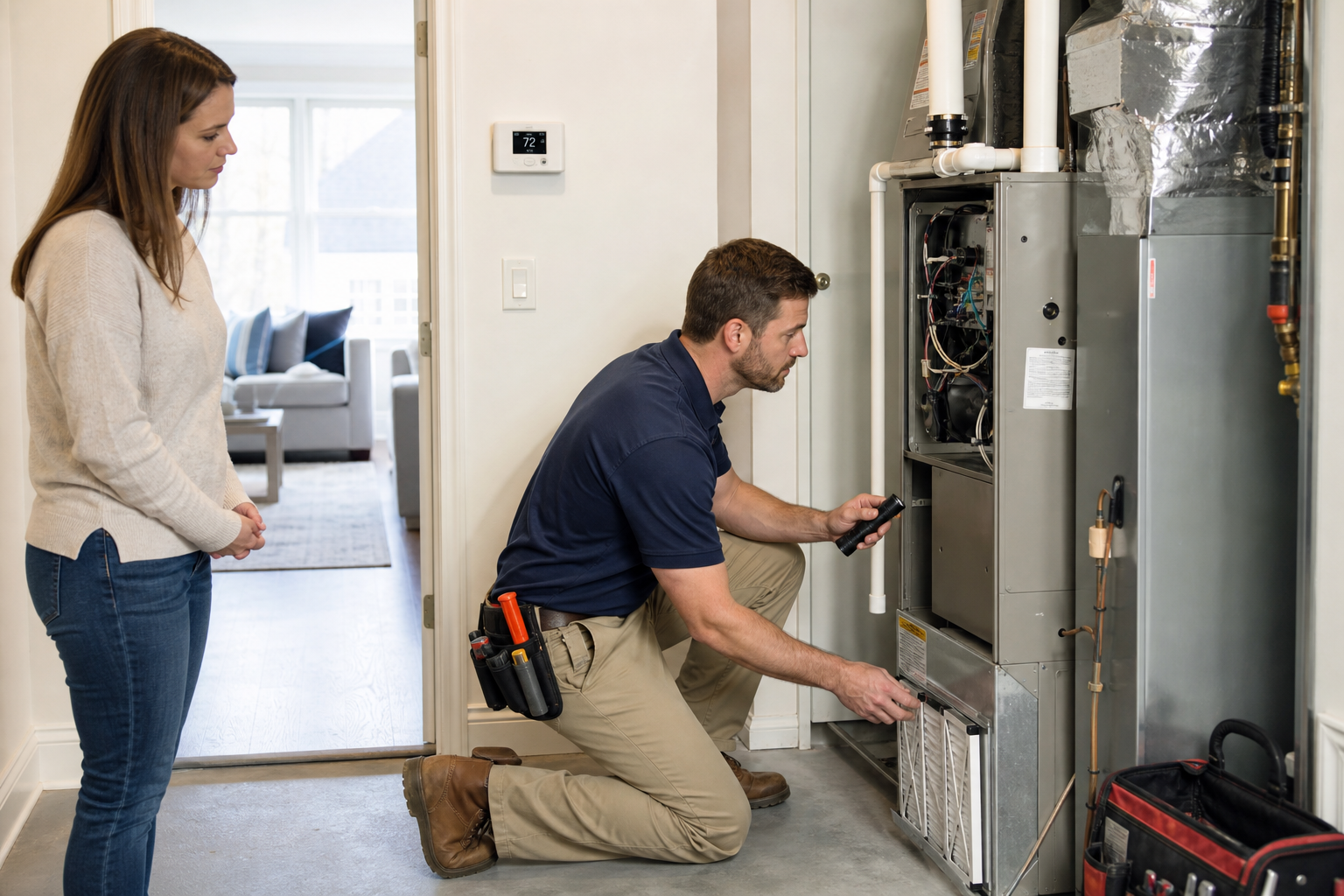
The technician should inspect the system, clean accessible components, check operation and safety, point out wear or performance concerns, and explain any recommended next steps in plain language.
It should not feel like a mystery, and it should not leave you guessing about what was done.
This guide explains what a typical HVAC maintenance visit looks like for a homeowner, what you can do before the appointment, and how to make sense of the findings afterward.
Because equipment types and local requirements vary, exact steps may differ by contractor, system design, fuel type, and region.
A maintenance visit is mainly about inspection, cleaning, testing, and early problem spotting.
It is not the same as a full repair appointment, and it may lead to a separate recommendation if the technician finds a failed part, a safety issue, or a larger airflow problem.
Why schedule an HVAC maintenance visit in the first place?
Your heating and cooling system works through a long chain of parts that all depend on each other.
Airflow, electrical connections, controls, drainage, refrigerant-side performance, combustion components on gas equipment, and moving parts all affect how the system operates.
Even when the system still turns on and seems to keep the house comfortable, small issues can build up over time.
A dirty coil can reduce airflow and efficiency.
A loose electrical connection can create intermittent operation.
A partially blocked condensate drain can turn into a water leak.
A worn contactor or weak motor may keep working until it suddenly does not.
The point of a routine HVAC maintenance visit is to catch obvious problems earlier, keep the equipment cleaner, confirm basic operation, and give you a clearer picture of the system’s current condition.
For homeowners, that matters because maintenance can reduce surprises during the hottest or coldest part of the year, when breakdowns are the most disruptive and service schedules are often the busiest.
Maintenance also gives you a chance to ask questions when the system is still running rather than waiting until it stops completely.
That can be especially helpful if your equipment is older, if some rooms have uneven temperatures, or if your energy bills seem to have changed without a clear reason.
How should you prepare before the technician arrives?
You do not need to do much, but a little preparation can make the appointment smoother and more productive.
Start by making sure the technician can reach the thermostat, indoor unit, outdoor unit, and any access panels that may need to be opened.
If the furnace or air handler is in an attic, crawlspace, closet, basement, or garage corner, clear away storage items so there is room to work safely.
If you have pets, plan to secure them before the visit begins.
Many service calls involve doors opening and closing, and technicians may move between indoor and outdoor equipment several times.
It also helps to write down any concerns you have noticed.
Maybe the system has been louder than usual, a room never gets comfortable, the thermostat seems inaccurate, or you have noticed moisture near the indoor unit.
Small details can help a technician focus on areas that deserve extra attention.
If you know the filter size, you may want to have a replacement on hand, although many contractors can supply filters during service.
If you do not know where the filter is located, this is a good time to ask.
- Clear access to the thermostat, indoor equipment, and outdoor unit.
- Move stored items away from service panels and working space.
- Secure pets before the appointment starts.
- Write down any comfort, noise, airflow, or drainage concerns.
- Have past service notes available if the system has recurring issues.
- Ask in advance whether you should provide replacement filters.
Homeowners also benefit from knowing what type of system they have.
For example, a heat pump, gas furnace with central air, ductless mini-split, or package unit may each involve somewhat different maintenance steps.
You do not need technical knowledge, but basic awareness helps you follow the technician’s explanation more easily.
What happens when the visit begins?
A professional HVAC maintenance visit usually starts with a short conversation.
The technician may ask whether you have noticed performance problems, odd smells, noise, water around the system, thermostat issues, or recent breaker trips.
This is the best time to bring up even minor concerns.
What seems small to you may point to a specific part of the system.
After that, the technician will typically verify the equipment type, inspect visible installation conditions, and start checking operation.
Depending on the season and the purpose of the tune-up, they may run the system in heating or cooling mode and observe how it starts, runs, and cycles off.
Some visits focus on cooling performance before summer, while others focus on heating performance before colder weather.
In many homes, maintenance involves both the indoor and outdoor sections of the system.
The technician may move back and forth several times while testing temperatures, pressures, controls, or airflow-related conditions.
You may hear the unit turn on and off more than once, and you may see access panels removed so internal components can be inspected.
A good visit should also include communication along the way.
If the technician finds something important early, such as a clogged drain, failed capacitor, damaged wiring, or safety concern, they should explain it before wrapping up.
What does the technician inspect on the indoor equipment?
The indoor side of the system often reveals a lot about overall HVAC health.
This part may include the furnace, air handler, evaporator coil area, blower compartment, electrical components, drain system, filter location, and thermostat controls.
Not every component is equally accessible on every system, but a typical HVAC maintenance visit may include several of the following checks.
The air filter is usually inspected first because it affects airflow throughout the system.
A clogged filter can make the blower work harder and can reduce comfort in the home.
If the filter is dirty, the technician may recommend replacement and may note whether the filter type or replacement schedule should change.
The blower assembly may also be inspected for dust buildup, wheel condition, and operation.
Excess dirt on blower components can restrict airflow and reduce performance.
The technician may check whether the blower starts properly, sounds normal, and moves air as expected.
The evaporator coil and surrounding area are another common focus.
If accessible, the technician may inspect for dirt, biological growth, signs of freezing, or drainage issues.
Because the coil is central to cooling and dehumidification, problems here can affect comfort, efficiency, and water management.
The condensate drain and drain pan are often checked during cooling-related maintenance.
This matters because a blocked or slow drain can lead to leaks, water damage, or system shutdown if a safety switch is triggered.
Some technicians will clear the drain line as part of routine maintenance if conditions allow.
Electrical components inside the furnace or air handler may be inspected for wear, loose connections, scorching, or signs of overheating.
Technicians may test capacitors, contactors, relays, boards, and wiring connections depending on the system and the service scope.
The thermostat may be checked for proper response and general accuracy.
This does not always mean a full calibration, but the technician should at least confirm that the thermostat communicates correctly with the system and that the equipment responds to calls for heating or cooling.
On gas heating equipment, maintenance may also include inspection of the burner area, flame characteristics, ignition components, safety controls, venting, and visible heat exchanger concerns as appropriate for the equipment design and access available.
Details vary by furnace type and local practices, so ask what was specifically inspected on your system.
What does the technician inspect on the outdoor unit?
For central air conditioners and heat pumps, the outdoor unit is another major part of a complete HVAC maintenance visit.
This section houses components that release or absorb heat depending on system mode, and it depends on proper airflow and electrical performance.
One of the most visible tasks is cleaning debris from the outdoor coil area.
Leaves, cottonwood, dirt, grass clippings, and general buildup can make it harder for the unit to transfer heat.
The technician may rinse or clean the coil using methods appropriate for the equipment condition and accessibility.
The fan and top section may also be inspected for secure mounting, damage, unusual noise, or wear.
If the fan motor shows signs of strain or if the blades are dirty or damaged, that can affect operation.
Electrical components in the condenser are often tested during maintenance.
This may include checking contactors, capacitors, wiring connections, disconnects, and amperage readings depending on the service procedures used.
Weak electrical components sometimes continue working for a while before failing, which is one reason maintenance can be useful.
The technician may also review refrigerant-side performance using temperature measurements and other system readings.
Homeowners should know that maintenance does not automatically mean refrigerant needs to be added.
If a system is low, the better question is why.
Because refrigerant operates in a sealed system, low charge may indicate a leak or another issue that needs diagnosis rather than just a top-off.
The outdoor unit base, general level condition, visible line insulation, and surrounding clearance may also be reviewed.
If shrubs, fencing, or stored items are crowding the unit, airflow may suffer.
Simple recommendations like trimming vegetation or improving clearance can help outdoor performance.
What common issues are often found during maintenance?
Many maintenance visits do not uncover major failures, but they often reveal smaller issues that are worth addressing before they grow.
Some of the most common findings are dirty filters, dirty coils, blocked condensate drains, worn capacitors, pitted contactors, loose wiring connections, and signs of airflow restriction.
Technicians also frequently find comfort-related issues that are not caused by a single failed part.
Examples include closed supply registers, undersized return airflow, heavily restricted filters, duct leakage, thermostat location problems, or poor air distribution to certain rooms.
In those cases, a maintenance visit may become the first step in a broader conversation about system performance.
You may also hear recommendations related to cleaning.
That might include indoor coil cleaning, blower cleaning, drain treatment, or outdoor coil cleaning beyond what can be done during a routine tune-up.
These recommendations are not automatically upsells.
Sometimes they are reasonable next steps if buildup is significantly affecting operation.
The key is to ask what problem the cleaning is meant to solve and what evidence supports the recommendation.
If the system is older, the technician may identify components that are working now but show signs of wear.
That does not mean immediate replacement is always required.
It means you should understand the current condition, the risk of continued use, and whether the issue is routine, urgent, or mainly something to monitor.
If a recommendation is unclear, ask the technician to separate findings into three categories: needs attention now, should be planned for soon, and simply monitor for future visits.
That makes it easier to decide what to do without feeling rushed.
What is routine maintenance not designed to fix?
This is an important point because many homeowners schedule maintenance hoping it will solve every comfort issue in the house.
Routine service is valuable, but it has limits.
It does not automatically correct poor duct design, undersized equipment, major refrigerant leaks, failing compressors, hidden electrical faults, insulation problems, or room-by-room airflow imbalances caused by the home’s layout.
It also may not fully diagnose intermittent issues that only happen under specific weather conditions or at certain times of day.
For example, if your upstairs is always warm, maintenance may confirm that the equipment is generally operating, but the underlying issue could involve duct routing, zoning, insulation, solar load, or system sizing.
Likewise, if the system occasionally trips a breaker, a maintenance visit may reveal clues, but a deeper electrical or mechanical diagnosis could still be needed.
Another common misunderstanding is that maintenance alone can restore an aging system to like-new condition.
Cleaning and inspection help, but they cannot reverse wear on major components or undo years of deferred service.
The value of maintenance is that it improves visibility into the system’s condition and gives you better information for your next decision.
If the technician recommends additional diagnostic work, ask what specific symptom or reading prompted that recommendation.
That helps you understand whether the next step is precautionary, performance-related, or urgent.
What questions should homeowners ask before the visit ends?
The end of the appointment is your chance to turn a routine HVAC maintenance visit into a more useful homeownership check-in.
You do not need to ask technical questions, but you should leave with a clear sense of the system’s condition and any next steps.
Start with the simplest question.
Ask whether the system is operating normally today.
Then ask whether the technician found any safety concerns, near-term repair risks, or maintenance items you should handle yourself between visits.
It is also smart to ask which findings are routine and which ones matter most.
If several recommendations are listed, ask them to prioritize.
That helps if you need to stage repairs over time.
- Is the system operating normally right now?
- Did you find any safety concerns or shut-down risks?
- Are there worn parts that may fail soon?
- Is airflow through the system acceptable?
- Does the drain system look clear and functional?
- Should I change the filter more or less often?
- Do you recommend any follow-up diagnostic testing, and why?
- What basic maintenance should I handle before the next visit?
You should also ask what you can do between service calls.
For most homeowners, that means changing filters on schedule, keeping vents open unless otherwise advised, maintaining outdoor clearance, watching for water near the indoor unit, and paying attention to new noises or odors.
If your system includes settings you do not understand, such as thermostat scheduling, fan modes, or humidity-related controls, ask for a quick walkthrough before the technician leaves.
That short explanation can improve comfort more than many homeowners expect.
Frequently Asked Questions
How long does an HVAC maintenance visit usually take?
The exact time varies by system type, accessibility, and whether issues are found.
A straightforward visit may be fairly quick, while homes with multiple systems, difficult access, or additional concerns may take longer.
Do I need maintenance if my system seems to be working fine?
Yes, many problems start small and are not obvious to the homeowner.
A system can still heat or cool while developing airflow, drainage, electrical, or wear-related issues that are easier to address earlier.
Will maintenance lower my energy bills?
It can help if the system has dirty components, airflow restrictions, or minor operating issues.
However, savings depend on the condition of the equipment, how the home is used, and whether there are larger performance problems elsewhere in the house.
Should refrigerant be added during every maintenance visit?
No, refrigerant is not a routine consumable like fuel in a car.
If levels appear low, the system may need further evaluation to determine whether there is a leak or another underlying problem.
What can I do myself between professional visits?
Most homeowners can change filters, keep the outdoor unit clear of debris and overgrowth, make sure supply and return vents are not blocked, and monitor for unusual sounds, smells, or water around the equipment.
For anything involving electrical parts, gas components, refrigerant, or internal disassembly, it is better to contact a qualified professional.
Final Thoughts
A home HVAC maintenance visit should leave you with more confidence, not more confusion.
At its best, it is a practical check on system condition, cleanliness, airflow, safety, and basic operation.
It may confirm that everything looks normal, or it may uncover issues that deserve attention before they become more disruptive.
For homeowners, the biggest benefit is often clarity.
You learn what the technician inspected, what shape the system is in today, what simple tasks you can handle yourself, and whether any repairs or deeper testing should be scheduled next.
If recommendations come up, do not hesitate to ask for plain-language explanations and priority levels.
The more clearly you understand your system, the easier it is to make smart maintenance and repair decisions over time.
Find an HVAC Installer Near You
Search the HVAC Installer Network to find local professionals, review installer profiles, and connect with contractors serving your area.
This article is for general homeowner education only and is not a substitute for on-site diagnosis or professional service.
Maintenance procedures, equipment access, and inspection scope vary by system type, age, installer practices, and local requirements.
If you suspect a safety issue, electrical problem, gas issue, refrigerant leak, or water damage, contact a qualified HVAC professional for evaluation.